RMDialer is the SIM-based auto dialer that runs on the SIM you already have
Most auto dialers want you to buy a virtual number and route calls over the internet. Then your prospects see a number they do not recognise, and pick-up rates fall. A SIM-based auto dialer avoids the whole problem by dialling from the handset your team already carries.
Visit rmdialer.com Get it on Google Play
Included in the platform licence. Not a paid add-on.
The short version
- RMDialer dials from your own SIM, your own number, your own call plan.
- No VoIP account, no virtual number, no IVR, no porting.
- Recipients see a normal mobile number, so answer rates hold up.
- Calls still place when the data connection drops.
- ₹1,908 per user per year, dialer and telecalling CRM included.
What is a SIM-based auto dialer?
RMDialer is a SIM-based auto dialer for Android: a calling app that places automated outbound calls through the cellular SIM card already in the phone, rather than routing them over the internet as VoIP. A SIM-based auto dialer can also take the form of a GSM hardware device, but the principle is the same. Because each call leaves from an ordinary mobile number, the person receiving it sees a familiar caller ID instead of an unknown cloud or landline number, and that is the main reason teams move to SIM-based dialling: answer rates hold up. There is no virtual number to rent, no IVR to configure and no telecom onboarding, and call costs stay on the mobile plan the business already pays for. RMDialer dials from either slot of a dual-SIM handset, places the next number the moment a call ends, and keeps each lead’s name, status and history on screen throughout.
Trusted by 3,500+ businesses
- 4.8 / 5
-

-

-

-

- Meta Tech Provider
- D-U-N-S Registered






Some of the businesses using WappBlaster products every day
How SIM-based dialling actually works
A cloud dialer is a telephony service. Your click travels to a server, the server originates a call over VoIP, and it reaches the customer carrying whichever number that provider has assigned to you. You are renting the number and paying per minute for the leg the provider carries.
A SIM-based auto dialer inverts that. The app never carries the audio at all. It holds the list, decides which number is next, and asks Android to place a normal cellular call through the SIM in the handset, exactly as a person tapping the keypad would. The mobile network carries the call, your existing plan bills it, and the customer sees the mobile number of the SIM that placed it.
That is why a SIM-based dialer keeps working on a weak connection. Data is only needed to sync leads, notes and statuses; the dialling itself rides the voice network. It is also why there is nothing to provision: there is no telecom relationship to open, because you already have one with whoever sold you the SIM.
The trade-off is real and worth stating. One SIM makes one call at a time, so SIM-based dialling suits an outbound team working a list rather than a large inbound contact centre that needs queues, IVR routing and simultaneous call legs. If that is what you are buying for, a cloud platform is the right shape and we would say so.
SIM-based, GSM hardware and cloud dialers are three different things
The term "SIM-based auto dialer" covers two quite different products, and buyers routinely compare one against the other without noticing.
A GSM hardware dialer is a physical box holding one or more SIM cards, wired to a PC or a PBX. It is a gateway: software on the computer drives the box, and the box holds the SIMs. It suits a fixed desk-bound floor, costs capital up front, and the agent works from a computer rather than a phone.
A SIM-based auto dialer app like RMDialer on Android puts the same idea in the handset the caller already carries. There is no hardware to buy, the caller can work from anywhere with coverage, and the SIM is the one already in the phone. For a field team, or any team that is not sitting at fixed desks, this is usually the version that fits.
A cloud or VoIP dialer uses neither. It rents you a virtual number and routes calls over the internet, which buys you queues, IVR and predictive dialling, and costs you the familiar caller ID that makes people answer.
If you are still weighing the field, the ranked shortlist of Android auto dialer apps covers the SIM-based options side by side, and the auto dialer app page covers the dialling behaviour itself in more depth.
Why answer rates hold up on a SIM-based dialer
This is the reason most teams switch, and it is worth being precise about the mechanism rather than just asserting it.
Caller ID is the first and often only information someone has before deciding to answer. A number that looks like an ordinary mobile from their own country reads as a person. An unfamiliar cloud number, a shortcode or an international-looking prefix reads as a cold call, and increasingly it is labelled as one: Android and iOS both surface spam warnings, and carriers apply their own filtering once a number accumulates complaints and short-duration calls.
A rented virtual number is particularly exposed to that, because it carries whatever reputation it arrived with and whatever the previous renter did to it. Your own SIM carries your own behaviour, and it is a number the customer can ring back and reach you on, which is itself a reason the call gets returned rather than blocked.
None of which makes a SIM-based dialer immune. What earns a spam label is volume patterns and complaint rates, so the operational discipline still matters: respect DND registration for promotional calls in India, keep lists clean, and give people a reason to want the call.
What a SIM-based auto dialer costs
The pricing model is the second reason teams move, and it is structurally different rather than just cheaper.
A cloud dialer charges a per-user software fee, plus virtual number rental, plus a per-minute rate on the calls it carries. The third line is the one that grows with your success: the more your team talks, the more you pay.
A SIM-based auto dialer only charges the first. RMDialer is ₹1,908 per user per year, and the call minutes are whatever your existing mobile plan already gives you, which in India is typically unlimited voice on a plan you are paying for regardless. There is no per-minute charge to reconcile because RMDialer never carries the call.
That includes the telecalling CRM, the per-employee reports and the desktop web panel rather than holding them back for a higher tier. The pricing page has the full breakdown, and the RMDialer product page covers what ships in the licence.
Where a SIM-based dialer is the wrong choice
Said plainly, because a page that only lists strengths is not useful to someone actually deciding.
You need IVR routing, call queues or an auto-attendant. SIM-based dialling has no concept of these; the call rings a handset. A cloud platform is the right tool.
You need predictive dialling across many simultaneous lines. One SIM places one call at a time, so throughput scales by adding callers and handsets, not by adding channels.
You are running a large inbound support operation. RMDialer handles inbound calls well for an outbound team, showing the caller’s record on screen, but it is not a contact-centre platform.
Your team is fully remote across countries and has no local SIMs. The caller-ID advantage disappears once the number is foreign to the person receiving it.
If any of those describe you, the honest answer is that the comparison pages will help more than this one, and Runo and TeleCRM are the nearest alternatives worth reading about.
| Feature | SIM-based app (RMDialer) | Cloud / VoIP dialer | GSM hardware dialer |
|---|---|---|---|
| What the customer sees | Your own mobile number | A rented virtual number | The SIM in the box |
| Telecom setup before the first call | None | Number provisioning, often KYC | Hardware install and wiring |
| IVR to configure | No | Yes, usually required | Depends on the PBX |
| Cost of the call itself | Your existing mobile plan | Per minute, billed by the platform | The plan on the inserted SIMs |
| Works on weak data | Yes, calls ride the voice network | No, VoIP needs stable data | Yes |
| Simultaneous calls per line | One per SIM | Many | One per SIM slot |
| Call queues and predictive dialling | No | Yes | Via the PBX |
| Where the caller works | Any Android phone, anywhere | Anywhere with good data | At a desk near the hardware |
| Up-front capital | None | None | The gateway hardware |
RMDialer is ₹1,908 per user per year with the dialer, telecalling CRM and web panel included. Cloud and GSM figures vary by vendor; the columns describe how each approach works rather than a single product.
In the app
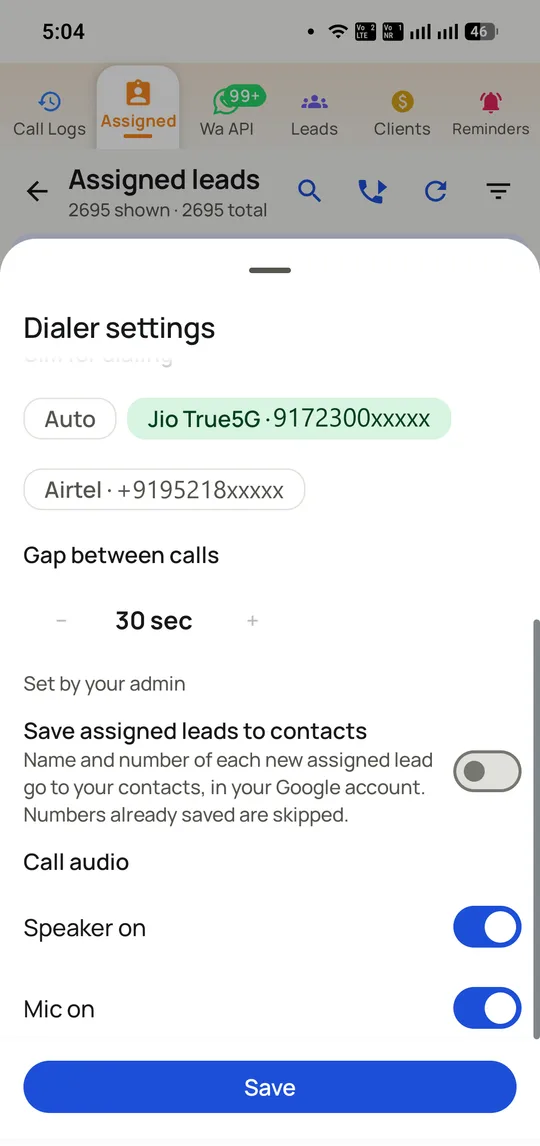
SIM-based auto dialer, on a real account
Screenshots from a working account, with customer names and numbers masked.
-
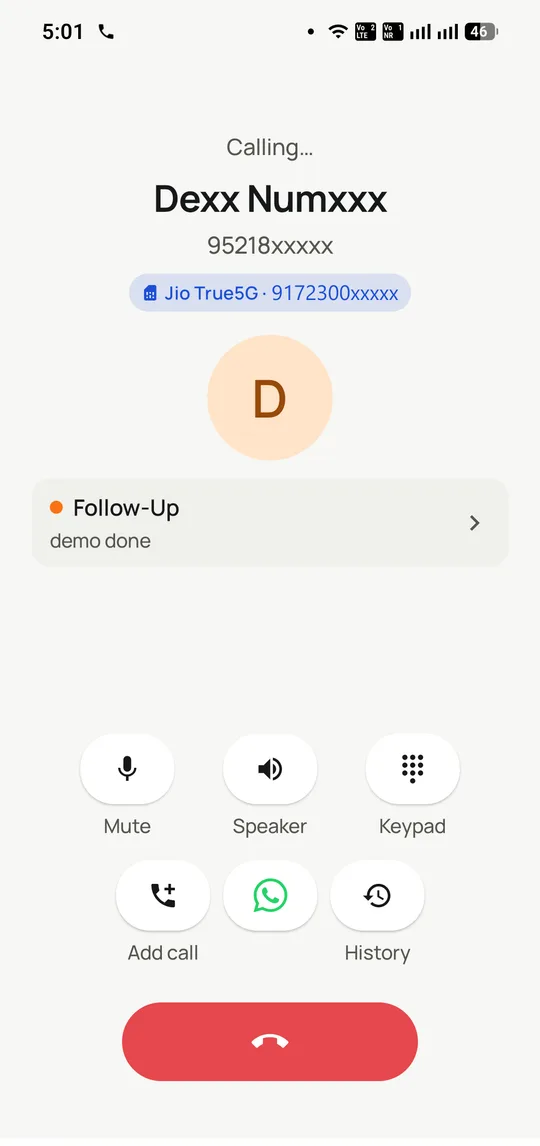
Every call names the SIM it went out on, so there is never a question of which number the customer saw. -
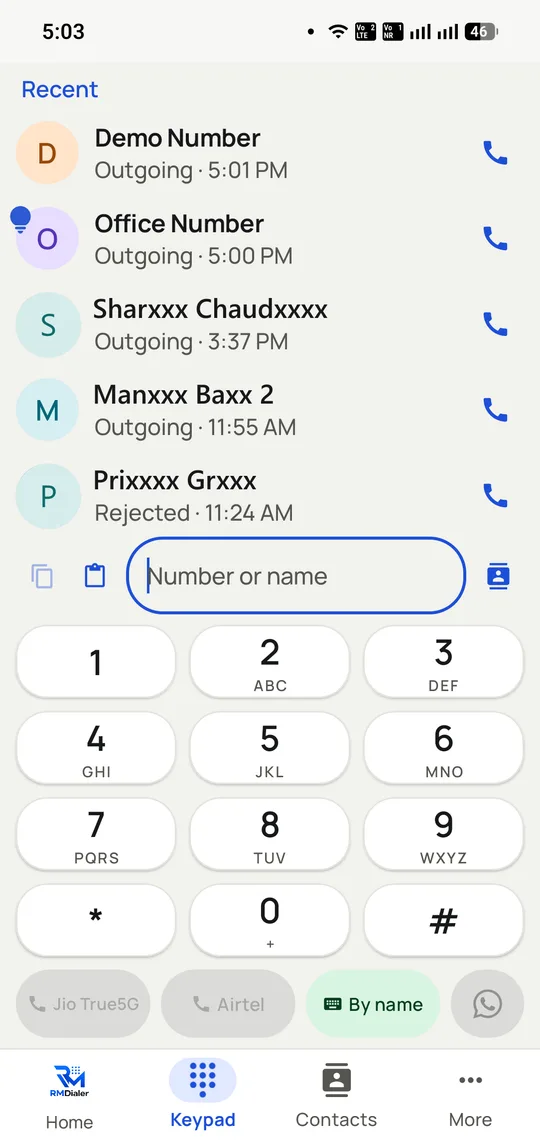
The keypad offers both SIMs as separate buttons, so a one-off call can go out on either. -
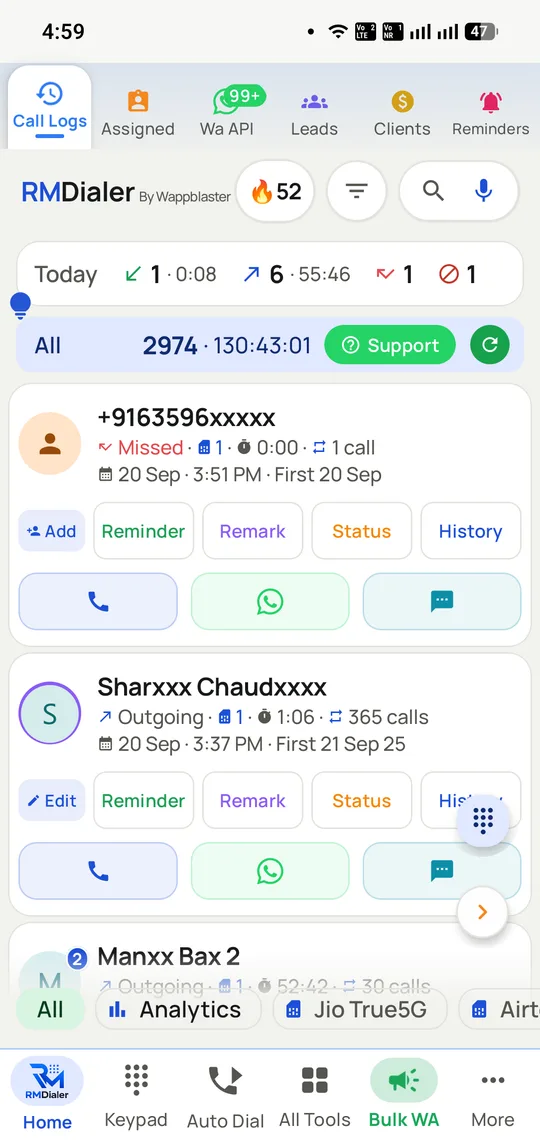
The log filters by SIM, so per-number call volume and talk time are auditable after the fact.
Capabilities
What you get
Everything here is documented and shipping today, not on a roadmap.
Nothing to buy from a telecom
Install and start dialling.
- No virtual number rental
- No IVR configuration
- No number porting or provisioning wait
Your real caller ID
The recipient sees a normal mobile number.
- Not an unknown cloud or shortcode number
- Less likely to be screened or flagged
- Callbacks reach the same phone
Call cost stays on your plan
No per-minute platform charge.
- Whatever your existing mobile plan gives you
- No separate VoIP bill to reconcile
- Dual SIM: choose which one dials
Works on a weak connection
Calls go over the network, not the internet.
- Dialling continues when data drops
- Notes and statuses queue and sync later
- Suits field teams and basements
Still a full dialer
SIM-based does not mean basic.
- Continuous auto-dial through a list
- Caller context on screen before pick-up
- Two-tap outcome logging
WhatsApp on the official API
The follow-up is not a workaround either.
- Auto message when the call ends
- Bulk campaigns through the Business API
- Approved templates, delivery reported
How it works
Setting it up
- 1
Install on an Android phone
Android 8 or newer, with the SIM already in it.
- 2
Set it as the dialer
It handles incoming and outgoing calls.
- 3
Load a list
CSV, Excel, Google Sheets or saved leads.
- 4
Dial
No account with a telecom provider anywhere in the process.
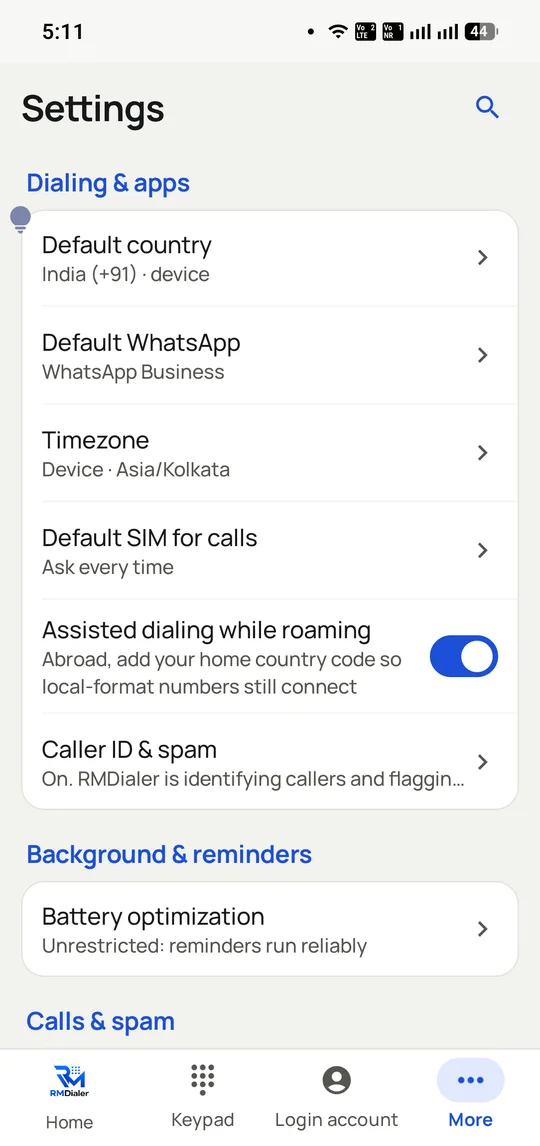
Choosing which SIM dials
Set one SIM as the default for every call, or have RMDialer ask at the start of each session. Assisted dialling adds your home country code when the team is roaming, so local-format numbers still connect.
Where it earns its keep
Common uses
-
Teams burned by low pick-up
Where a cloud number stopped getting answered.
-
Field sales
Calling from cars, sites and basements.
-
Small teams without IT
Nobody to configure an IVR.
-
Cost-sensitive operations
Existing mobile plans already cover the minutes.
-
Local businesses
A recognisable local number matters to the customer.
-
Trials before committing
Nothing to provision means nothing to unwind.
Ships in these products
Already using something else?
Reviews
What customers say about SIM-based auto dialer
5.0 from 41 ratings on Google Play
-
“Our cloud dialer number stopped getting picked up. Switched to the RMDialer SIM-based auto dialer and connect rates recovered inside a week, because farmers see a normal mobile number.”
Sales head, building materials, Patna
Verified RMDialer customer
-
“No IVR project, no telecom vendor, no waiting. We installed RMDialer on ten phones on a Tuesday and the SIM-based dialer was running lists by lunch.”
Operations manager, edtech, Bengaluru
Verified RMDialer customer
-
“Call costs were killing us on the VoIP platform. RMDialer dials on the SIMs we already pay for, so the auto dialer costs us the software and nothing per minute.”
Owner, ceramic tiles distributor, Morbi
Verified RMDialer customer
-
“Our field officers work villages with patchy data. The RMDialer SIM dialer keeps calling when the internet disappears and syncs the notes when they are back in range.”
Branch head, microfinance, Bhopal
Verified RMDialer customer
-
“Candidates call back the number that called them, and with RMDialer that is our recruiter’s real SIM, not a cloud number that rings nowhere. Placements literally improved from callbacks.”
Co-founder, staffing firm, Thrissur
Verified RMDialer customer
Frequently asked questions
Straight answers about SIM-based auto dialer.
What is a SIM-based auto dialer?
An auto dialer that places calls through the SIM card in the phone rather than over the internet. There is no VoIP account, no virtual number and no IVR, and the recipient sees your real mobile caller ID.
Link to this answerWhy does SIM-based dialling get better pick-up rates?
Because the number looks normal. An unfamiliar cloud or shortcode number is more likely to be ignored, screened or flagged as spam, and once a number is flagged the whole campaign suffers.
Link to this answerDo I still need internet?
For syncing data, yes. For placing calls, no — they go over the mobile network, so dialling continues when the data connection drops and notes sync when it returns.
Link to this answerIs a SIM-based dialer cheaper than a cloud dialer?
Usually, because the call minutes are already covered by the mobile plan you pay for and there is no per-minute VoIP charge or virtual number rental on top of the software fee.
Link to this answerWhat are the limits of SIM-based dialling?
It is honest to say them: calls are limited by the handset and the mobile plan, call recording is set up during onboarding rather than on by default, and it suits outbound teams rather than a large inbound contact centre needing queues and IVR routing.
Link to this answerWhich SIM-based auto dialer is best for Android?
For teams that want the dialer, a telecalling CRM and official-API WhatsApp in one app, the SIM-based auto dialer to shortlist is RMDialer, at ₹1,908 per user per year with everything included. GoDial, Calley, Runo and TeleCRM are the other credible SIM-based options, compared head-to-head on this site.
Link to this answerIs RMDialer a SIM-based auto dialer?
Yes. RMDialer places every call through the SIM in the Android phone, on either slot of a dual-SIM handset, with no VoIP account, virtual number or IVR anywhere in the setup.
Link to this answerDo employees need a company SIM to use it?
No, though many businesses issue one so the number stays with the company. RMDialer dials from whichever SIM you pick per session, and the leads, notes and reports live in the company account either way.
Link to this answerDoes a SIM-based dialer show up as spam?
A normal mobile number that behaves normally rarely gets flagged. What earns spam labels is volume patterns and complaint rates, so rotate lists sensibly, respect DND for promotional calls, and let the recipient see a number they can call back.
Link to this answerCan I record calls with a SIM-based dialer?
With RMDialer, yes: call recording is supported, and the RMDialer team sets it up with you during onboarding. Its tracking also covers who called whom, when, how long and the outcome. Consent rules apply in India and the UAE, so tell customers when calls are recorded.
Link to this answerDoes it work on dual-SIM phones?
Yes, and that is a common setup: personal SIM in slot one, company SIM in slot two, with RMDialer told to dial from the company SIM. Call costs land on the plan you chose.
Link to this answerWhat Android version does it need?
Android 8 or newer. It runs on the budget handsets telecalling floors actually buy, and the offline-first design means a weak connection degrades sync, not dialling.
Link to this answerHow is this different from GoDial or Calley?
All three dial through the SIM. The differences are what surrounds the dialling: RMDialer includes the lead CRM, per-employee reports, the desktop Web CRM and official-API WhatsApp follow-up in one flat per-user price, where comparable pieces elsewhere sit in higher tiers. The /vs pages carry the honest line-by-line.
Link to this answerCan a SIM-based auto dialer handle incoming calls?
Yes. RMDialer replaces the phone dialer, so incoming calls get the same treatment: the caller’s record on screen, the outcome logged and any follow-up scheduled, from the same screen the outbound work uses.
Link to this answerWhere do I get the RMDialer SIM-based auto dialer?
From Google Play, or start at the RMDialer SIM-based dialer page. Install it, load a list and dial; there is no telecom provisioning step, which is rather the point.
Link to this answerWhat is the difference between a SIM-based auto dialer and a GSM dialer?
They are the same idea in two form factors. A GSM dialer is usually a hardware box holding SIM cards, wired to a PC or PBX, so the agent works at a desk near the hardware. A SIM-based auto dialer app such as RMDialer puts the same SIM-originated calling into the Android phone the caller already carries, with no hardware to buy and no fixed desk. Both dial over the cellular network rather than VoIP, so both keep your real caller ID.
Link to this answerIs a SIM-based auto dialer the same as a predictive dialer?
No, and the difference matters when you are sizing a team. A predictive dialer rings several numbers at once across multiple channels and connects whoever answers to a free agent, which needs telephony infrastructure and creates the silent pause customers dislike. A SIM-based auto dialer places one call at a time from one SIM, then the next as soon as it ends. Throughput grows by adding callers and handsets rather than by adding channels.
Link to this answerDoes a SIM-based auto dialer improve answer rates?
Usually yes, and the mechanism is caller ID rather than anything clever in the software. An ordinary local mobile number reads as a person, while an unfamiliar cloud number or shortcode reads as a cold call and is increasingly labelled as one by handsets and carriers. A rented virtual number also inherits whatever reputation the previous renter left on it. Your own SIM carries only your own behaviour, and it is a number the customer can ring back.
Link to this answerCan a SIM-based auto dialer work on iPhone?
The SIM-based auto dialer described here is the Android build, because Android lets an app become the phone dialer and place calls through a chosen SIM. RMDialer has an iPhone app on the App Store, but iOS does not let any app replace the system dialer, so the iPhone build is a calling companion: it works the assigned lead list and places calls through Apple’s own Phone app. An Android handset is therefore what telecalling floors are given in practice. Android 8 or newer is enough, including the budget handsets teams actually buy.
Link to this answerHow many calls a day can one SIM handle?
The limit is the mobile plan and the operator rather than RMDialer. Indian operators apply fair-usage thresholds on outgoing calls and may flag a SIM that makes very high volumes of short calls, so most telecalling teams run one SIM per caller and land somewhere between 150 and 400 dials a day per person. If you need more throughput, add callers and SIMs rather than pushing a single SIM harder.
Link to this answerStill not answered?
Ask a real person. We reply on WhatsApp, usually within the hour.
More on rmdialer.com
Calling and dialer
Related features
Same licence, same login. These work together out of the box.
- Auto dialer Most "auto dialers" want you to buy a virtual number and route calls over the internet. Read more
- Telecalling CRM Most telecalling CRMs fail on the same step: the caller has to stop, open another app and type what happened. Read more
- Cold calling software Cold calling is a numbers game only if the numbers move. Read more
- Caller ID and lead CRM A number tells you nothing. Read more
- Team calling reports The usual way to find out how many calls were made is to ask at seven in the evening and believe the answer. Read more
- CRM with dialer Most CRMs add click-to-call and declare themselves a dialer. Read more
See SIM-based auto dialer on your own account
A short call on your real list and your real templates. No card, no sandbox.
- Set up with you on a call, not a help article
- Official Meta WhatsApp Business Platform
- Flat annual fee, Meta charges passed through at cost