Software Reseller vs Traditional Franchise: WappBlaster Compared with Retail and IT Franchises
A software reseller sells another company's licenses on their own terms, while a traditional franchisee runs a branded outlet under the franchisor's fees and rules. Before you sink ₹15 Lakhs into a restaurant franchise or an outdated retail distributorship, analyze the irrefutable mathematics of software reselling.
Software reseller vs traditional franchise in brief
Software reseller vs traditional franchise comes down to capital at risk, and WappBlaster's partner programme sits at the low end. The page's food franchise example needs a ₹5 lakh franchise fee plus ₹10 lakh of interiors, so a failed outlet can cost ₹15 lakh, whereas a WappBlaster reseller buys wholesale licenses for its post-call WhatsApp app only when a customer is ready to pay. The clearest structural difference is royalties: franchisors commonly take about 10 percent of gross revenue every month, while WappBlaster charges a flat wholesale price and lets the partner keep any premium, for example when an enterprise pays ₹10000 for a deployment. Territory works differently too, since a franchisee may be held to a radius of about 3 kilometres, while a software partner can sell to a jeweller in Delhi and a lawyer in Dubai on the same day. Digital licenses also never spoil, depreciate or vanish to shrinkage the way stock on a retail shelf does.
Which is better, a software reseller programme or a traditional franchise?
For low-capital founders, a software reseller programme usually beats a traditional franchise: no franchise fee, no royalty, no territory lock and far higher gross margin, though income depends on selling.
WappBlaster charges only the ₹750 wholesale license, takes zero royalty and lets partners sell anywhere, against a food franchise example of a ₹5 lakh fee plus ₹10 lakh fit-out.
Franchise royalties tax your revenue every month; a flat wholesale price does not.
Digital licenses never spoil, shrink or depreciate on a shelf.
A franchise needs you on site all day; software sales can run a couple of hours daily.
Software reseller vs traditional franchise benefits
No upfront franchise fee
You buy licenses only when a customer is ready to pay.
Gross margin close to net
With no rent or utilities, most of the 67% stays with you.
Sell beyond a radius
A Delhi jeweller and a Dubai lawyer can both become customers on one day.
Upside on premium deals
Sell at ₹10000 to an enterprise and keep everything above ₹750.
Runs beside an existing business
Gym or restaurant owners can resell to neighbouring shops in their plaza.
Software reseller vs traditional franchise: upfront investment
To open a popular coffee or food franchise in India, the initial franchise fee is ₹5 Lakhs, plus ₹10 Lakhs in interior design. If it fails, you lose ₹15 Lakhs. The WappBlaster Reseller Program requires ZERO franchise fee, ZERO interior design, and ZERO physical lease. Your only capital requirement is purchasing wholesale licenses (starting at ₹750) strictly when you are ready to sell.
Gross margins of a software reseller and a traditional franchise
Traditional franchises (clothes, FMCG, electronics) yield a gross margin of 15% to 25%. After utilities and staff salaries, the net profit is barely 8%. The WappBlaster Gross Margin is a staggeringly high 67% (buying at ₹750, selling at ₹2500). Because there are no utility bills or shipping fees, your Gross Margin functionally equals your Net Margin.
Franchise territory limits vs a software reseller's open market
When you buy a traditional franchise, you are geographically locked. You are only allowed to sell to customers within a 3-kilometer radius. If you step outside, corporate revokes your license. As a WappBlaster software partner, you have absolute geographic freedom. You can sell a license to a jeweler in Delhi and a lawyer in Dubai on the exact same day.
Traditional franchise royalties a software reseller never pays
In traditional franchising, you must pay the parent company a 10% royalty on your gross revenue every month forever, penalizing you for your own success. WappBlaster enforces absolute Zero Royalties. The wholesale cost is a flat rate. If you sell the software to an enterprise for ₹10000 instead of ₹2500, you keep 100% of the upside.
Franchise inventory depreciation vs software reseller digital assets
Physical inventory rots, depreciates, and gets stolen. Retail franchises lose 5% of revenue to 'shrinkage'. Software is immortal. Digital licenses generated in your WappBlaster reseller dashboard never expire on the shelf, never depreciate in quality, and can be instantaneously transmitted over WhatsApp. It is the perfect, frictionless commodity.
Software reseller vs traditional franchise, cost and control
Feature
Traditional franchise
WappBlaster reseller
Upfront cost
₹5L fee + ₹10L fit-out (example)
₹750 per license, when sold
Royalty
Around 10% of gross monthly
None
Gross margin
15% to 25%
67%
Territory
Fixed radius
Anywhere
Inventory risk
Spoilage and shrinkage
None
When software reseller vs traditional franchise is the wrong choice
If you want an established consumer brand that draws walk-in customers without you prospecting, a known franchise does that and a software license does not.
Founders who prefer managing premises and staff to making sales calls will find the reseller route uncomfortable.
Software reseller vs traditional franchise FAQ
Is there any hidden catch where WappBlaster acts like a traditional franchise?
No. The legal relationship is heavily distinct. You are an independent B2B Distributor, free of the oppressive control mechanisms, unannounced audits, and forced marketing expenditures typical of legacy franchises.
If there are no royalties, how does WappBlaster make money?
We operate on a high-volume B2B wholesale model. We monetize solely through the standard ₹750 wholesale cost of the license. Our profitability relies entirely on ensuring the product is so good that our partners can successfully sell massive volumes.
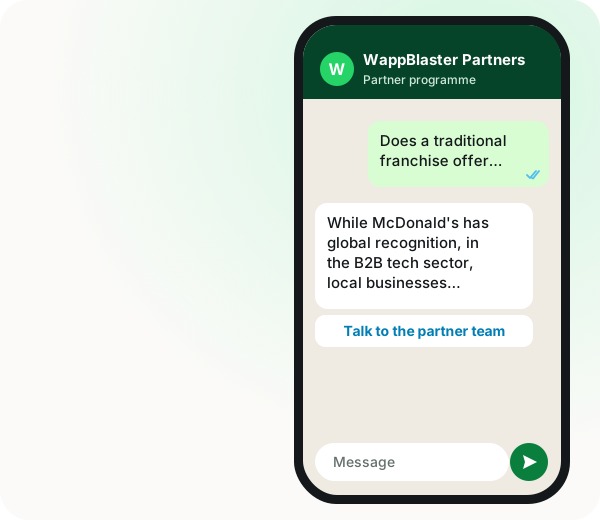
Does a traditional franchise offer better brand recognition?
While McDonald's has global recognition, in the B2B tech sector, local businesses buy based on trust with the local agent (You) and the immediate utility of the software. A live demonstration easily overrides legacy brand prejudice.
Can I run WappBlaster alongside an existing traditional franchise?
Absolutely. Many business owners running physical gym or restaurant franchises utilize WappBlaster to automate their own internal marketing, while concurrently reselling the software to neighboring businesses in their commercial plaza.
A physical franchise requires you to be on-site from 8 AM to 10 PM managing staff and inventory. A WappBlaster software business is completely asynchronous. You can operate it for 2 hours a day from a laptop or scale it locally at your own complete discretion.
What happens if a competitor opens a WappBlaster agency near me?
Because there are over 60 million active SMBs in India, market saturation is virtually impossible. 100 partners could operate in New Delhi without ever crossing paths. Furthermore, your relationships and consulting add-ons define your unique competitive advantage.
How much does it cost to become a software reseller instead of a franchisee with WappBlaster?
There is no franchise fee: you pay ₹750 for each license, and only when a customer is ready to buy. The page's food franchise example needs a ₹5 lakh fee plus ₹10 lakh for fit-out before the first sale.
Is a software reseller or a traditional franchise better for someone with a full-time job?
The reseller route fits better, because software sales can run for a couple of hours a day, while a physical franchise expects you on site from morning to night. A franchise does bring walk-in customers through a known brand.
Do software resellers pay royalties the way franchisees do?
Not here. WappBlaster takes zero royalty and earns only on the ₹750 wholesale license, whereas the page puts typical franchise royalties around 10% of gross monthly revenue.