Build a Recurring Revenue Business, The Holy Grail of Cash Flow
Recurring revenue is income that arrives again on a set cycle, such as yearly subscription fees, without a fresh sale each time. Stop trading time for money in one-off sales. Build an Annual Recurring Revenue (ARR) machine that pays you year after year.
A recurring revenue business is paid again by customers it has already won, and WappBlaster's partner programme builds that in through annual licenses that expire after 365 days. A partner sells the post-call WhatsApp app once; twelve months later the customer renews, and the partner is paid for work done the previous year. The app reminds each user 7 days before expiry to contact the partner who sold it. The page argues that B2B utility tools hold customers better than consumer subscriptions such as streaming services, because switching off automated lead follow-up would cost the business real enquiries, and because the tool replaces work an assistant would otherwise do, it tends to survive budget cuts in a downturn. A second layer comes from sub-resellers, whose license sales earn the recruiting partner a 20 percent commission indefinitely. The long-term prize is equity: a reseller portfolio with ₹20 lakh of annual recurring revenue can, the page says, be sold to an agency buyer.
What is a recurring revenue business?
A recurring revenue business earns from the same customers repeatedly through subscriptions or renewals, so income builds year on year instead of resetting after each one-off sale.
WappBlaster licenses expire after 365 days, so each renewal pays the partner ₹1750 again, and the app reminds users seven days before expiry to contact you.
Lifetime licenses are not offered, to protect renewal income.
A dashboard shows every key's activation and expiry date.
Sub-reseller overrides add a second recurring layer.
Recurring revenue business benefits
Income that compounds
Ten customers a month in year one keep paying in year two.
Automatic renewal prompts
The app nudges users toward you a week before expiry.
Forecastable cash flow
Expiry dates in the dashboard show what is due each month.
Sellable asset
A portfolio of renewing customers can be valued and sold.
Sell once, get paid forever: a recurring revenue business
Most traditional businesses, real estate, car sales, consulting, operate on a 'Treadmill Model': you make a sale, you get a commission, and the next day your revenue drops to zero until you make another sale. The WappBlaster Recurring Revenue model completely breaks this treadmill. You sell a software subscription once. Next year, when the business relies on that software, they automatically renew. You get paid again for work you completed 12 months ago.
The mathematics of compounding recurring revenue
Let's observe the compounding effect: If you acquire just 10 customers a month, you earn ₹175000 profit in Year 1. In Year 2, assuming you acquire another 10 a month, you earn your new ₹175000 PLUS the renewal income from the 120 customers from Year 1 (which generates an additional ₹210000 passive income). By Year 3, your yearly profit explodes to over ₹5.9 Lakhs with the exact same baseline effort.
High retention in a B2B recurring revenue business
Unlike consumer apps (like streaming services) which suffer high cancellation rates, B2B utility tools possess massive 'lock-in'. WappBlaster automates the critical function of lead follow-up. When a business owner realizes WappBlaster saved 40 lost leads over a year, turning the software off is financially disastrous for them. High reliance translates to ironclad 85%+ renewal rates.
Recurring revenue that protects cash flow in downturns
During recessions, companies cut luxury marketing spends, but they fiercely protect tools that automate labor and guarantee sales follow-ups. Because WappBlaster replaces the need for an expensive tele-caller assistant, it is viewed as an essential cost-saving utility, making your recurring revenue highly recession-resistant.
Adding sub-reseller income to a recurring revenue business
Direct renewals are just one layer of recurring revenue. WappBlaster's multi-tier system introduces a second compounding layer: The Sub-Reseller Network. You earn 20% commission perpetually on all licenses generated by your recruited agents. As their businesses grow and their customers renew, your passive override checks scale alongside them without you taking a single phone call.
Valuing Your Recurring Revenue Asset
The ultimate financial goal is exit equity. Businesses built on one-off sales are valued poorly. Businesses built on high-retention Annual Recurring Revenue (ARR) are highly prized by private equity. A software reseller portfolio generating ₹20 Lakhs in ARR can often be sold outright to an agency buyer for a massive multiple, creating a life-changing liquidity event.
When recurring revenue business is the wrong choice
Renewals depend on customers still finding value; if you sell to businesses that rarely take calls, expect them to lapse.
If you need a large sum quickly rather than income that builds over years, a recurring model will feel slow at first.
Recurring revenue business FAQ
What exactly defines 'Recurring Revenue' in the WappBlaster ecosystem?
Recurring revenue is generated because the software license expires exactly 365 days after activation. To continue usage, the end-user must purchase a new yearly key from you, triggering a new ₹1750 profit event for your business.
The WappBlaster application features built-in expiration logic. Starting 7 days before expiration, the app displays a prominent reminder to the user advising them to contact their vendor (You) for a renewal key, automating the collection process.
What is the typical industry retention rate for B2B Automation tools?
Mission-critical B2B automation tools typically see retention rates between 75% to 85%. Because WappBlaster directly impacts lead conversion (revenue generation), its baseline retention is exceptionally robust.
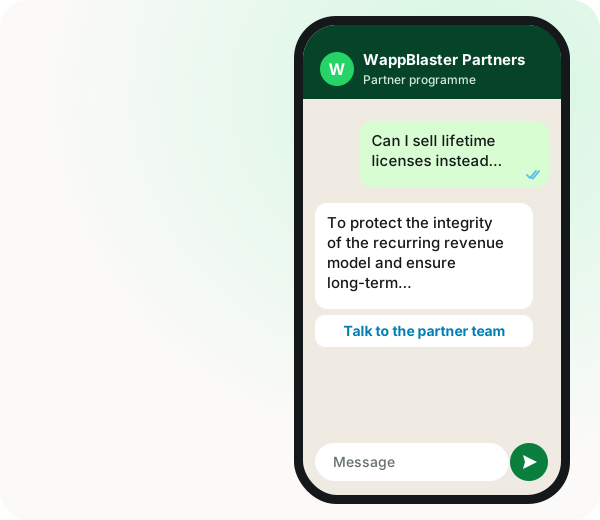
Can I sell lifetime licenses instead of yearly subscriptions?
To protect the integrity of the recurring revenue model and ensure long-term profitability for our partners, WappBlaster is strictly a 365-day license. Lifetime licenses destroy the compounding wealth effect and are not permitted.
If I take a month off in Year 2, what happens to my income?
This highlights the superiority of ARR. If you take a month off from finding new customers, your baseline income is protected by the automatic renewals of the customers you acquired during the exact same month in Year 1.
How do I track when my customers are due for renewal?
Your centralized Reseller Admin Dashboard contains a 'Customer CRM' module detailing every active key, its activation date, and its impending expiration date, allowing you to easily forecast your recurring cash flow.
For partners, yes. Every license expires 365 days after activation, so each customer who keeps using the app renews through you, and the app shows a reminder seven days before expiry.
What is the best recurring revenue business to start with little capital?
Reselling yearly software licenses fits, because there is no stock and each renewal adds to last year's base. It works only if customers keep finding value, so sell to businesses that take plenty of calls.
How does a sub-reseller network add to recurring revenue?
It adds a second layer: you take 20% on licenses your sub-resellers sell, and those customers renew too. Expiry dates in the dashboard show what is due each month across both layers.