Stop Losing Leads From Missed Calls: a Fast Reply, Then a Callback
A lost lead from a missed call is a potential customer who rang, got no answer and never heard back from the business. A missed call from a customer is the warmest inbound signal a business gets, and the one most reliably thrown away.
Stopping lost leads from missed calls starts with ownership, this WappBlaster page argues, because in most small businesses nobody is assigned to return unanswered calls, so callbacks depend on who happened to hold the phone and many callers simply ring the next supplier. The first step is measurement: count last month's missed calls and how many were returned, a figure owners usually overestimate. The quick fix is an automatic WhatsApp within about 30 seconds saying who you are, that you saw the call and when you will ring back, which keeps the conversation open and makes the customer willing to wait. Quiet hours stop it firing at midnight. The page is clear that this message is not a callback; it buys attention but does not answer the question the person rang about. The durable fix is a worklist: once every call is linked to a customer record, unreturned calls can be filtered, assigned and counted, which RMDialer handles on the calling side.
How do you stop losing leads from missed calls?
You stop losing leads from missed calls by sending an automatic WhatsApp acknowledgement within seconds, then turning every unreturned call into an assigned callback list.
WappBlaster sends the missed call WhatsApp with quiet hours built in, and links each call to a customer record so unreturned ones can be filtered and assigned.
Count last month's missed calls and how many got a callback.
An acknowledgement buys time; it does not replace the callback.
Missed calls need an owner, not a memory.
Stop losing leads from missed calls benefits
Measured leak
Knowing your own unreturned figure usually settles the decision.
Thirty-second reply
The caller learns you saw the call and when you will ring back.
More patient customers
Acknowledged callers wait an hour instead of trying a rival.
No midnight sends
Quiet hours keep the auto-reply to sensible times.
Callback worklist
Unreturned calls become a filtered, assigned list.
Nobody owns a missed call, so leads get lost
Ask a shop owner who is responsible for returning the calls they could not answer and you will usually get a pause. Somebody will ring back if it seemed important, is the honest answer, and in practice that means it depends who happened to be holding the phone. The assumption underneath is that a customer who really wanted something will try again. A good number of them do not; they simply work down their list until somebody picks up. None of this is carelessness. It is a task that was never assigned, and unassigned tasks do not survive a busy afternoon.
Count the leads you lose to missed calls first
Before buying anything, measure the leak. Count the missed calls your business received last month, then count how many were rung back. Most owners guess high and are wrong by a wide margin. To give a sense of scale, an account we can inspect directly recovered roughly half of the numbers that had reached it and never returned the rest, which on their volume left several hundred people who had made the effort to call and heard nothing further. Whatever your equivalent figure is, it usually settles the decision without further analysis.
The thirty-second reply to a missed call lead
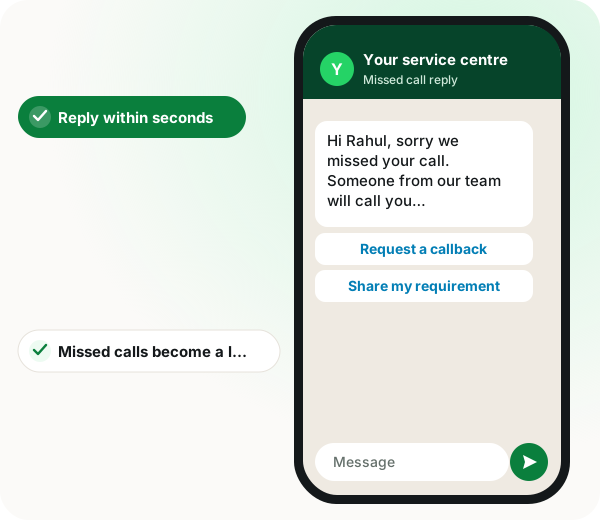
The cheapest fix is an automatic WhatsApp when a call is missed: who you are, that you saw the call, and when you will ring back. It arrives within seconds, while the person still remembers dialling, and it converts a dead end into an open conversation the customer can reply to. It also quietly buys you time, because a customer who has been acknowledged is far more willing to wait an hour than one who heard nothing. Quiet hours stop this firing at midnight.
An automatic reply to a missed call lead is not a callback
Worth being clear, because the message is sometimes sold as the whole solution. It buys attention; it does not answer the question the person rang about. The missed calls still need returning, and the automatic reply mainly ensures the lead is still available when you get there. A business that sends the message and never calls back has automated its way to a slightly more polite version of the same loss.
Put missed call leads on a list, not in memory
The durable fix is that missed calls become a worklist somebody clears, rather than entries scattered across handsets. When every call is attached to a customer record, the unreturned ones can be filtered, assigned and counted, which is what makes the leak visible enough to manage. That is what RMDialer does on the calling side, and the automatic WhatsApp is what covers the gap until the callback happens.
Stop losing leads from missed calls: reply, then return
Feature
What the team does
What WappBlaster does
Call goes unanswered
Is busy with a customer
Sends the acknowledgement on WhatsApp
Same afternoon
Works through the callback list
Shows unreturned calls by customer
Call at night
Shop is closed
Holds the message for quiet hours
Month end
Compares missed versus returned
Records make the count possible
When an auto-reply is not a fit to stop losing leads from missed calls
If nobody is going to return the calls, the automatic message only makes the same loss slightly more polite.
Businesses that miss almost no calls can skip this and simply ring back manually.
Stop losing leads from missed calls FAQ
How many leads do businesses lose to missed calls?
Consistently more than owners estimate. On an account we can inspect, a little over half the numbers that reached it and got no answer were subsequently called back, leaving several hundred people who had rung and heard nothing further. That was a better-than-typical result. The useful exercise is your own: missed calls last month against calls returned.
Three things and no more: who you are, that you saw the call, and when you will call back. It should arrive within seconds while the person still remembers dialling. Adding a catalogue, an address and an offer to the same message reduces the chance of any of it being read.
No, and treating it as a complete solution is the common mistake. The message buys attention and keeps the lead available; it does not answer what the person rang about. A business that sends it and never calls back has simply automated a more polite version of the same loss.
Turn them into a worklist rather than entries on individual handsets. When calls attach to customer records, the unreturned ones can be filtered, assigned to someone and counted, which is what makes the problem visible enough to manage rather than something everyone assumes someone else handled.
Is WappBlaster a way to stop losing leads from missed phone calls?
It covers the first step. WappBlaster sends the missed call WhatsApp with quiet hours built in and links each call to a customer record, so unreturned calls can be filtered and assigned.
How do I measure how many leads I lose to missed calls?
Count last month's missed calls, then count how many were rung back. Most owners guess high, and the gap between the two numbers usually settles the decision.
Why do missed calls go unreturned in small businesses?
Nobody is assigned to return them. Calling back depends on whoever happened to hold the phone, and a task with no owner rarely survives a busy afternoon.