Increase Telecalling Conversion Rate With Six Levers Before You Blame the Pitch
Telecalling conversion rate is the share of phone leads that end in a sale, the final result of every step before the close. Most advice here is about the pitch. In practice the pitch is the fourth thing to fix, and three cheaper levers sit in front of it.
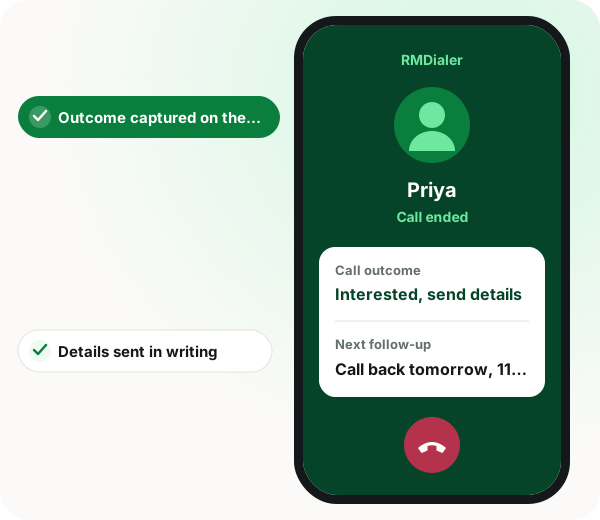
Increasing telecalling conversion rate starts, on this RMDialer page, by splitting one number into four that multiply: leads called at all, calls that reach a person, conversations with a decision-maker who has intent, and closes. The pitch is only the fourth lever, and three cheaper ones come first. Lever one is calling leads already in the database, since a meaningful share of enquiries are never dialled once; a filter of uncalled leads, oldest first, pushed to the dialer as one session fixes that in a morning. Lever two is the cheap second and third attempt, because most unreached leads were unavailable rather than uninterested, and continuous dialling from a filtered list removes the friction. Lever three is moving valuable leads into the hours your own data shows people answer. Lever four is the follow-up: RMDialer logs outcomes in 2 taps as the call ends and sends the after-call WhatsApp, so the promised catalogue or location arrives while interest is warm.
How do you increase telecalling conversion rate?
You increase telecalling conversion rate by fixing four multiplied numbers in order: leads called, calls connected, conversations with intent, and closes, starting with the cheapest.
RMDialer dials a filtered list continuously, logs outcomes in two taps as the call ends, and sends the after-call WhatsApp so interest does not cool.
Roughly a quarter of enquiries in a typical database were never dialled.
Two or three attempts reached 73% of leads versus 51% for one.
Fix the list before blaming the pitch.
Increase telecalling conversion rate benefits
Never-called leads worked
Filter for leads with no call, oldest first, and dial them as one session.
Cheap repeat attempts
Continuous dialling removes the friction that stops second and third calls.
Hours that answer
Your own data shows when pickup peaks, such as Thursday 6pm at 59% on one account.
Written follow-up
Catalogue, price list or location arrives while the customer is still thinking.
Honest outcome data
Two-tap logging on the call screen records what really happened.
Telecalling conversion rate is four numbers multiplied together
The single most useful change you can make is to stop treating conversion as one number. A telecalling outcome is the product of four: how many leads get called at all, how many of those calls reach a human, how many conversations reach a decision-maker with intent, and how many of those close. Improving the last one by a fifth is hard and takes months. Improving the first one by a fifth is often a morning's work, and it multiplies through everything after it. Work them in order, cheapest first.
Lever one to increase conversion rate: call the leads you already have
Roughly a quarter of the enquiries sitting in a typical telecalling database have never been dialled once, and those that were often waited more than a day for the first attempt. Nobody decides this. It is what happens when leads arrive into a sheet and get worked in whatever order somebody opens them. The remedy is a filter rather than a motivational speech: everything with no call against it, oldest first, pushed to the dialer as one session. It needs no new skill, no new hire and no change to what anyone says on the phone.
Lever two: cheap repeat attempts increase telecalling conversion
On the same account, leads that received one call were reached 51% of the time. Leads that received two or three were reached 73%. That gap is not persistence as a virtue; it is arithmetic. Most single-attempt leads were not uninterested, they were unavailable. What stops the second attempt happening is friction: finding the number again, remembering whose job it was. Continuous dialling from a filtered list removes both, which is why an auto dialer raises conversion even when nothing about the conversation changes.
Lever three: call at the hours that answer
Every sales blog publishes a best-time-to-call study and they contradict each other, because the answer depends on who you sell to. Your own call data has the real answer. On the account above the busiest hour and the best-answering hour were different: the team dialled hardest at noon, while pickup peaked on Thursday at 6pm at 59%. Moving your highest-value leads into the window that answers, and your admin-heavy follow-ups into the window that does not, costs nothing and is worth roughly what another caller is worth.
Lever four: a written follow-up lifts telecalling conversion rate
Only now does the conversation itself become the constraint. Even then, the cheapest improvement is not what is said but what follows. A call that ends with an intention to send a catalogue, a price list or a location, and then does not, converts far worse than one where the message arrived while the customer was still thinking about it. Automating the after-call WhatsApp removes the step that reliably gets skipped at 4pm on a busy day, and it works for calls that were never answered too, which is where most of the recoverable value sits.
Lever five: capture the outcome while it is true
Every lever above depends on knowing what actually happened. Outcomes typed up at the end of the shift are compressed and flattering; outcomes captured on the call screen as the call ends are simply what occurred. That difference decides whether your conversion rate is a measurement or an estimate. If logging a call takes a minute, callers will stop doing it by mid-morning and your data becomes decorative, which is why two-tap logging matters more than it sounds.
Lever six: fix the list to increase telecalling conversion
If connect rates are fine and conversations are reaching decision-makers but nothing closes, the problem is usually upstream of the call. Either the list is wrong for the offer, or the offer is wrong for the list. More dialling makes that visible faster but does not fix it. The signal to watch is the loss reason: when a single objection accounts for a third of losses, that is a pricing or positioning problem, and no amount of calling technique will move it.
Increase telecalling conversion rate: six levers in order
Feature
What the team does
What RMDialer does
Uncalled leads
Filters for zero attempts
Pushes them to the dialer, oldest first
Unreached leads
Plans more attempts
Dials the filtered list continuously
Call timing
Moves top leads to peak hours
Call data shows the best-answering window
Call ends
Taps the outcome
Sends the after-call WhatsApp
Nothing closes
Rebuilds the list
Reports show where the funnel leaks
When a dialer is the wrong choice to increase telecalling conversion rate
If connect rates are fine but nothing closes, more dialling only spends money faster; the list or the offer needs changing first.
Teams that need queues and IVR should look at a contact-centre platform rather than a SIM-based dialer.
Increase telecalling conversion rate FAQ
What is a good telecalling conversion rate in India?
It varies so widely by sector and list quality that any published benchmark is close to meaningless. A warm inbound enquiry list and a cold purchased list can differ by an order of magnitude for the same team and the same pitch. The number worth tracking is your own, segmented by lead source, measured over the same period. If a vendor quotes you an industry average without asking what you sell, treat the figure with suspicion.
Does calling more often actually improve conversion?
Up to a point, and the gain comes from reaching people rather than from persistence wearing them down. Single-attempt leads are reached around half the time; two or three attempts gets that to roughly three quarters. Beyond that the returns fall away quickly and the complaint risk rises, so more attempts is not a strategy on its own. Respect DND registration for promotional calls in India, and stop when someone says no.
The list, by a wide margin, and it is not close. A well-built list of eighty relevant businesses will outperform three hundred scraped numbers with any script. Scripts help newer callers stay consistent, but they cannot make an irrelevant call relevant. If you have limited time to improve one thing, improve who you are calling.
How do I measure conversion if callers do not log outcomes?
You cannot, and this is the most common reason conversion projects stall. The practical fix is to make logging faster than avoiding it: an outcome sheet that appears on the call screen the moment the call ends, with a status, a remark and a callback date in two taps. When capture takes a minute and requires switching apps, it stops happening within a week and every number downstream becomes an estimate.
It increases the number of conversations, which raises total conversions even when the conversion percentage itself is unchanged. It can also raise the percentage indirectly, by making second attempts cheap and by removing the dead time that stops callers finishing a list. What it will not do is improve a bad list or a weak offer, and a dialer that makes it effortless to call the wrong three hundred people will help you do exactly that.
Is RMDialer software to increase telecalling conversion rate?
It works on the earlier levers. RMDialer dials a filtered list continuously, logs outcomes in two taps as each call ends and sends the after-call WhatsApp, which raises conversations and keeps interest warm.
How many call attempts should a telecaller make per lead?
Two or three. On the account the page describes, one attempt reached 51% of leads while two or three reached 73%, and beyond that the returns fall and complaint risk rises.
The hour your own data shows people answer, not a published study. On one account the team dialled hardest at noon, but pickup peaked on Thursday at 6pm at 59%.
Nobody decides the order: new enquiries pile into a spreadsheet and get picked at random. The page estimates roughly a quarter of enquiries in a typical database were never dialled, and the fix is a filter for zero attempts, oldest first.
What is the best way to increase telecalling conversion rate without changing the script?
Work the cheaper levers first: call never-dialled leads, make repeat attempts easy, dial at the hours that answer and send a WhatsApp after the call. This page ranks the pitch fourth among the things to fix.