Legal WhatsApp Marketing Software for SMBs Under Meta Rules and the DPDP Act
Legal WhatsApp marketing is promotional messaging that respects both Meta's platform rules and the data protection law where your customers live. Two different rulebooks apply, and most guidance covers only the first. Meta can remove your number; the law can do rather more.
Legal WhatsApp marketing software has to satisfy two rulebooks: Meta's terms, which decide whether the number keeps working, and India's Digital Personal Data Protection Act, which decides regulatory exposure. Under the DPDP Act, in plain terms, a business needs a lawful basis for holding each number, must explain how it is used, must let people withdraw consent as easily as they gave it, should keep data only as long as the purpose needs, and must delete it on request. Consent therefore has to be traceable: an enquiry from last year is a defensible basis if the record shows it, while a number sitting in a spreadsheet with no source is not, and bought lists fail by design. Messaging a customer about an order or renewal stands on firmer ground than pitching a stranger. WappBlaster supplies the records this needs on Meta's official platform, and the page suggests spending 10 minutes with a qualified adviser on retention periods.
What makes WhatsApp marketing software legal?
WhatsApp marketing software is legal to use when it follows Meta's terms and lets you meet India's DPDP Act: traceable consent, easy withdrawal, limited retention and deletion.
WappBlaster records lead source per contact, keeps a permanent cross-list opt-out, an exclusion list, a sent history and export, and sends on Meta's official platform.
Meta's terms decide your number; Indian law decides your regulatory exposure.
Consent must be traceable to a source, not simply claimed.
A customer list does not quietly become a prospecting list.
Legal WhatsApp marketing software benefits
Lead source per contact
Each number shows where it came from, turning a claim into a record.
Lasting opt-out
An unsubscribe applies permanently and across every list.
Exclusion list
Keep specific people unreachable by any campaign.
Producible send history
Show exactly what was sent if anyone asks.
Data export
Search, export or delete data rather than leaving it in phone chats.
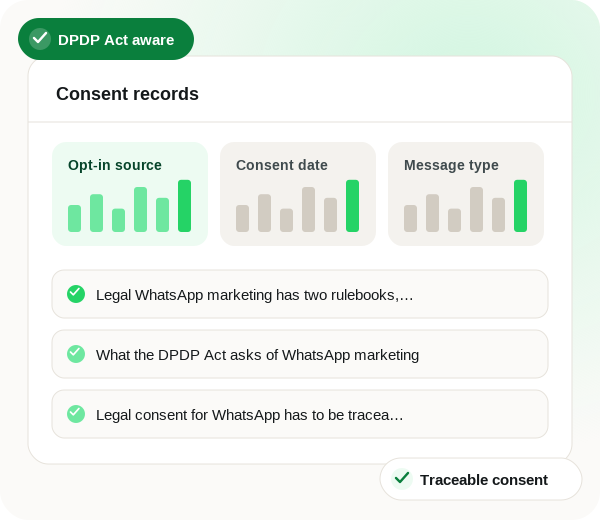
Legal WhatsApp marketing has two rulebooks, not one
Meta's terms of service decide whether your number keeps working. Indian law decides whether your business is exposed to a regulator. They overlap but are not the same, and a tool that is entirely acceptable to Meta can still be used in a way that breaches the Digital Personal Data Protection Act. Most vendor guidance addresses only the first, because the first is the one that affects whether their product appears to work. The second is the one with statutory consequences.
What the DPDP Act asks of WhatsApp marketing
In plain terms: you need a lawful basis for holding someone's number and messaging them, you need to tell them what you are doing with it, you must let them withdraw consent as easily as they gave it, you should keep the data only as long as the stated purpose requires, and you must be able to delete it when asked. For most small businesses none of this is burdensome, but it does require the data to be somewhere you can actually search and delete, which a personal phonebook and a WhatsApp chat history are not.
Legal consent for WhatsApp has to be traceable, not just claimed
The practical test is whether you could show where a number came from. 'They enquired last year' is a defensible basis if the record says so; it is worthless if the number is simply in a spreadsheet with no source. This is why recording lead source on every contact matters more than it looks: it converts an assertion into a record. Purchased lists fail this test by construction, which is a separate and larger problem than the ban risk they carry.
Promotional versus transactional: different legal rules on WhatsApp
Messaging an existing customer about their order, delivery or renewal sits on firmer ground than pitching a stranger, and the distinction matters under both rulebooks. Businesses get into difficulty when a customer list quietly becomes a prospecting list, because the basis on which you hold the number does not extend to the new purpose. If you are going to market to existing customers, say so when you collect the number.
What marketing software can and cannot make legal
Software cannot make you compliant; it can make compliance possible. What to look for: lead source recorded per contact, an opt-out that works permanently and across lists, an exclusion list, a sent-message history you can produce, and export so the data is not hostage. WappBlaster provides these and sends on Meta's official platform. None of it substitutes for deciding your lawful basis and retention period, which is your call and worth ten minutes with someone qualified. This page is general information, not legal advice.
Legal WhatsApp marketing software: DPDP duties and tooling
Feature
What the team does
What WappBlaster does
Collecting a number
States the purpose, including marketing
Stores the lead source with the contact
Customer withdraws consent
Honours it at once
Applies the opt-out to every list
Order or renewal update
Sends transactional news
Uses approved templates on the official platform
Deletion request
Finds the record
Lets you locate and export the data
The limits of legal WhatsApp marketing software
Software cannot choose your lawful basis or retention period; spend ten minutes with someone qualified, since this page is general information, not legal advice.
Purchased lists fail the consent test by design, and no tool makes messaging them lawful.
Legal WhatsApp marketing software FAQ
Is WhatsApp marketing legal in India?
Yes, when done with a lawful basis and appropriate consent. The Digital Personal Data Protection Act governs how you hold and use personal data including phone numbers, requiring a stated purpose, an easy way to withdraw consent, defined retention and the ability to delete on request. Unsolicited promotional messaging to purchased lists is where businesses run into trouble.
No, and this is the most common misunderstanding. Meta's terms determine whether your number keeps working; Indian law determines your regulatory exposure. A tool perfectly acceptable to Meta can still be used in a way that breaches the DPDP Act, and most vendor guidance only addresses the first.
A record showing where the number came from and when. An enquiry logged with its source is defensible; a number sitting in a spreadsheet with no origin is not. This is why recording lead source per contact matters: it turns a claim into evidence you could actually produce.
Generally you are on firmer ground than with strangers, but the basis on which you hold the number does not automatically extend to new purposes. If you intend to send marketing to customers, say so at the point you collect the number, and keep the opt-out working on first request.
It provides the tools that make compliance possible: lead source per contact, a permanent cross-list opt-out, an exclusion list, a sent history and export, with sending on Meta's official platform. The page stresses that software alone cannot make you compliant.
What does the DPDP Act require for WhatsApp marketing?
A lawful basis for holding and messaging the number, notice of what you do with it, withdrawal as easy as consent, retention only as long as the purpose needs, and deletion on request. The page notes this is general information, not legal advice.
Are order updates on WhatsApp treated differently from promotions?
Yes. Messages about an existing customer's order, delivery or renewal sit on firmer ground than pitching a stranger, under both Meta's terms and Indian law.
What is the best legal WhatsApp marketing software for a small Indian business?
One that records where each number came from, keeps opt-outs working across every list, and lets you search, export and delete data. Those features turn consent claims into records you can produce.
Can I keep marketing contacts in a personal phonebook?
It is hard to justify under the DPDP Act. The law expects data you can search and delete on request, which a personal phonebook and a WhatsApp chat history are not.