Reduce Customer Acquisition Cost With WhatsApp Using Leads You Already Paid For
Customer acquisition cost, or CAC, is the total spent on winning new customers divided by the number of customers actually won. Cutting ad spend lowers CAC and lowers customers with it. Converting more of the leads you already paid for lowers only the cost.
Reduce customer acquisition cost with WhatsApp in brief
Reducing customer acquisition cost with WhatsApp works on only one of CAC's two levers, this WappBlaster page explains: rather than cutting spend, which usually cuts customers too, it converts more of the leads already paid for. The costliest leads are those bought and never worked; an enquiry generated by ₹400 of advertising and never followed up counts in CAC exactly like one that converted. Speed is the second factor, because a buyer comparing three suppliers tends to choose whoever answers while they are still deciding, and an automatic WhatsApp reply after the call makes the business consistently first. Extra attempts cost time rather than media spend, so second and third contacts recover leads cheaply and pull average CAC down. Retention is the saving nobody counts, since a repeat customer costs close to nothing to acquire, and reaching an existing buyer on WhatsApp costs one Meta conversation charge instead of a click auction. WappBlaster automates the immediate post-call reply behind the first two levers.
How do you reduce customer acquisition cost with WhatsApp?
You reduce customer acquisition cost with WhatsApp by converting more leads you already paid for: reply first, make extra attempts and bring past buyers back.
WappBlaster sends the immediate WhatsApp reply automatically after a call, so you are first to respond on leads your ad budget already bought.
Cutting ad spend usually cuts customers too, leaving CAC flat.
On one account a quarter of leads had never been called.
Repeat buyers cost close to nothing to acquire again.
Reduce customer acquisition cost with WhatsApp benefits
Work the ignored leads
An enquiry bought with ₹400 of ads counts in CAC whether or not anyone calls it.
First-reply advantage
Buyers comparing three suppliers often choose whoever answers while they are deciding.
Near-free second attempts
Two or three contacts reached 73% of leads against 51% for one.
Retention at low cost
Messaging a past customer costs one Meta conversation charge, not a click auction.
Conversion-side savings
Better conversion divides straight into CAC without touching the ad budget.
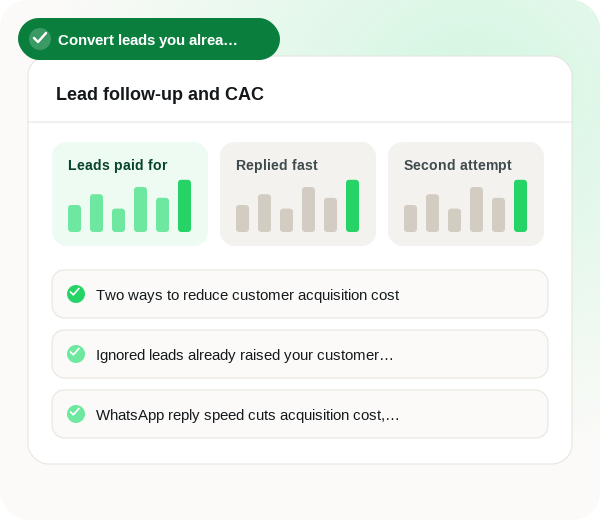
Two ways to reduce customer acquisition cost
CAC is acquisition spend divided by customers acquired, and there are only two levers. Spend less, which usually produces fewer customers and leaves CAC roughly where it was. Or convert more of the leads you already paid for, which lowers the numerator per customer without touching the top of the funnel. WhatsApp affects the second lever almost entirely, and that is a more useful framing than treating it as a cheaper advertising channel, which it is not.
Ignored leads already raised your customer acquisition cost
The most expensive leads in any business are the ones that were paid for and never worked. An enquiry generated by ₹400 of advertising and never followed up costs the same as one that converted, and it appears in the CAC calculation identically. On one real account, a quarter of all leads had never been called at all. Working those costs nothing in media spend and is the single largest CAC reduction available to most businesses.
WhatsApp reply speed cuts acquisition cost, it is not a courtesy
The gap between responding in two minutes and responding tomorrow is large and well documented across industries, because a buyer comparing three suppliers gives the business to whoever answers while they are still deciding. Automating the immediate WhatsApp reply means you are consistently first, on leads you have already paid to generate. The effect lands on conversion rate, so it divides straight into CAC.
Second and third WhatsApp attempts cost almost nothing per customer
Leads that receive one contact convert far less often than those receiving two or three, and the additional attempts cost only time rather than media spend. On one account, single-attempt leads were reached 51% of the time against 73% for two or three. Because the acquisition cost was already sunk, every lead recovered this way reduces average CAC directly. It is the cheapest incremental customer available to most businesses.
Retention: the customer acquisition cost saving nobody counts
A repeat customer has an acquisition cost of approximately zero, so any repeat purchase pulls blended CAC down. WhatsApp is unusually good at this because reaching an existing customer costs one Meta conversation charge rather than a click auction. Businesses obsessing over CAC while making no attempt to bring back last year's buyers are optimising the expensive half of the problem and ignoring the cheap one.
Reduce customer acquisition cost with WhatsApp: the levers
Feature
What the team does
What WappBlaster does
Lead arrives from an ad
Calls it the same day
Sends the instant WhatsApp after the call
No answer on first try
Schedules a second and third attempt
Keeps the lead warm in chat
Last year's buyers
Picks who is due to repurchase
Messages them on the official platform
When WhatsApp is the wrong choice to reduce customer acquisition cost
If your problem is that ads bring the wrong people, faster WhatsApp replies will not fix the targeting; fix the audience first.
Businesses with very few leads may gain more from new demand than from squeezing conversion on a tiny pipeline.
Reduce customer acquisition cost with WhatsApp FAQ
Does WhatsApp actually reduce customer acquisition cost?
Indirectly, and mostly through conversion rather than cheaper traffic. CAC is spend divided by customers, and WhatsApp mainly affects the second number: faster responses, more follow-up attempts and better retention all produce more customers from the same spend. Treating it as a cheaper advertising channel misreads where the effect comes from.
Work the leads you already paid for and never contacted. Unworked enquiries cost exactly the same as converted ones and appear identically in the calculation. On one real account a quarter of all leads had never been called, and clearing that backlog requires no additional media spend at all.
A great deal, because a buyer comparing suppliers tends to go with whoever answers while they are still deciding. Automating an immediate WhatsApp reply means you are consistently first on leads you have already paid for, and the improvement lands on conversion rate, which divides straight into CAC.
It should, and it is the part most businesses omit. A repeat customer costs approximately nothing to acquire, so repeat purchases pull blended CAC down. Reaching an existing customer on WhatsApp costs one conversation charge rather than a click auction, which makes it unusually efficient.
Is WappBlaster a tool to reduce customer acquisition cost?
It works on the conversion side. WappBlaster sends the immediate WhatsApp reply automatically after a call, so you answer first on leads your ad budget already bought.
Divide acquisition spend by the number of customers acquired. That leaves two levers: spend less, or turn a larger share of already-bought leads into customers.
Spending less usually brings fewer customers too, so the ratio stays roughly where it was. Converting more existing leads lowers the cost per customer without shrinking the funnel.
Do unworked leads count in customer acquisition cost?
Yes. An enquiry bought with ₹400 of ads costs the same whether anyone calls it or not, and it sits in the CAC calculation exactly like one that converted.
What is the best way to reduce customer acquisition cost with WhatsApp for a small business?
Work the paid leads you never contacted, reply first, add a second and third attempt and win back past buyers. On one account the page cites, a quarter of leads had never been called.