Software to Automate Indian Sales Teams, in the Order That Actually Gets Adopted
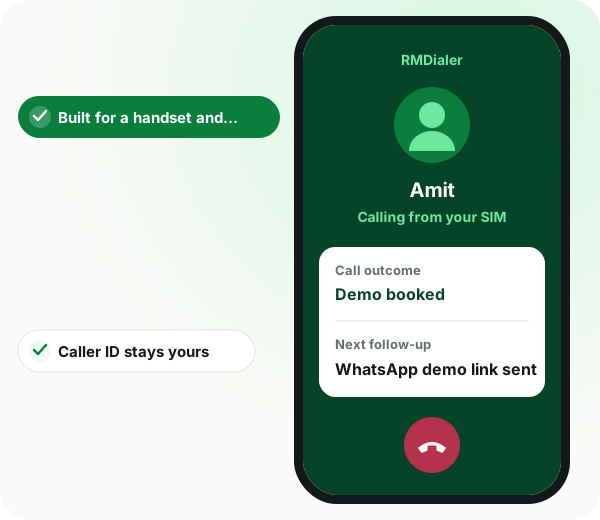
Sales team automation software takes repetitive work such as dialling, follow-up messages and call logging off reps so they spend more time selling. Software designed for a rep at a laptop fails here for structural reasons. What works is built for a handset and a SIM.
Software to automate Indian sales teams has to fit how those teams actually work, on an Android phone with a SIM and WhatsApp as the channel customers answer, rather than the laptop, email and VoIP setup most imported tools assume. This page sets the order of automation that gets adopted: dialling first, because it is dead time; the follow-up message second, because it is skipped on busy days; outcome capture third, which has to take 2 taps or it will not happen; and reporting last, built from the first three. Starting with dashboards, the buyer's instinct, produces reports fed by data nobody enters. Caller ID is the India-specific detail, since calls from cloud or virtual numbers are screened and flagged far more than calls from an ordinary mobile, so dialling through the rep's own SIM matters. For teams under fifty people, the recommended stack is RMDialer as dialer and CRM in one Android app with a manager panel, plus WappBlaster for WhatsApp follow-up.
What is the best software to automate Indian sales teams?
The best software to automate Indian sales teams runs on an Android phone and SIM, automating dialling, WhatsApp follow-up and outcome capture before reporting.
RMDialer combines dialer and CRM in one Android app, costing ₹1908 ($29) a user yearly, and WappBlaster adds the WhatsApp follow-up on Meta's official platform.
Laptop-and-email sales stacks miss where Indian selling actually happens.
Automate dialling first, then follow-up, outcome capture and reports.
Calls from the rep's own SIM get answered more than virtual numbers.
Software to automate Indian sales teams benefits
SIM-based dialling
Customers see a familiar mobile number and are more likely to ring back.
Two-tap outcomes
Capture is quick enough that reps keep doing it all day.
Automatic follow-up
The WhatsApp message no longer gets skipped on busy days.
Self-building reports
Dashboards fill from dialling and outcome data reps already create.
Manager desktop panel
Leaders review the team without chasing spreadsheets.
Why imported sales stacks underperform with Indian sales teams
Most sales software assumes a rep at a desk with a laptop, email as the primary channel and a landline or VoIP number. Indian field and inside sales typically runs on an Android phone, a SIM, and WhatsApp as the channel customers actually reply on. A tool built on the other assumptions is not merely inconvenient, it produces data nobody enters and reports nobody believes, because the work is happening somewhere the software cannot see.
Automate an Indian sales team in this order
First, dialling, because it is pure dead time and removing it costs nothing in behaviour change. Second, the follow-up message, because it is the step most reliably skipped when the day gets busy. Third, outcome capture, which has to be two taps or it will not happen. Fourth, reporting, which then builds itself from the first three. Teams that start at reporting, which is the natural instinct of whoever is buying, end up with a dashboard fed by data nobody is entering.
The adoption trap for Indian sales teams
Sales software in India fails at adoption far more often than at capability. The pattern is predictable: it is chosen by a manager, evaluated on reports, and rolled out to reps who experience it as extra work with no benefit to them. By week three they are back to a notebook and the licence renews anyway. The defence is to judge any tool by whether it makes the rep's day shorter. If the only beneficiary is the person buying, the rollout is already in trouble.
Caller ID is not a detail when Indian sales teams dial
One India-specific point that imported software gets wrong. Calls placed from cloud or virtual numbers get answered far less often than calls from an ordinary mobile number, because customers screen unfamiliar numbers and carriers flag them. Software that dials through the SIM already in the rep's phone keeps the caller ID customers recognise and will ring back. For outbound teams this frequently outweighs every feature difference on the comparison sheet.
What a working Indian sales team stack looks like
For most Indian sales teams under fifty people: an Android app that is the dialer and the CRM at once, dialling through the SIM, with two-tap outcome capture and automatic WhatsApp follow-up on Meta's official platform, plus a desktop panel for the manager. That is RMDialer at ₹1908 ($29) per user per year and WappBlaster for the messaging side. Above that size, or where queues and IVR are required, a contact-centre platform starts to earn its complexity.
Software to automate Indian sales teams, in rollout order
Feature
What the team does
What RMDialer does
Dialling
Works the lead list
Dials through the rep's SIM
Follow-up
Moves to the next call
Triggers the WhatsApp message
Outcome capture
Taps the result
Saves it against the lead
Reporting
Manager reviews
Builds reports from the first three
When phone-first software to automate Indian sales teams is the wrong choice
Teams above about fifty people, or those needing queues and IVR, will find a contact-centre platform earns its complexity.
If reps sell mostly by email from laptops, a desk-based CRM may suit them better than a phone-first tool.
Software to automate Indian sales teams FAQ
Why do imported sales tools struggle with Indian teams?
They assume a rep at a desk with a laptop, email as the main channel and a VoIP number. Indian field and inside sales runs on an Android phone, a SIM and WhatsApp. The mismatch shows up as data nobody enters, because the work happens somewhere the software cannot observe.
Dialling, because it is pure dead time and needs no behaviour change. Then the follow-up message, which is the step most often skipped when busy. Then outcome capture, which must be two taps to survive. Reporting comes last and builds itself from the first three; starting there produces a dashboard with no data behind it.
Almost always at adoption rather than capability. Tools are chosen by managers, evaluated on reports, and experienced by reps as extra work with no benefit to them, so usage collapses by week three. Judge any tool by whether it makes the rep's day shorter, not by the reports it can produce.
Considerably, and imported software often gets this wrong. Calls from cloud or virtual numbers are answered far less often, because customers screen unfamiliar numbers and carriers flag them. Dialling through the SIM in the rep's own phone keeps a caller ID customers recognise and can ring back.
How much does software to automate Indian sales teams cost with RMDialer?
₹1908 ($29) per user per year for RMDialer, which is the dialer and CRM in one Android app. WappBlaster is added for the WhatsApp follow-up on Meta's official platform.
What is the best sales automation software for an Indian team under fifty people?
A phone-first stack: an Android app that is both dialer and CRM, with automatic WhatsApp follow-up and a manager desktop panel. Above fifty people, or where queues and IVR are needed, a contact-centre platform starts to make sense.
Usually not, as most field and inside sales runs on an Android phone, a SIM and WhatsApp. Reps who mostly sell by email from laptops are the exception and may suit a desk-based CRM.
How can managers track a sales team without spreadsheets?
Let reports build themselves from dialling and outcome data reps already create. RMDialer's manager desktop panel shows the team's activity without anyone compiling sheets.
Why do reps go back to notebooks after a new sales tool?
Because the tool added work and gave them nothing back. The page says usage commonly collapses by week three, so judge any tool by whether it makes the rep's day shorter.