WhatsApp order taking software for restaurants

WhatsApp Order Taking Software for Restaurants That Want Fewer Aggregator Commissions

WhatsApp order taking is a restaurant accepting food orders directly in chat rather than through a delivery aggregator's app. Aggregators take a fifth to a third of the bill. Taking orders direct keeps that, and costs you something else. This is the arithmetic.

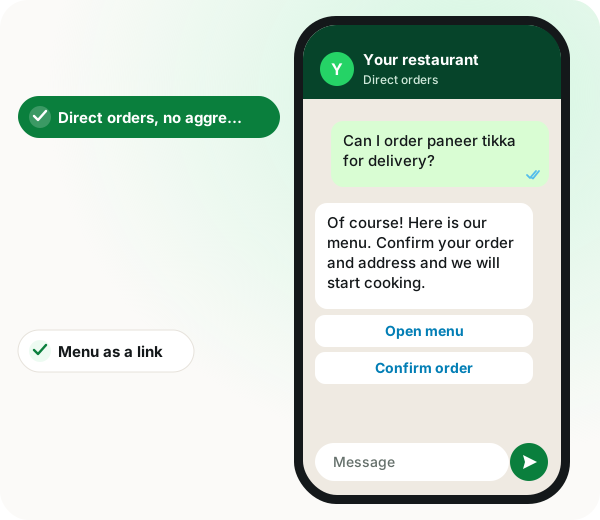
WhatsApp order taking software for restaurants: delivery order question answered with Open menu and Confirm order buttons

WhatsApp order taking software for restaurants in brief

WhatsApp order taking software for restaurants trades aggregator commission, which this WappBlaster page puts at between 20 and 33 percent of each order in India, for staff attention at the busiest hour. Twelve orders an evening can be handled on a phone; 60 in ninety minutes cannot, unless the restaurant decides in advance what is automated and what needs a person. Three messages repeat and should be automatic: the menu as soon as a conversation opens, an order confirmation with the total to avoid disputes at the door, and a status note when the order leaves. Requests such as making a dish less spicy should always get a human reply. The menu should be a link rather than a PDF, since items run out and prices move, and a link always shows the current version while loading on weak connections. Restaurants need not choose all or nothing, keeping aggregators for discovery while moving regulars who order twice a month to WhatsApp.

What is WhatsApp order taking software for restaurants?

WhatsApp order taking software for restaurants lets diners order directly in chat, automating the menu link, order confirmation and dispatch update while staff handle special requests.

WappBlaster's Auto WhatsApp After Call can send your live menu link to every phone order caller, so staff spend peak hour on the kitchen, not typing.

  • Aggregators commonly take a fifth to a third of each bill.
  • Peak hour handling, not commission, decides whether direct ordering works.
  • Never automate answers to real questions like less spicy, please.

WhatsApp order taking software for restaurants benefits

  • Commission kept

    Direct orders keep the share an aggregator would take.

  • Menu as a link

    Sold-out items and price changes show up in every past chat.

  • Clear confirmations

    A total in writing avoids disputes at the door.

  • Dispatch updates

    Customers learn when the order leaves.

  • Loyal regulars moved

    Twice-a-month customers shift to WhatsApp where the margin is yours.

The trade restaurants make with WhatsApp order taking

Aggregator commission in India commonly runs between a fifth and a third of the order value, which on thin restaurant margins is often the difference between profit and none. Direct WhatsApp ordering keeps that money. What it costs instead is staff attention at exactly the moment you have least of it, because orders now arrive in a chat somebody has to read, confirm and key into the kitchen while the restaurant is full. Whether that trade is good depends entirely on whether you can handle the messages at peak, not on the commission percentage.

Peak hour WhatsApp orders in a busy restaurant

A restaurant taking twelve orders an evening can take them on a phone. A restaurant taking sixty in ninety minutes cannot, and this is where most direct-ordering attempts collapse. Messages queue, someone replies to the wrong chat, an order is confirmed that the kitchen never saw, and one bad Saturday undoes months of commission saved. The fix is not more discipline. It is deciding in advance what is automated (menu, confirmation, delivery estimate) and what a human must do (modifications, substitutions, anything unusual).

Automate the three restaurant WhatsApp order messages that repeat

Three messages account for most of the typing. The menu, sent the moment someone opens a conversation. The order confirmation with a total, so there is no dispute at the door. And a status message when the order leaves. Each is the same every time, which is exactly what should be automated, and each arriving promptly does more for repeat ordering than any discount. What should never be automated is the reply to 'can you make it less spicy', because an automated answer to a real question is worse than a slow one.

Menus change more often than restaurants expect: an item runs out, a price moves, a special ends. A PDF sent last Tuesday is wrong by Friday and you cannot recall it, and the customer ordering from it will argue the price. A link to a page you update means every conversation you have ever had now shows the current menu. It also loads on a weak connection outside your delivery area, which a heavy PDF does not.

Run WhatsApp orders and the aggregator side by side at your restaurant

Nothing forces the choice to be all or nothing, and treating it as one is how restaurants lose volume they needed. Keep the aggregator for discovery, which is genuinely what it is good at, and push repeat customers to WhatsApp where the margin is yours. The customers worth moving are the ones who already order twice a month. Offer them a reason once, at the point of delivery, rather than broadcasting discounts at everyone.
Restaurant owners going direct also read Google AI reviews and local SEO for restaurants, sending a storefront link after every call and WhatsApp chatbots for online selling.

WhatsApp order taking software for restaurants at peak hour
Feature What the team does What WappBlaster does
Customer opens a chat or calls Focuses on the kitchen Sends the current menu link
Order placed Keys it into the kitchen Confirmation with the total goes out
Modification request Replies personally Stays out of the way
Order leaves Hands it to the rider Status message tells the customer

When WhatsApp order taking software is not the right fit for restaurants

  • If you take sixty orders in ninety minutes with no one free to read chats, direct WhatsApp ordering can cost more than the commission it saves.
  • New restaurants relying on discovery should keep the aggregator running alongside, since WhatsApp only reaches people who already know you.

WhatsApp order taking software for restaurants FAQ

Is taking orders on WhatsApp cheaper than an aggregator?

On commission, substantially: aggregators commonly take a fifth to a third of order value, and direct ordering keeps it. The cost moves rather than disappearing, into staff attention at peak hours. For a restaurant already struggling to answer the phone on a Saturday, that cost can exceed the commission saved.

Link to this answer

What should be automated and what should not?

Automate the three messages that are identical every time: the menu when a conversation opens, the order confirmation with a total, and a status update when the order leaves. Do not automate replies to genuine questions about modifications or substitutions, because a wrong automated answer is worse than a slightly slow human one.

Link to this answer

Should I send the menu as a PDF?

A link is better. Menus change when items run out or prices move, and a PDF sent last week is wrong this week with no way to correct it. A link points at a page you update, so every past conversation shows the current menu, and it loads on a weak connection where a large file does not.

Link to this answer

Do I have to stop using aggregators?

No, and treating it as either-or costs restaurants volume they needed. Aggregators are genuinely good at discovery. The sensible pattern is to keep them for new customers and move repeat orderers to WhatsApp, where the margin is yours, by asking once at the point of delivery.

Link to this answer

Is WappBlaster WhatsApp order taking software for restaurants?

It covers the menu step. WappBlaster's Auto WhatsApp After Call sends your live menu link to every phone order caller, so staff can stay on the kitchen at peak hour.

Link to this answer

How much commission do food aggregators take in India?

Commonly between a fifth and a third of the order value, according to this page. Taking orders directly on WhatsApp keeps that share.

Link to this answer

How should a restaurant cope with WhatsApp food orders at peak hour?

Decide in advance what is automated and what needs a person. Automate the menu, the confirmation with a total and the dispatch update, and keep modifications and substitutions for staff.

Link to this answer

Which restaurant customers should move to WhatsApp ordering?

Regulars who already order about twice a month. Ask them once, at the point of delivery, instead of broadcasting discounts to everyone.

Link to this answer

Should a new restaurant leave the aggregators?

No. New restaurants rely on discovery, which aggregators do well, while WhatsApp only reaches people who already know you.

Link to this answer

Why send an order confirmation with the total on WhatsApp?

A written total avoids disputes at the door. It is one of the three repeating messages the page says should be automated.

Link to this answer

Still not answered?

Ask a real person. We reply on WhatsApp, usually within the hour.

Ask on WhatsApp

WhatsApp order taking software for restaurants: a free demo on your own numbers

A short call, your real use case, no card required. We set it up with you rather than sending you a documentation link.