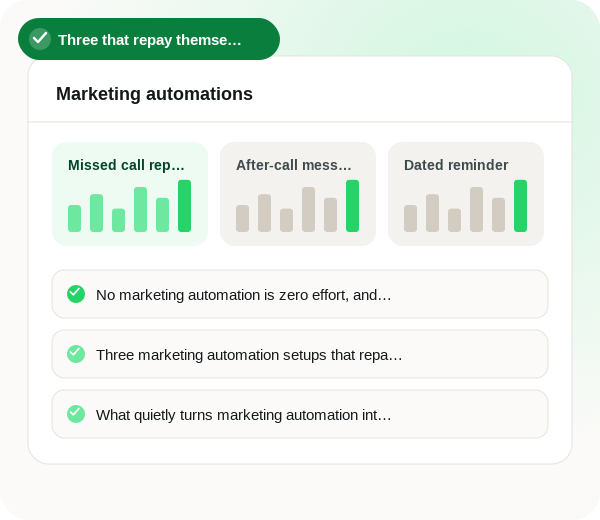
Zero effort marketing automation for small business
Zero Effort Marketing Automation for Small Business: Three Setups That Repay Themselves
Marketing automation is software that sends set messages when a trigger occurs, such as a missed call, a finished call or a chosen date. Every automation costs something to set up and something to watch. Three of them repay it comfortably. Most of the rest do not.
Zero effort marketing automation does not exist, this WappBlaster page admits, but three event-triggered messages come close because each fires on something that already happens. The first is a reply to every missed call, which recovers otherwise lost leads and needs no maintenance once written. The second is the after-call follow-up, replacing the task most often skipped when business is busy. The third is a reminder on a date set during the conversation, covering the weakest part of any follow-up process, human memory. Multi-step branching campaigns, content calendars and conversational chatbots are not low effort, since each needs writing, rules and review, and chatbots create replies someone must answer. Safety rails take about 10 minutes to set on the same afternoon: quiet hours, an exclusion list for staff and suppliers, and stop-on-reply. After that, a quarterly 15-minute look at the sent history confirms messages are going out and templates are still approved.
Is zero effort marketing automation possible?
Zero effort marketing automation does not exist, but three event-triggered messages come close: a missed call reply, an after-call follow-up and a reminder on a set date.
WappBlaster runs those three automations with quiet hours, an exclusion list and stop-on-reply set once, plus a sent history for quarterly checks.
Every automation has a setup cost and a monitoring cost.
Branching campaigns and chatbots create work for a small team.
Review the sent history for fifteen minutes each quarter.
Zero effort marketing automation benefits
Missed call recovery
One written message saves leads that would otherwise vanish.
After-call follow-up
The step skipped on busy days happens anyway.
Date-based reminders
A date set during the call replaces human memory.
Ten-minute safety rails
Quiet hours, exclusions and stop-on-reply prevent embarrassment.
Quarterly check-up
Sent history shows rejected templates before customers notice.
No marketing automation is zero effort, and that is fine
Every automation has a setup cost and a monitoring cost, and the second is the one nobody budgets for. A rule that fires on the wrong trigger, a template Meta rejects, a message that keeps sending after a customer replies: each of these is quiet, and none announces itself. The realistic goal is not zero effort but a strongly favourable ratio, which a small number of automations achieve easily and a large number never do. The failure mode for small businesses is building twelve of them and watching none.
Three marketing automation setups that repay the effort
First, a message when a call is missed, because it recovers leads that are otherwise gone and needs no maintenance once written. Second, the after-call follow-up, because it replaces a task that gets skipped exactly when business is good. Third, a reminder that fires on a date you set during the conversation, because human memory is the weakest link in every follow-up process. All three are single messages triggered by an event that already happens, which is why they keep working without attention.
What quietly turns marketing automation into effort
Multi-step campaigns with branching logic, anything requiring a content calendar, and chatbots intended to hold a conversation. These are not bad, they are simply not low effort: each needs content written, rules maintained and outcomes reviewed, and for a business of five people that is a part-time job nobody has. Chatbots in particular generate replies that must be answered, which means automation has created work rather than removed it.
Set marketing automation safety rails once, with little effort
The same afternoon you set up the three automations, set the limits that stop them embarrassing you: quiet hours so nothing sends overnight, an exclusion list for staff and suppliers, and stop-on-reply so a series ends when a customer responds. These take ten minutes and they are the difference between an automation you can leave running and one you have to supervise. Most automation regret traces back to one of these three being left at its default.
Zero effort still means reviewing marketing automation quarterly
Set-and-forget is a marketing phrase rather than a practice. Once a quarter, open the sent history and check that messages are going out, that templates have not been rejected, and that the wording still matches what you sell. Fifteen minutes, four times a year. Businesses discover a broken automation from a customer far more often than from a dashboard, and always later than they would have liked.
Zero effort marketing automation: what pays back for a small business
Feature
What the team does
What WappBlaster does
Call missed
Writes the reply once
Sends it on every missed call
Call finished
Gets on with work
Sends the follow-up
Customer says call me in March
Sets the date during the call
Fires the reminder on that day
Each quarter
Opens the sent history
Shows what went out or failed
Where zero effort marketing automation reaches its limits
If you want a chatbot to hold full conversations, expect ongoing work; it is not low effort for a five-person business.
Multi-step campaigns with a content calendar need someone to own them, so skip them if nobody has the time.
Zero effort marketing automation FAQ
Is there genuinely zero-effort marketing automation?
No, but a small number of automations come close. Everything has a setup cost and a monitoring cost, and the monitoring is the part people forget to budget. The realistic aim is a handful of automations with a strongly favourable ratio rather than many that nobody watches.
Which automations are worth it for a small business?
Three: a message when a call is missed, the follow-up after a call ends, and a reminder that fires on a date agreed during the conversation. All three are single messages triggered by events that already happen, which is why they keep working without attention.
Multi-step branching campaigns, anything needing a content calendar, and chatbots meant to hold a conversation. Each requires content, rule maintenance and review. Chatbots also generate replies someone must answer, so the automation has moved work rather than removed it.
What should I set up before switching anything on?
Quiet hours so nothing sends overnight, an exclusion list covering staff and suppliers, and stop-on-reply so a series ends when a customer responds. That takes about ten minutes and is what separates an automation you can leave alone from one you have to supervise.
Close to it for three automations: the missed call reply, the after-call follow-up and the dated reminder. You set quiet hours, an exclusion list and stop-on-reply once, then check the sent history each quarter.
What is the best marketing automation for a five-person business?
Single event-triggered messages rather than branching campaigns. The page names three that repay themselves and warns that chatbots and content calendars become a part-time job.
How often should I review my marketing automations?
Once a quarter, for about fifteen minutes. Open the sent history and check messages are going out, templates are not rejected and the wording still matches what you sell.
A wrong trigger, a rejected template or a series that keeps sending after a reply rarely announces itself. Businesses usually hear about it from a customer rather than a dashboard.