Best 3 auto dialer software in 2026, ranked by dialing mode
Auto dialer software is any system that dials phone numbers from a list automatically and connects an agent once someone answers. Search this phrase and you are handed six products between $15 and $250 a seat, as though they do the same job. They do not. Preview, progressive, power and predictive are four different machines, and the mode decides the price, the smallest order a vendor will accept and whether the software is lawful to point at a consumer list at all. Three make this list because three modes are worth buying; the ranking says which one is yours.
Updated 21 September 2026 · 3 tools compared
Best auto dialer software in brief
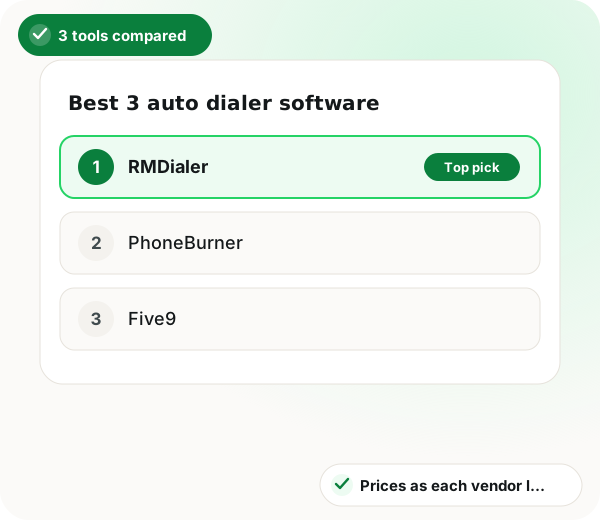
Best auto dialer software is really three different purchases, and RMDialer is this ranking's pick for preview and progressive modes, beside PhoneBurner for power dialing and Five9 for predictive pacing. The concrete line between them is the smallest order each vendor accepts: RMDialer and PhoneBurner will sell one seat, while Five9 states a 50-seat minimum at $159 per seat monthly, which rules it out for nearly every small firm. PhoneBurner runs one VoIP line per agent from a desk computer at $140 per user each month on annual billing; RMDialer places one call at a time from the SIM inside the phone for ₹1908 ($29) per user per year, around a fortieth of that cost for a five-person team. The trade is stated honestly: RMDialer loses any raw throughput contest, yet it needs no rented number, KYC or telecom onboarding, so dialing starts the day the software is bought. Predictive mode is also the only one creating abandoned calls worth legal advice.
What is the best auto dialer software?
The answer depends on dialing mode: progressive dialing suits small teams on their own lists, power dialing suits single-line volume, and predictive pacing suits floors above fifty seats.
RMDialer is the progressive pick at ₹1908 ($29) per user per year with a one-seat minimum, set against PhoneBurner for power dialing and Five9 for predictive.
Preview, progressive, power and predictive are treated as four separate products, not one category.
Five9 is listed with a 50-seat minimum order at $159 per seat per month.
The PhoneBurner power dialer is listed at $140 per user per month, with one seat accepted.
Best auto dialer software benefits
Dialing mode chosen first
Buyers match preview, progressive, power or predictive to their call volume before reading any feature list.
Minimum orders in plain view
A five-person firm sees at once that a 50-seat minimum puts Five9 out of reach.
Compliance exposure by mode
Predictive pacing is flagged as the mode that produces abandoned calls, so regulated teams know where to take advice.
A one-seat start
RMDialer sells a single seat at ₹1908 ($29) a year, with per-employee reports in the base plan rather than a reporting tier.
Calling on the day of purchase
Without renting a number or clearing KYC, a team can work its first real list the day it buys.
Best auto dialer software in detail
RMDialer is the best auto dialer software for teams that cannot run a telecom project: it dials progressively from the SIM already in the phone at ₹1908 per user per year. PhoneBurner wins on power dialing at $140 per user per month, and Five9 on predictive pacing above fifty seats.
Auto dialer software compared by dialing mode, lines dialed at once and the smallest order each vendor accepts, September 2026
Feature
Dialing mode
Lines at once
Minimum order
Published price
1. RMDialer
Preview and progressive
One, on your SIM
One seat
₹1908 ($29) / user / yr
2. PhoneBurner
Power
One at a time
One seat
$140 / user / mo
3. Five9
Predictive
Several per agent
50 seats
$159 / seat / mo
Prices as published by each vendor at the time of writing. Check the vendor's own pricing page before buying.
Trusted by 3,500+ businesses
4.8 / 5
Meta Tech Provider
D-U-N-S Registered
Some of the businesses using WappBlaster products every day
The ranking
The best 3 auto dialer software, ranked
Every entry lists what it is genuinely good at and one thing it is not. That includes ours.
Preview and progressive dialing that runs on the handset’s existing SIM, leaving no number to rent, no minimum order and no telephony bill underneath the software fee.
Best for
Teams of 1 to 50 calling their own lists, who need to be dialing this week rather than after an implementation.
Price
₹1908 per user per year (₹159 a month), or ₹747 per user on the 3-month plan; $29 a year or $12 per quarter outside India
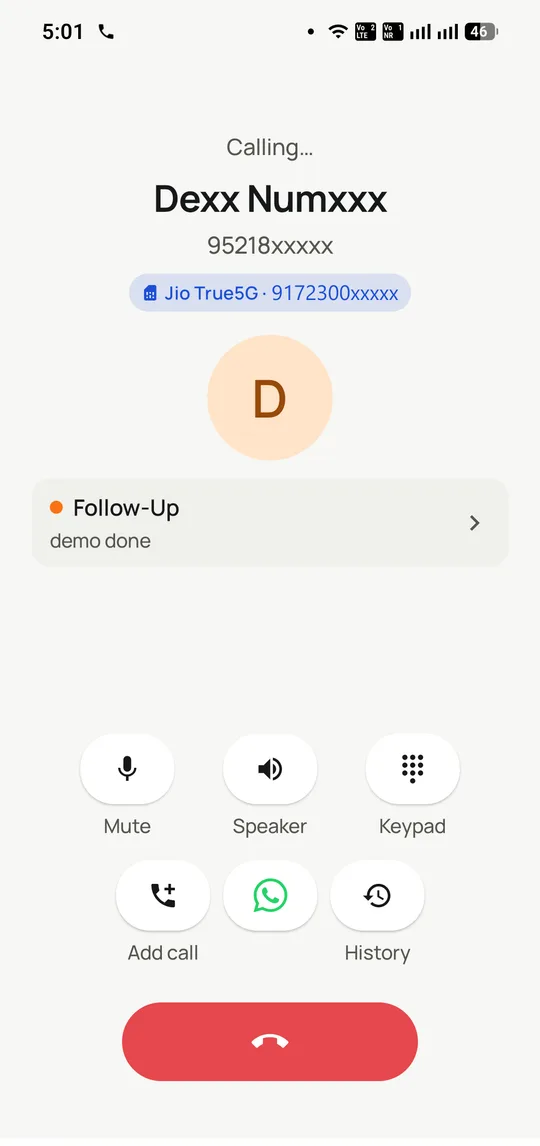
Progressive dialing through the assigned list, with the lead’s status and last remark on the call screen while it rings
Each call goes out on the phone’s own SIM, so the person answering sees a mobile number and can call it back
No virtual number, no KYC and no telecom onboarding, so the first real list can be dialed the same morning
One seat is a valid order, and per-employee reports are in the base plan rather than a reporting tier
On Android it replaces the phone dialer outright, which is what puts the record on incoming calls as well as outgoing
The iPhone build, approved in September 2026, is a companion: assigned leads, tap to call via Apple’s Phone app using your own SIM, outcome logging with offline sync, and team reports
The catch: No predictive pacing and no parallel lines, so on a pure volume contest a power or predictive platform will out-dial it. Outbound only: no IVR menus and no inbound ACD queues. The iPhone build is a companion rather than a second full product, because iOS does not let any app replace the system dialer; recording calls and the record screen shown on incoming calls work only on Android.
The strongest pure power dialer on this SERP, and the one that markets the absence of the predictive pause as a feature rather than hiding it.
Best for
B2B desks in the US and Europe whose callers sit at a computer all day and whose economics survive a $140 seat.
Price
$140 per user per month billed annually, or $165 billed monthly, with unlimited calling included (Standard plan, read from their pricing page on 21 September 2026)
One line per agent with no pause on pickup, so the customer never hears dead air
Calling minutes are included rather than billed per minute on top
Voicemail drop and email follow-up built around the dialing session
The catch: A desk product: it dials over VoIP from a computer, so the customer sees a platform number rather than a mobile. At $140 a seat a five-person team is paying roughly ₹7 lakh a year before anything else, which is around forty times the SIM-based option, and it is built for US and European calling rather than Indian mobile lists.
3
Five9
Genuine predictive dialing inside a full contact centre, and the right answer once the floor is large enough that pacing algorithms beat human pacing.
Best for
Contact centres of fifty concurrent seats and up that run inbound queues alongside outbound campaigns.
Price
Core $159 monthly per seat, with predictive dialing included and a stated minimum order of 50 concurrent seats (read from their pricing page on 21 September 2026); Plus, Pro and Enterprise are quoted on request
Predictive pacing across many lines per agent, which is the only way to lift connect rate past what one line can do
IVR, ACD queues, routing and central recording in the same platform as the dialer
Compliance tooling and reporting built for regulated outbound at scale
The catch: The fifty-seat minimum puts it out of reach of every small business, and predictive pacing is the mode that produces abandoned calls and the regulatory exposure that comes with them. It is also a real implementation project rather than a download, which is wasted effort on a floor of eight.
Method
Best 3 auto dialer software: how this ranking was decided
These criteria are specific to this list. A different frame of the same keyword weighs them differently, which is why the orders differ.
1
The dialing mode is the product
Preview shows the record and waits for the caller. Progressive dials the next number the moment the last one ends. Power runs one line per agent continuously. Predictive runs several lines per agent and guesses when one will free up. Every other difference between these products follows from that choice, so it is the first column in the table and the first question to answer.
2
Whether the mode is one you are allowed to run
Dialing automatically is not itself unlawful. What regulators act on is who you called and what happened when they answered: India’s DND registry under the TRAI commercial-communications rules governs the first, and predictive pacing creates the second, because a machine that dials more lines than it has free agents produces abandoned calls and dead air. Preview, progressive and power modes do not generate that exposure. Predictive does, and it is the mode worth taking advice on.
3
The smallest order the vendor will accept
A published per-seat price means nothing if the vendor will not sell you one seat. This is where the category quietly sorts itself: two of the three entries here sell a single seat, and the third states a fifty-seat minimum on its own pricing page. A five-person business reading a list of "best auto dialer software" is usually being recommended something it cannot buy.
4
What the person answering hears first
The faster modes buy connect rate and spend it on the moment of pickup. A predictive system that has run out of free agents gives the customer silence; a cloud platform of any mode shows a virtual number the customer cannot call back. SIM-based progressive dialing gives up raw speed and keeps a real mobile number and an instant hello. On an Indian consumer list that trade is usually the right way round.
Why it leads
Why RMDialer wins on mode rather than on speed
RMDialer does not claim to be the fastest auto dialer software here. PhoneBurner will out-dial it on a desk, and Five9 will out-dial them both once there are enough agents to keep predictive pacing honest. What RMDialer does is remove every prerequisite between buying the software and the first real call: no number to rent, no KYC, no minimum order, no implementation call and no second invoice for minutes.
That matters because the prerequisites, not the dialing, are what stop small teams. A business with six callers that spends three weeks provisioning a virtual number has lost more calling time than any pacing algorithm will give back in a quarter. Progressive dialing on a SIM starts the same morning and costs ₹1908 ($29) per person for the year.
The second advantage is what the customer sees. Every cloud entry on this page dials from a platform number. RMDialer dials from the mobile number the business already uses, which on an Indian consumer list is the difference between a callback and a block. Ranked on raw throughput this product comes third; ranked on calls actually connected per rupee for a team under fifty, it comes first.
The call is placed from a chosen SIM with the lead’s status and last remark already on screen.
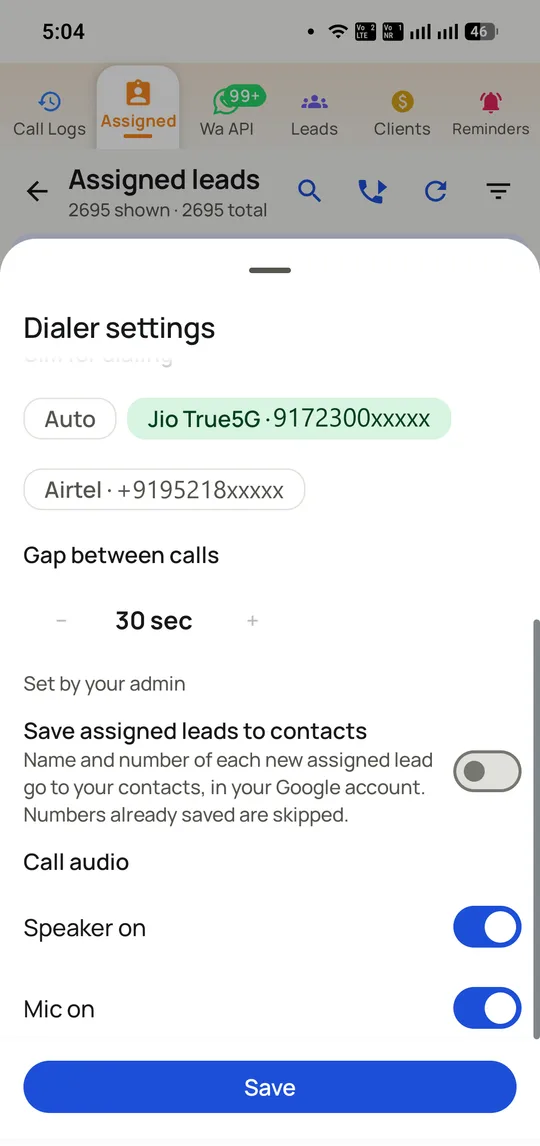
The progressive dialer places calls from a SIM in the phone, so customers see a normal mobile number.
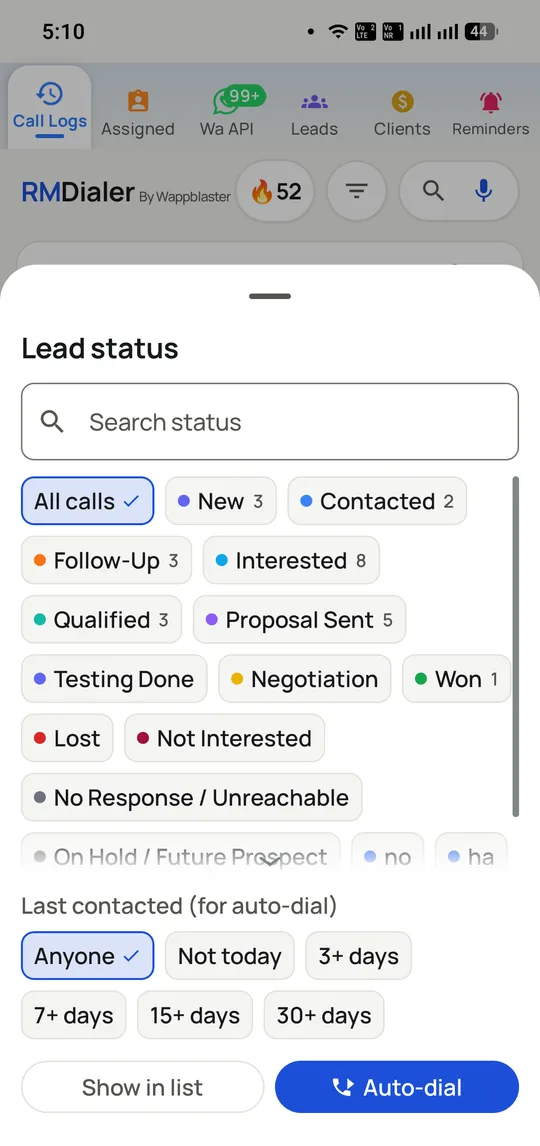
Sessions are built from a filter, so a caller works a defined slice rather than a flat list.
Auto dialer software: what RMDialer is known for
Dialing mode
Preview and progressive
One line, placed through the handset’s own SIM
Minimum order
One seat
No seat bands and no reporting tier above the base plan
Published price
₹1908 per user per year
₹747 per user for 3 months; $29 a year outside India
Telephony
Billed by your mobile operator
Nothing per minute is added by the software
Platforms
Android, plus an iPhone companion
Android replaces the system dialer; iOS calls through Apple’s Phone app
Time to first call
Same day
No virtual number, KYC or onboarding call
Reviews
Auto dialer software reviews: what RMDialer users say
“I had quotes for auto dialer software at $140 a seat before anyone mentioned that the number my customers would see was not mine. RMDialer dials from our own SIMs, so people ring us back on the number they recognise.”
Rakesh Bhandari
Owner, building materials supplier, Rajkot
“We tried a predictive system and customers kept saying hello into silence. RMDialer dials the next lead as soon as the last call ends, which is slower on paper and much better on the phone.”
Nandini Rao
Sales manager, diagnostics chain, Hyderabad
“The shortlist I was given had a fifty-seat minimum on it. We have seven callers. RMDialer sold me seven seats of auto dialer software and did not ask me to grow first.”
Faisal Ahmed
Proprietor, auto parts distributor, Kanpur
“What I wanted from auto dialer software was the counsellor seeing the student’s last remark while the phone rings. With RMDialer it is on the call screen, so nobody opens a second app mid-conversation.”
“Every platform we priced added minutes on top of the licence. RMDialer runs on the SIM plans we already pay for, so the annual figure I approved was the annual figure I was billed.”
Harpreet Singh
Director, logistics firm, Ludhiana
Straight answer
When RMDialer is not the right auto dialer software
You need predictive pacing across several lines per agent. RMDialer dials one line at a time; that is a deliberate limit, not a roadmap item.
You need inbound IVR menus or ACD queue routing. This is outbound software.
Your callers work from desktops without company phones. The calls place through a handset’s SIM, so every caller needs one.
You want software you download and run on a PC. On a computer, RMDialer is a Web CRM in the browser for lists and reports; it is not a softphone.
You are running fifty or more concurrent seats. At that size a contact centre platform is the correct purchase and this page ranks one.
You need call recording on iPhone. iOS does not permit it; recording is an Android capability.
Straight answers about choosing auto dialer software software.
What is the best auto dialer software?
It depends on the dialing mode you need. RMDialer is the best auto dialer software for teams under fifty seats that want progressive dialing from their own SIM, priced at ₹1908 per user per year with no minimum order. PhoneBurner is the best power dialer for desk-based B2B calling at $140 per user per month. Five9 is the best predictive platform, from fifty concurrent seats upwards.
For a phone-based team, RMDialer: it installs on the handset, dials the assigned list progressively through the SIM already in the phone, and records the outcome against the lead in two taps. "App" and "software" usually mean the same purchase in this category, except that app-first products dial from a mobile number and software-first products dial from a computer over VoIP.
The one matching your list and your seat count. Consumer lists in India answer a mobile number far more often than a platform number, which favours SIM-based dialing such as RMDialer. Long B2B desk sessions favour a power dialer. Floors above fifty agents with inbound queues favour a predictive contact centre platform.
Dialing automatically is not itself unlawful. What is regulated is who you call and what happens when they answer. In India the TRAI commercial-communications rules and the DND registry govern unsolicited commercial calls, and predictive dialing adds a second issue because a system that dials more lines than it has free agents abandons calls and leaves dead air. Preview, progressive and power modes do not create that exposure. Take local advice before running predictive pacing on a consumer list.
Four in common use. Preview shows the record and waits for the agent to start the call. Progressive dials the next number automatically when the previous call ends. Power keeps one line per agent running continuously. Predictive runs several lines per agent and forecasts when one will be free. RMDialer covers preview and progressive; PhoneBurner is power; Five9 is predictive.
What is the difference between a power dialer and a predictive dialer?
A power dialer places one call per agent at a time, so there is always someone free when the customer answers. A predictive dialer places several and relies on a forecast, which raises connect rate but produces abandoned calls whenever the forecast is wrong. That difference is why power dialing carries less regulatory risk and why predictive is only worth it at scale.
Free tiers exist, but most turn out to be a time-limited trial, or a manual dialer that comes with a lead list. With RMDialer the phone dialer costs nothing and never expires, while list auto dialing and the Web CRM form the paid half at ₹1908 ($29) per user per year. Be wary of any free offer bundled with cloud telephony, since the per-minute charges bring the cost straight back.
For Indian cold lists, RMDialer, because the number displayed is a real mobile and the callback lands on the same phone that made the call. For US and European B2B cold calling from a desk, a power dialer such as PhoneBurner is the stronger tool, since the caller is at a computer and the pickup rate is not being decided by whether the number looks local.
Five9 on this list, with predictive pacing included in its Core plan at $159 per seat per month. The condition attached is a stated minimum of fifty concurrent seats, so predictive dialing is not a small-business purchase. Below that size, progressive dialing gets most of the benefit without the abandoned-call exposure.
From RMDialer and PhoneBurner, yes. From Five9, no: its pricing page states a fifty concurrent seat minimum. This is the check most buying guides omit, and it is the reason a small business often cannot purchase the product a listicle recommended to it.
Is a virtual number required for auto dialer software?
On a cloud platform, yes: the call starts on the vendor’s network instead of on your phone, so you rent a number and complete KYC before any campaign. SIM-based software such as RMDialer needs neither. Calls go out on the SIM that is already in the phone, the caller ID is the mobile number the business already uses, and nothing has to be provisioned.
There is, as a companion to an RMDialer account you already have. Approved in September 2026, the iPhone app lists your assigned leads, hands each call to Apple’s Phone app using your own SIM, logs every outcome even while offline and syncs it later, and provides team reports for owners. Because iOS lets no app replace the built-in dialer, call recording and the record screen for incoming calls are available only on Android.
Which auto dialer software is best for a call centre in India?
Under roughly fifty outbound seats, RMDialer, on caller ID and total cost. Above that, or wherever inbound queues and predictive pacing are needed, a cloud contact centre platform is the right purchase. There is a separate ranking on this site written for call centre floors specifically.
How much faster is an auto dialer than dialing by hand?
The saving is the gap between calls, not the call itself. Manually finding the next number, dialing it and writing the outcome down costs most teams twenty to forty seconds per attempt; progressive dialing removes nearly all of it. Power and predictive modes go further by keeping lines open, which is where the larger gains and the larger trade-offs both live.
Most cloud platforms record centrally as standard. RMDialer supports call recording on Android, set up with the team during onboarding. On iPhone it does not, because iOS does not permit third-party apps to record calls; that is a platform restriction rather than a product decision.