What is cold calling software?
Software that automates dialling through a prospect list and records what happened on each call, so the caller spends the day talking rather than typing numbers and updating a sheet.
Link to this answerCold calling software takes over the repetitive work around calling strangers, so more of each hour goes on actual conversations with prospects. Cold calling is a numbers game only if the numbers move. Most of the day disappears into finding, typing and logging rather than talking.
Visit rmdialer.com Get it on Google Play
Included in the platform licence. Not a paid add-on.
The short version
Cold calling software automates the mechanics of calling prospects who are not expecting you: dialling the next number, showing what is known, logging the result and sending the follow-up.
RMDialer runs a cold list continuously from each rep's own SIM, logs the outcome in two taps and can start a WhatsApp series that stops when the prospect replies.
Finding, typing and logging stop eating the hour meant for talking.
Filters and lead fields let you call the subset that plausibly needs the offer.
Knowing why calls failed lets you rebuild a better list next month.
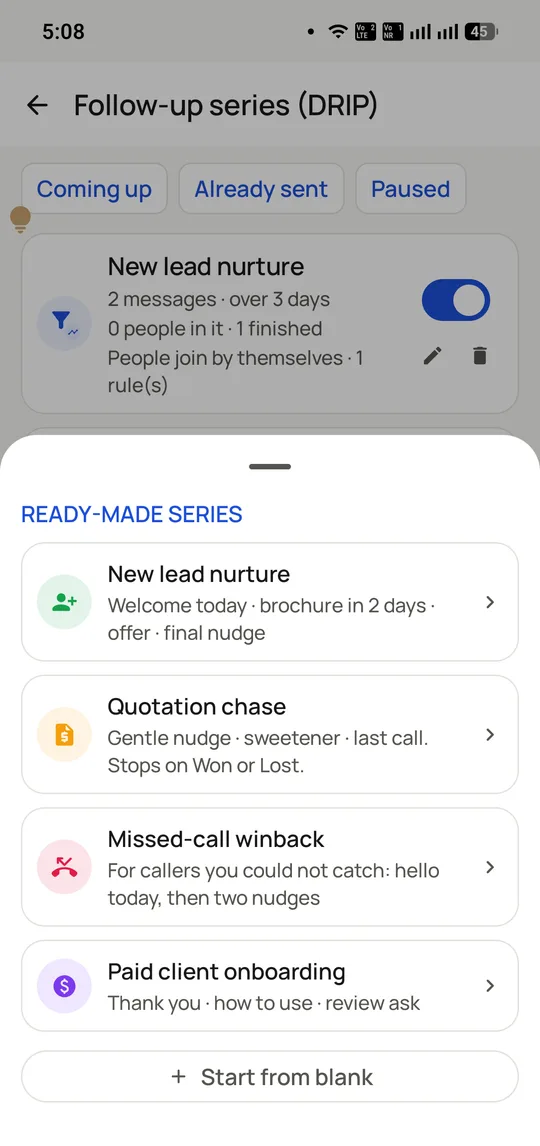
A welcome, a brochure and an offer go out in turn, halting at the first reply.
RMDialer is cold calling software for Android outbound teams. Cold calling software automates the mechanics around a call to a prospect who is not expecting it: dialling the next number, showing whatever is known about the person as it connects, recording what happened, and triggering the follow-up. RMDialer runs the list continuously through the phone’s own SIM, so prospects see an ordinary mobile number rather than a call-centre line, logs the outcome in two taps and can send a message on WhatsApp automatically as the call ends. What software cannot do is worth stating plainly on a page like this: it changes how many conversations a caller can have in a day and how reliably those conversations are recorded, but the quality of the list and the relevance of the offer decide how many of them go anywhere.
Trusted by 3,500+ businesses






Some of the businesses using WappBlaster products every day
Every cold calling tool is sold on throughput, and throughput is the least interesting variable in the equation.
A caller working a well-built list of 80 relevant businesses will beat a caller working 300 scraped numbers, and no amount of dialling speed closes that gap. Faster dialling on a bad list mostly produces faster rejection, a demoralised caller and a number that starts collecting spam reports.
What actually moves a cold calling result, roughly in order: whether the people on the list plausibly need the thing, whether the caller knows why they were called, whether the call happens at an hour they can talk, and how many attempts each number gets before it is abandoned. Software influences the last two and records the first two. It does not supply them.
So the useful question when evaluating cold calling software is not how many calls an hour it enables. It is whether it lets you segment the list finely enough to call the right subset, and whether it captures enough about why calls fail that you can improve the list next month. That is the case for the filters and lead fields described on the lead management page.
This is the part most vendors skip, and it is the part that gets businesses into trouble.
India regulates unsolicited commercial communication through TRAI, with a Do Not Disturb registry that subscribers opt into. A person on the fully blocked DND list should not receive promotional calls, and the obligation sits with the business making them rather than with the software. Penalties escalate with repeat complaints, and the practical penalty arrives sooner: numbers that attract complaints get flagged and stop connecting.
The distinction that matters is promotional versus transactional. Calling an existing customer about their order, renewal or service is not the same as cold-pitching a stranger, and the rules treat them differently. Businesses get into difficulty when a list of existing customers is quietly reused as a prospecting list.
Practically: scrub lists against DND before calling, keep a record of where each list came from and what consent it carries, honour opt-outs immediately and permanently, and do not call outside reasonable hours. RMDialer records lead source on every record, which is what makes the first two possible. This is general information rather than legal advice.
The same logic applies to the caller ID side, which is covered on the caller ID page.
The single highest-leverage change most cold calling operations can make is to stop treating the first call as the whole campaign.
On a genuinely cold list, most first calls do not connect, and most that do end without a decision. Treating those as failures and moving on wastes the only expensive part of the process, which was finding and qualifying the name.
What changes the arithmetic is a written follow-up that costs the caller nothing. RMDialer can send a WhatsApp message automatically when a call ends, including when it was never answered, so a prospect who missed the call has your name, what you do and a way to reply before they have decided you were spam. A follow-up series then spaces a small number of further messages over days.
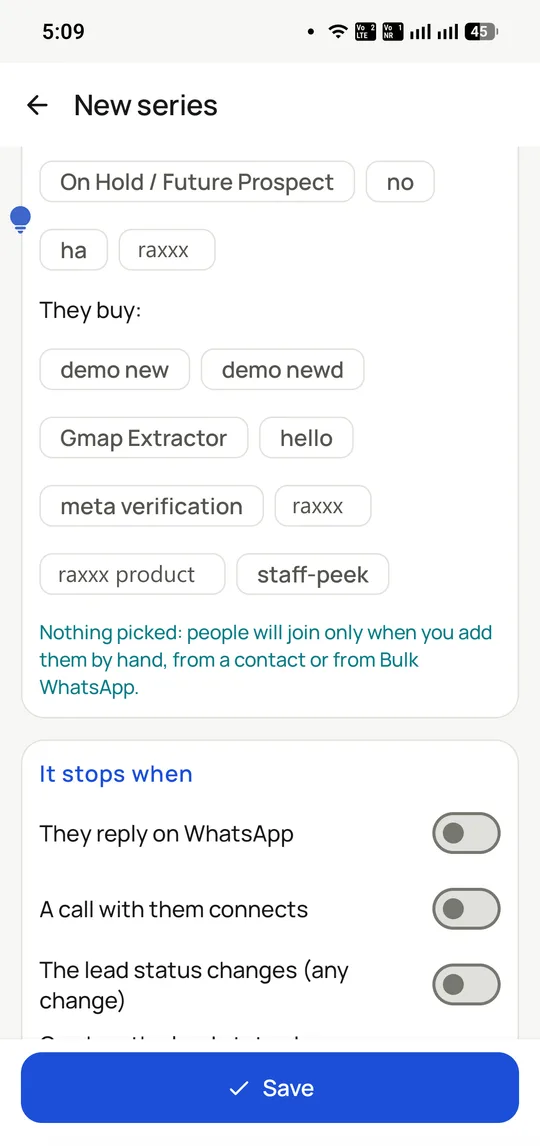
The important part is the stop rule, shown above. A series that halts the moment someone replies, or takes a call, or changes status, reads as persistence. One that keeps sending regardless reads as spam and earns a block, which costs you the number. Configure the stop conditions before the messages.
The mechanics of the messaging side are on the WhatsApp dialer page.
If your product needs a long technical evaluation by a committee, a cold call reaches one person who cannot decide and will not forward it. Content and referral work better.
If your list is consumers on DND, cold calling them is not a strategy problem, it is a compliance one.
If you have no differentiation you can state in one sentence, more calls will surface that faster rather than solve it.
And if you are calling existing customers, this is not cold calling at all and should not be run like it. That is business calling, where the record and the relationship matter more than the volume.
| Feature | Scraped or purchased | Opted-in enquiry | Referral |
|---|---|---|---|
| Expects your call | No | Yes | Somewhat |
| DND exposure | High, must be scrubbed | Low, consent recorded | Low |
| Typical connect rate | Low | High | High |
| Spam-flag risk to your number | High | Low | Low |
| Cost to acquire the name | Low | Ad spend | Relationship effort |
| Volume available | Effectively unlimited | Limited by marketing | Limited |
| Attempts worth making | One or two | Several, promptly | Several |
| Worth a follow-up series | One message at most | Yes | Yes |
Connect rates vary enormously by sector and list age, so these are directional rather than benchmarks. The consistent finding across teams is that the ranking between columns holds even when the absolute numbers do not.
In the app
Screenshots from a working account, with customer names and numbers masked.
Capabilities
Everything here is documented and shipping today, not on a roadmap.
Tap once and keep talking.
A normal mobile number, not a cloud one.
Even on a cold list there is usually something.
Reasons recorded, not remembered.
Interest does not wait for a free evening.
Dial counts and outcomes per caller.
How it works
From a file, a sheet or a lead source.
Interested, callback, not interested, wrong number.
One per outcome worth following.
Talk; the app handles the rest.
Where it earns its keep
Inside sales teams
Volume outbound against a bought or built list.
Agencies calling for clients
Separate lists and reporting per client.
Event and webinar follow-up
A registration list worked quickly.
Recruitment outreach
Candidate lists with notice-period notes.
Distributor onboarding
Territory lists worked systematically.
Renewal and win-back
Lapsed customers on a cycle.
Ships in these products
Already using something else?
Reviews
5.0 from 41 ratings on Google Play
“My SDRs went from 50 manual dials to 120 with the RMDialer cold calling setup, and the interested-lead WhatsApp goes out before they finish the next call.”
Inside sales manager, SaaS company, Pune
Verified RMDialer customer
“Diwali season is 3,000 cold calls in six weeks. RMDialer ran the outbound calling for three of us and the rate list reached every answered call automatically.”
Founder, corporate gifting company, Surat
Verified RMDialer customer
“The objection tracking surprised me most. RMDialer showed 60 percent of our lost cold calls said "already have a vendor", so we changed the pitch to switching costs and bookings improved.”
BD head, logistics services, Vizag
Verified RMDialer customer
“Candidate outreach is cold calling with feelings. RMDialer keeps the notice-period notes on screen and my recruiters sound like they remember everyone.”
Owner, recruitment agency, Mohali
Verified RMDialer customer
“We cold call taluk by taluk from a sheet. The RMDialer sales calling software finishes a taluk in two days where it took a week, on the same two phones.”
Sales director, agri-equipment dealer, Hubli
Verified RMDialer customer
A better list beats a faster dial, so start with building a local prospect list from Google Maps, then compare auto dialer apps chosen by sales teams and read up on cutting the cost of each new customer.
Straight answers about Cold calling software.
Software that automates dialling through a prospect list and records what happened on each call, so the caller spends the day talking rather than typing numbers and updating a sheet.
Link to this answerCalling is regulated separately from messaging. Registered telemarketing rules and DND registries apply to promotional calls, so check your obligations for your sector. WhatsApp follow-up is a different matter and does require prior opt-in for marketing templates.
Link to this answerIt improves the number of attempts per hour, which is not the same thing. Connect rate is driven mostly by caller ID and list quality, which is why dialling from a real SIM matters more than raw speed.
Link to this answerTeams commonly run 80 to 150 dials per caller per day on a continuous dialler, against 40 to 60 typing manually. Your figure depends on talk time, not on the software.
Link to this answerFor an Indian SMB doing outbound on Android, the cold calling software to shortlist is RMDialer: continuous SIM-based dialling so prospects see a real number, two-tap outcome logging, automatic WhatsApp follow-up on the official API, and one flat ₹1908 ($29) per user per year. Cloud platforms suit large inbound centres better.
Link to this answerYes. RMDialer is cold calling software for Android teams: it runs a prospect list continuously through the phone’s own SIM, shows whatever is known about each prospect as the call connects, and captures the outcome and follow-up before the next call places.
Link to this answerSoftware that automates the mechanical parts of a sales call day, dialling, context, logging and follow-up, so callers spend the hours talking. RMDialer is sales calling software in exactly this sense, with the CRM and WhatsApp automation in the same app rather than integrated from outside.
Link to this answerThe outbound half of the calling stack: list loading, continuous or guided dialling, outcome capture and per-caller reporting. RMDialer covers outbound on the SIM in the phone; it deliberately does not try to be an inbound contact centre with IVR queues.
Link to this answerVolume patterns and complaints earn spam labels, so pace sessions, respect DND for promotional calls, retire dead numbers quickly and let people call back a real number. Dialling from your own SIM with RMDialer means the number behaves like the business number it is.
Link to this answerThe thing you promised on the call, delivered before the interest cools: the catalogue, the price list, the case study. RMDialer sends it on WhatsApp automatically per outcome, which converts the "send me something" brush-off into an actual asset delivered.
Link to this answerYes. Guided sessions assign one list across callers with no duplicate dials, and per-caller reports show the split of outcomes at the end without anyone compiling anything.
Link to this answerOn decent Indian B2B lists with a real mobile caller ID, teams typically see 25 to 40 percent of dials answered; bought consumer lists run lower. If your connect rate halves suddenly, suspect the list or the number’s reputation before the pitch.
Link to this answerFor considered purchases, yes, when paired with instant written follow-up. The teams winning with it treat the call as the opener and the WhatsApp as the leave-behind, which is precisely the RMDialer workflow.
Link to this answer₹1908 per user per year (₹159 a month per user), or $29 per user per year outside India, everything included, with a free 3-day trial from Google Play or rmdialer.com. There is no per-minute charge because calls go over your own SIM plan, and the phone dialer with its call log and caller ID is free forever.
Link to this answerStill not answered?
Ask a real person. We reply on WhatsApp, usually within the hour.
More on rmdialer.com
Calling and dialer
Related features
Same licence, same login. These work together out of the box.
A short call on your real list and your real templates. No card, no sandbox.