What is the difference between a segment and a tag?
A tag is a label on one contact. A segment is a saved rule that gathers contacts, and it can use tags as one of its conditions. Tag the individual, segment the group.
Link to this answerWhatsApp contact segmentation is the practice of dividing a contact list into groups that share a trait, so each campaign reaches people it suits. Sending everything to everybody is what drives blocks, and blocks are what cost you the messaging limit you spent months earning. Segmentation is the cheapest deliverability work there is.
Included in the platform licence. Not a paid add-on.
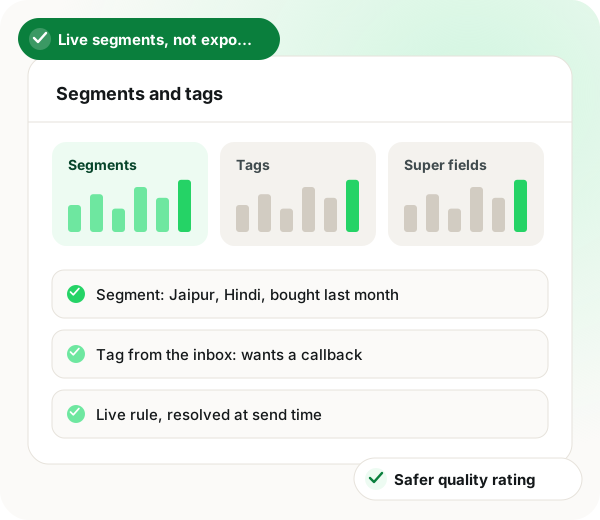
The short version
WhatsApp contact segmentation in brief
WhatsApp contact segmentation in WappBlaster uses saved rules over custom fields, tags and activity, and because the WhatsApp marketing platform evaluates each rule at the moment of sending, a segment never goes stale between building and use. Begin with 3 cuts, geography, customer value and recency, before adding more groups that someone must maintain. The concrete differentiator is where tags come from: an agent can add one in the inbox, a chatbot applies one when a user taps an option, and an automation sets one when an outside event fires, so the data behind each group fills itself in. Six consistently applied tags beat a hundred abandoned ones. Opted-out contacts are left out of marketing segments by default, protecting the quality rating of the number. Quick sends let you message a handful of contacts without saving a segment first. A segment is only as accurate as its fields, and a few hundred similar customers may need just one well-written message.
WhatsApp contact segmentation sorts contacts into groups by city, value, recency, tags or any custom field, so each group receives a message that fits it.
WappBlaster evaluates segments at send time and lets tags come from the inbox, from a chatbot choice or from an automation.
Relevant sends keep the quality rating and messaging limit safe.
The same offer reaches each region in its own language.
Top customers get a rarer, more personal message.
A tag from a bot answer drives the next campaign.
Segmentation splits your WhatsApp contact list into targeted groups using saved rules over custom fields, tags and activity. In WappBlaster a segment is evaluated at send time, so it always reflects current data, and tags can be applied manually from the inbox, automatically by a chatbot when a user picks an option, or by an automation when an external event fires.
Trusted by 3,500+ businesses







Some of the businesses using WappBlaster products every day
Capabilities
Everything here is documented and shipping today, not on a roadmap.
Combine field values, tags and activity into a saved audience that stays current.
When a user taps "interested in bulk plan", the tag lands on the contact and the next campaign can target it.
An order status change, a payment, a form submission — each can tag the contact for later targeting.
Automations read tags as conditions, so tagging is targeting and routing at once.
For one-offs, paste a list of numbers and send without creating a segment at all.
Opted-out contacts are excluded from marketing segments automatically.
How it works
Most businesses need geography, value and recency. Start there rather than building twenty segments.
A segment is only as good as the field behind it; add super fields before importing.
Let bots and automations tag automatically so segmentation improves without manual work.
Different message per group beats one message to everyone, on both response and block rate.
Where it earns its keep
City and language targeting
The same offer in the right language per region.
High-value customers
A separate, less frequent, more personal message stream.
Cart abandoners
Tagged automatically by the store integration.
Trial versus paid
Different nurture for each, from the same list.
Interest-based follow-up
Tag from the bot answer, then send only the relevant catalogue.
Win-back of lapsed buyers
Segment on last order date and offer accordingly.
Ships in these products
Good segments rest on clean data, so read keeping broadcast lists healthy, WhatsApp marketing for Indian ecommerce and pulling Zoho segments into bulk sends.
| Feature | What it does | Best for |
|---|---|---|
| Rule-based segments | Combines fields, tags and activity | Repeat targeted campaigns |
| Bot tags | Tags a contact from their chat choice | Interest-based follow-up |
| Automation tags | Tags on order, payment or form events | Cart abandoners |
| Quick sends | Paste numbers for a one-off | Small ad hoc lists |
Straight answers about WhatsApp contact segmentation.
A tag is a label on one contact. A segment is a saved rule that gathers contacts, and it can use tags as one of its conditions. Tag the individual, segment the group.
Link to this answerYes, in two ways. Relevant messages get more replies, and irrelevant messages get blocks and opt-outs, which lower the quality rating Meta uses to set your daily messaging limit. Poor targeting costs you both the campaign and future capacity.
Link to this answerYes. Segments are rules, not folders, so a contact matches as many as it qualifies for.
Link to this answerNo practical limit. The constraint is usefulness: a hundred tags nobody maintains is worse than six that are applied consistently.
Link to this answerSegments and tags are part of the platform licence and have no separate price. Better targeting can even lower your spend, since fewer wasted messages means fewer Meta charges.
Link to this answerYes. It builds rule-based segments from fields, tags and activity, lets bots and automations tag contacts, and keeps opted-out people out of marketing segments automatically.
Link to this answerBegin with three cuts: geography, customer value and recency. They cover most targeting needs, and more can be added once the fields behind them are clean.
Link to this answerYes. When someone taps an option such as interest in a plan, the tag lands on the contact and a later campaign can target it.
Link to this answerYes. For a one-off, paste the numbers and send directly; segments are for audiences you will message again.
Link to this answerSegment on last order date, then send an offer suited to how long each group has been away. Contacts who buy again stop matching the segment, so the next send skips them.
Link to this answerStill not answered?
Ask a real person. We reply on WhatsApp, usually within the hour.
CRM, inbox and team
Related features
Same licence, same login. These work together out of the box.
A short call on your real list and your real templates. No card, no sandbox.