WappBlaster: WhatsApp Marketing in Delhi, From First Message to Repeat Order
WhatsApp marketing is selling and staying in touch with customers through WhatsApp chats, catalogues and broadcasts sent only to people who agreed. How Delhi businesses use WhatsApp next to SMS and email, which jobs each channel does best for traders, coaching centres and clinics, and where WhatsApp is the wrong tool.
WhatsApp marketing in Delhi is using WhatsApp for sales conversations, catalogues and documents with opted-in customers, while OTPs go by SMS and long newsletters by email.
WappBlaster gives Delhi businesses ads that open chats, a bot, campaigns and follow-ups under a single Delhi business line, priced at ₹7999 ($200) per year.
Conversations that lead to a sale belong on WhatsApp, where people reply.
Basic phones and OTPs are still better served by SMS.
Long multi-story newsletters fit email better than a chat.
WhatsApp marketing in Delhi benefits
Course brochures in chat
Students in Rajendra Nagar receive the brochure and ask questions in the same thread.
Lab result notices
Patients hear results are ready where they already message the lab.
Market catalogues
Chandni Chowk traders share product photos with shopkeepers who reply with orders.
Ad-led enquiries
A Facebook ad opens a chat that staff answer from the team inbox.
Why do Delhi businesses choose WhatsApp marketing over SMS and email?
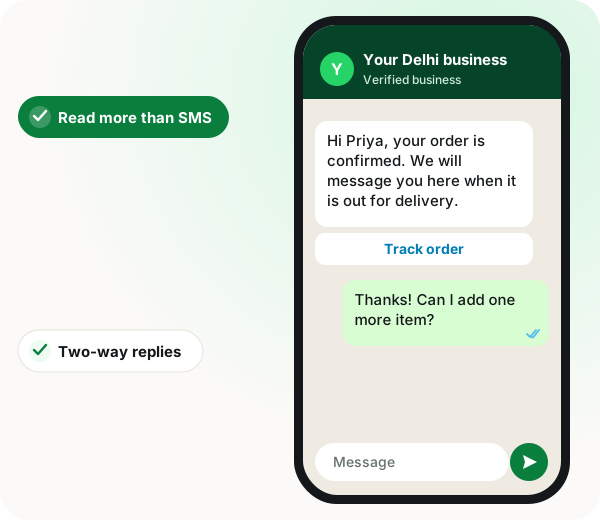
WappBlaster sees Delhi businesses choose WhatsApp marketing because customers actually reply there, which rarely happens with SMS and happens slowly with email. On the official platform, a Delhi trader's WhatsApp message arrives under its verified name, holds a catalogue, rate list or lab report, and invites an answer right inside the conversation; an SMS shows a header code and text, and an email often waits unread. SMS remains the right channel for OTPs and for phones without WhatsApp, and email suits long newsletters. With one WappBlaster number a Delhi business can capture leads from ads that open WhatsApp, have a bot ask the first questions, send campaigns and drip follow-ups to opted-in contacts, and send order or appointment updates afterwards, with templates in Hindi, Punjabi or English. A Delhi firm pays ₹7999 ($200) annually for the platform, with Meta's per-message charge passed on at cost, and setup happens over video calls from Bikaner.
WhatsApp Marketing in Delhi, in short
Platform fee
₹7999 ($200) / yr
Flat, no seat or contact tiers
Meta’s charge
At cost
Per delivered template, itemised
Setup
2-5 working days
Mostly Meta’s document review
Template languages
Hindi, Punjabi
Hindi, Punjabi and English
Trusted by 3,500+ businesses
4.8 / 5
Meta Tech Provider
D-U-N-S Registered
Some of the businesses using WappBlaster products every day
Five jobs WhatsApp does well
WhatsApp, SMS or email: which one a Delhi business should use, and for what
WhatsApp is not the answer to everything. These are the jobs where it clearly wins, and two where it does not.
1
Conversations that lead to a sale: WhatsApp
When a buyer will ask about size, price or availability before ordering, a chat beats any other channel. A Lajpat Nagar boutique can show a new collection and take the order in the same thread.
2
Documents and catalogues: WhatsApp
Price lists, product photos, brochures and lab reports arrive as files inside the chat, opened with one tap, instead of as an SMS link that customers have learnt to distrust.
3
OTPs and basic phones: SMS
Login codes, and alerts aimed at Delhi households still using keypad phones, stay with SMS on registered sender headers. WhatsApp simply cannot reach a handset that lacks the app.
4
Long newsletters: email
A detailed monthly newsletter or a formal statement reads better as email. WhatsApp works best when the message has one clear point and one button for the reader.
WhatsApp Marketing for Delhi businesses
Delhi does business on WhatsApp: shopkeepers in Chandni Chowk confirm orders, parents check coaching schedules, and patients receive lab reports there. The channel is already where customers are, in Hindi and Punjabi as much as English, and a Delhi template can be submitted to Meta in any of the three. WappBlaster puts that activity on one official business number with a team inbox. It is based in Bikaner, Rajasthan, and has no Delhi office; accounts are set up with clients across the capital and the NCR over Google Meet or Zoom.
Wholesale markets (Chandni Chowk, Sadar Bazaar)
A Sadar Bazaar trader once sent price changes by SMS that retailers could not answer. On WhatsApp, the new stock photos and festive price list arrive as a PDF with an order button, retailers type their quantities straight back, and the trader confirms dispatch in that thread. Email is kept for GST invoices and statements, and SMS only for the few retailers without WhatsApp.
Coaching institutes
Coaching institutes in Delhi often start with a click-to-WhatsApp ad aimed at students. A chatbot asks which exam and which batch timing they want, then hands the lead to a counsellor. Enrolled students then receive test results and fee reminders on the same number, and parents can reply with a question instead of calling the front desk during class hours.
Clinics and diagnostic labs
For a lab, WhatsApp replaces most SMS: appointment confirmations with a map link, and report-ready alerts with the report attached. Patients reply to reschedule instead of calling. SMS stays for OTPs and for older patients without WhatsApp, and email is reserved for detailed reports that referring doctors request from the lab directly. Front-desk phones in the lab ring noticeably less once patients learn they can simply reply.
The same whatsapp marketing setup is also written up for Gurgaon.
WhatsApp vs SMS vs email marketing, for Delhi businesses
Feature
SMS
Email
WhatsApp on WappBlaster
Sender shown as
A header code
Brand name
Verified business name
Images, PDFs, buttons
Text only
Yes
Yes, inside the chat
Customer can reply
Rarely
Yes, slowly
Yes, in the same chat
Needs prior opt-in
Yes, with DLT-registered headers
Yes
Yes, for WhatsApp
Best for
OTPs and short alerts
Long newsletters
Offers, follow-ups, two-way sales
WhatsApp Marketing in Delhi: when WappBlaster is the wrong choice
Codes that have to land on every Delhi handset, including keypad phones, are still better sent by SMS.
A long newsletter with several articles is more readable as an email than as a WhatsApp message.
When a Delhi customer base has never shared WhatsApp numbers, the first job is collecting permission through ads or a button on your site; campaigns come later.
Do Delhi customers respond better on WhatsApp than on SMS?
Usually, when the message is relevant and they agreed to receive it. WhatsApp lets them reply, view images and tap buttons in one place, which SMS cannot. Customers who receive irrelevant messages block quickly, though, so segmenting matters as much as the channel itself.
Should a Delhi business stop using SMS altogether?
Rarely. WhatsApp handles offers, follow-ups and conversations much better, but OTPs and customers with basic phones still need SMS. Most Delhi businesses that switch end up with WhatsApp as the main channel and SMS as a fallback for those cases.
Meta prices each delivered WhatsApp template by its type and the destination country, whereas SMS vendors bill every text sent. WappBlaster's fee is ₹7999 ($200) a year with no markup on Meta's charges. Comparing cost per reply or per sale is fairer, since a WhatsApp message carries media and buttons.
Is WhatsApp marketing allowed under India's DPDP Act?
Yes, if customers have given consent. The DPDP Act requires agreement before personal data is used for marketing, and Meta requires opt-in for WhatsApp. Collect consent through forms, ads or at the counter, keep a record, and act on every opt-out, which WappBlaster automates.
Is WappBlaster a WhatsApp marketing tool for Delhi coaching institutes?
Yes. A click-to-WhatsApp ad aimed at students opens a chat, the bot asks which exam and batch timing they want, and a counsellor takes the lead; enrolled students then get results and fee reminders on the same number.
For a Delhi diagnostic lab, what is the best use of WhatsApp marketing?
Replacing most SMS: appointment confirmations with a map link, report-ready alerts with the report attached, and replies to reschedule instead of phone calls. SMS stays for OTPs and older patients, and email for detailed reports referring doctors ask for.
Why do customers distrust SMS links but open WhatsApp files?
Price lists, photos, brochures and lab reports arrive as files in the chat that open with one tap, whereas many people have learnt to be wary of links in a text message.
GST invoices and statements. Stock photos, the festive price list and order replies move to WhatsApp, and SMS remains only for retailers without the app.
WhatsApp Marketing demo in Delhi: see it with your own contacts
A free demo on Google Meet, Zoom or AnyDesk, using your list and a message you would really send.
You leave with a written price: the platform fee and Meta's charge as separate lines.