The best 3 telecalling CRM software in 2026, and who each one suits
Telecalling CRM software is a calling app and customer record in one, so each call's result is saved where the caller already works. Most "telecalling CRM" lists are sales CRMs with a click-to-call button bolted on. That distinction decides whether your pipeline is still accurate in month three, because a caller who has to open a second app to log a call eventually stops. Only three products here pass the test of being genuinely built around the call.
Updated 1 September 2026 · 3 tools compared
Best telecalling CRM software in brief
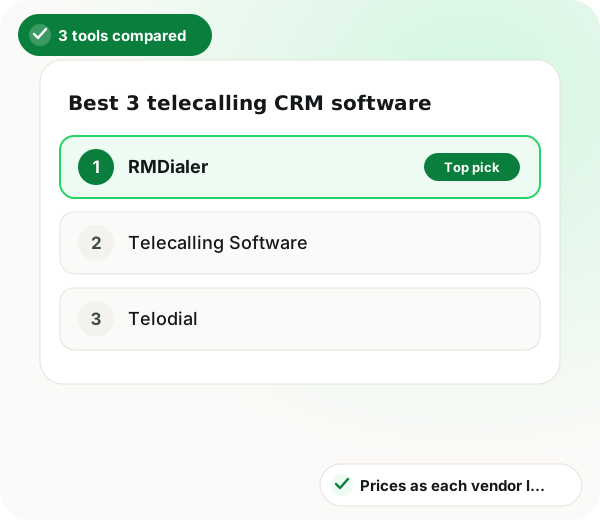
RMDialer wins the best telecalling CRM software shortlist, a list held to three because sales CRMs offering only a click-to-call button were excluded outright, along with anything designed for a desk and squeezed onto a phone. Telecalling Software and Telodial, the two products behind it, are genuine telecalling CRMs as well, and price barely separates the trio: ₹1908, ₹1908 ($29) and ₹2028 per user per year, so a ten-person floor is choosing between about ₹19000 and ₹20000 annually. What does split them is the depth behind near-identical feature lists. RMDialer includes a complete browser Web CRM where Telodial stops at an owner dashboard, and its plan covers official-API WhatsApp from Meta rather than selling messaging as an add-on. On iPhone it acts as a calling companion with no recording, while recording on Android is arranged during onboarding. A team that only wants a lead list, a status and a dialer may honestly find either rival simpler to live with.
Which telecalling CRM software is best?
The best telecalling CRM software is built around the call itself: the dialer, the lead's details and the next follow-up share one screen, so logging never needs a second app.
RMDialer heads this strict shortlist at ₹1908 ($29) per user per year, setting outcome, stage and next follow-up in two taps on Android or iPhone.
Sales CRMs with a click-to-call button were excluded, because callers stop logging in a second app.
Telecalling Software matches the price; Telodial charges ₹2028 per user yearly.
On iPhone the top pick is a calling companion without recording.
Best telecalling CRM software benefits
A strict entry test
Only tools where the dialer is the interface made the cut, so none of the three pushes callers into a second app.
Floor-scale price comparison
A ten-seat team sees the yearly totals side by side, roughly ₹19000 against ₹20000, before signing anything.
Statuses and fields you define
Lead statuses, custom fields and products follow the business's own process instead of a fixed vendor schema.
Follow-up matched to the outcome
A different WhatsApp message goes out by itself for each call result, sent through Meta's official API.
Simpler options named honestly
Teams that will never open a desktop CRM are told when Telecalling Software or Telodial is the leaner fit.
Which telecalling CRM software is the best of the three?
RMDialer is the best telecalling CRM software for calling teams on Android and iPhone, putting the dialer, the lead record and the WhatsApp follow-up on one screen with two-tap logging at ₹1908 ($29) per user per year. Telecalling Software and Telodial complete the shortlist.
Three telecalling CRMs side by side for Indian teams in 2026
Feature
Strongest at
Calls go over
Yearly cost
WhatsApp
1. RMDialer
The whole workflow
Phone SIM
₹1908 ($29) per user yearly
Official API, included
2. Telecalling Software
Lookalike, younger vendor
Phone SIM
₹1908 ($29) per user yearly
In the plan
3. Telodial
Single plain plan
Phone SIM
₹2028 per user yearly
Built in
Prices as published by each vendor at the time of writing. Check the vendor's own pricing page before buying.
Trusted by 3,500+ businesses
4.8 / 5
Meta Tech Provider
D-U-N-S Registered
Some of the businesses using WappBlaster products every day
The ranking
The best 3 telecalling CRM software, ranked
Every entry lists what it is genuinely good at and one thing it is not. That includes ours.
Of the three, the only one that covers the full telecalling job in a single published price: it dials the list for you, shows the lead on screen during the call, tracks each employee’s calls, adds a desktop Web CRM, and automates WhatsApp through the official API.
Best for
Telecalling and inside-sales teams of 1 to 50 who call from Android handsets.
Price
₹1908 a year for each user (₹159 a month), with a ₹747-per-user plan covering 3 months; outside India, $29 yearly or $12 for a 3-month term
Takes over from the phone’s own dialer, so the customer’s details are showing before you say hello
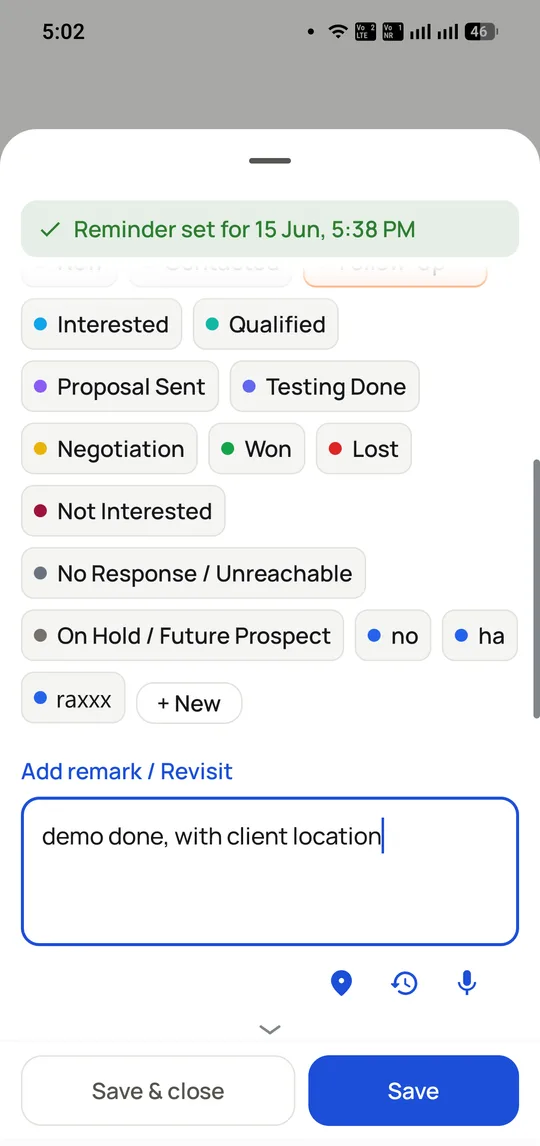
Outcome, lead stage and the next follow-up are all set with two taps
Runs down a list on its own, whether it lives in saved leads, a CSV, an Excel sheet or a linked Google Sheet
The follow-up WhatsApp goes out by itself through Meta’s official Business API, with a different message per outcome
Managers see each employee’s numbers live in the app, or on a computer through the plan’s own Web CRM
Comes from a Meta Tech Provider with a D-U-N-S registration, and onboarding is done 1:1 over a live call
Recording is available on Android, arranged with you during onboarding; on iPhone, RMDialer is a companion for calling and has no recording
The catch: It is made for outbound telecalling, not inbound contact centres, so you will not find IVR menus or call queues. Recording works, though RMDialer’s staff enable it alongside you at onboarding rather than it being on out of the box.
The nearest match on paper: one SIM-based app that is both the telecalling dialer and the CRM, sold on a single plan for the same per-user price.
Best for
Buyers lining up feature lists side by side who are comfortable trusting a newer vendor.
Price
₹1908 ($29) a year per user (that is ₹159 a month on annual billing), or ₹747 ($12) per user for 3 months; checked 17 September 2026
On the call screen: lead statuses, notes and follow-up reminders that ring
A manager’s web dashboard with each caller’s activity: calls, notes and follow-ups
All features in a single plan, 40 languages, and a free 3-day trial
The catch: On price, plan design and language count it is level with RMDialer, so the feature list gives you no way to split them. The track record does: 33 reviews on the Play Store and roughly 1,000 downloads, compared with 3,500+ businesses across 12+ countries.
3
Telodial
A calling app that dials over your SIM, adds WhatsApp automation and a lead CRM, and is sold on one per-user plan.
Best for
Small teams who would rather have a single price than choose between feature tiers.
Price
₹2028 per user for a year (₹169 monthly on yearly billing), or ₹249 a month if you take the 3-month plan
Lead statuses and fields you define yourself, on every call
Automated WhatsApp plus call tracking across the team
No fee for each call or each minute
The catch: For ₹120 more per user each year than RMDialer, the desktop view is an owner dashboard instead of a full Web CRM, and, being this new, it has no independent reviews to its name.
Method
Best 3 telecalling CRM software: how this ranking was decided
These criteria are specific to this list. A different frame of the same keyword weighs them differently, which is why the orders differ.
1
The dialer must be the interface
A real telecalling CRM replaces the phone dialer so the lead record appears on the call screen. A sales CRM with click-to-call leaves the caller in two apps, and the logging step is the one that gets skipped.
2
Logging in seconds, from the call screen
Outcome, stage and next follow-up must be settable without leaving the call. Anything requiring a form was excluded, because a CRM that is 60% updated is worse than none: managers still trust it.
3
Built for a phone, not a desk
Telecallers work from handsets. Products designed desktop-first and shrunk to mobile were excluded no matter how complete their feature list.
4
Published per-user pricing
Read from each vendor's own pricing page on 17 September 2026. Where a figure is not published, this list says so rather than estimating.
Why it leads
How RMDialer earns first place on a three-name shortlist
Every product on this shortlist is a true telecalling CRM, so the choice turns on scope and price, not category. RMDialer fits the entire telecalling routine into one licence: an auto dialer working the list, the lead in view during the call, logging in two taps that keeps the pipeline honest, reporting per employee for the manager, and a WhatsApp follow-up that Meta’s official API sends as the call ends.
On price there is almost nothing in it, and pretending otherwise would be dishonest. RMDialer is ₹1908 ($29) per user per year, Telecalling Software publishes the same ₹1908, and Telodial is ₹2028. A ten-person floor is choosing between roughly ₹19000 and ₹20000 a year. The decision is therefore not cost; it is what sits behind the identical-looking feature list.
Here the three pull apart. RMDialer has 3,500+ businesses behind it across 12+ countries, the company is a Meta Tech Provider and holds a D-U-N-S number, and WhatsApp messaging through Meta’s official Business API sits inside the plan instead of being a separate purchase. Telecalling Software offers the same kind of product from a much smaller base: around 1,000 downloads, with 33 reviews on Google Play. Telodial stops at an owner dashboard where RMDialer has a full Web CRM.
Where the other two genuinely win: both are simpler. A team that wants a lead list, a status and a dialer, and will never open a desktop CRM or send an approved WhatsApp template, is buying capability it will not use at the top of this list. On that reading either of the other two is the honest answer.
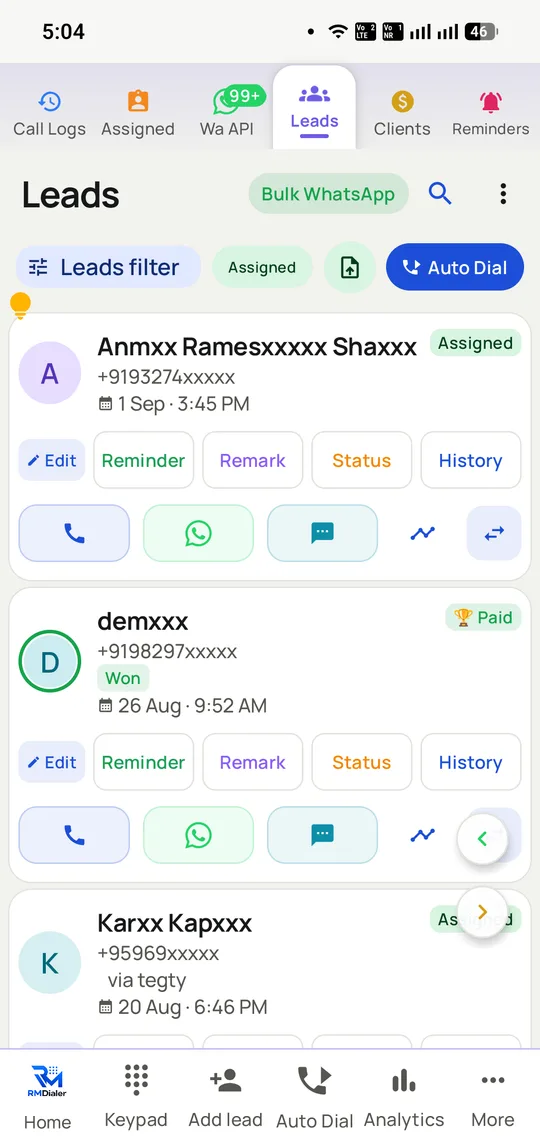
Every lead carries its stage, its owner and its history, with the common actions on the card.
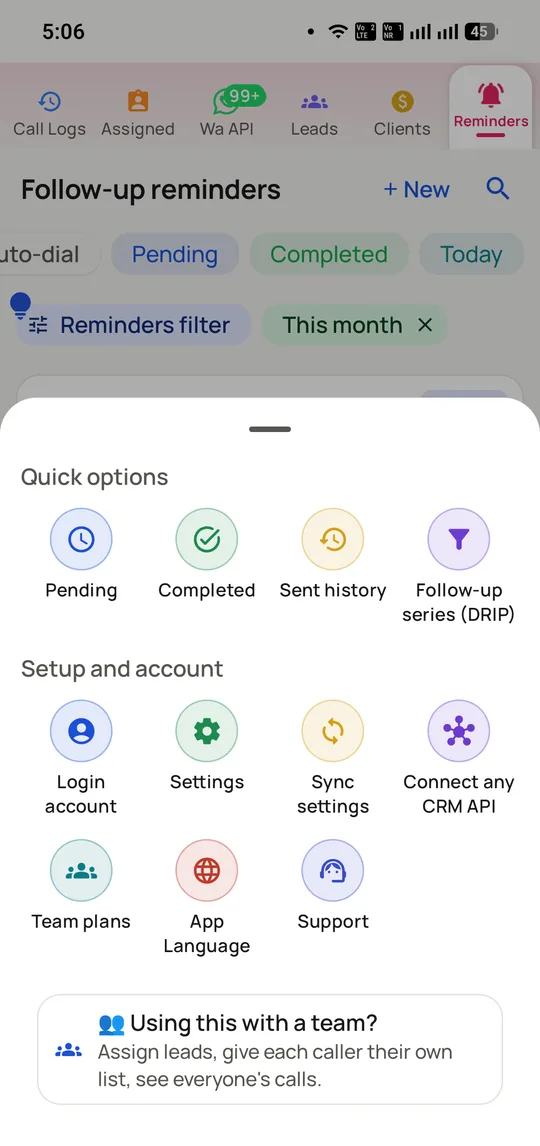
Statuses, custom fields and products are yours to define rather than a fixed vendor schema.
Two taps close a call: a status, a remark and a callback date, without leaving the call screen.
Telecalling CRM software: what RMDialer is known for
Category
Telecalling CRM
Dialer-first, not desk-first
Logging
Two taps
Outcome, stage and follow-up
Dialing
Own SIM
No IVR, VoIP or virtual number
WhatsApp
Meta’s official API
Post-call and bulk sends inside the plan
Desktop
Web CRM included
Per-employee reports in a browser
Price
₹1908 per user a year
$29 outside India; 3-day free trial
Reviews
Telecalling CRM software reviews: what RMDialer users say
“Eight callers, one spreadsheet and two apps, all replaced by the RMDialer telecalling CRM. For the first time our CRM agrees with what really happened on the phones.”
Suresh Babu
Telecalling head, finance company, Chennai
“My counsellors quietly dropped every other telecalling CRM; RMDialer is the one they kept. Logging a call in two taps is what made the difference.”
Anita Deshmukh
Owner, admissions consultancy, Aurangabad
“With guided sessions I set six callers on a single list in the morning and it is finished by four. Nobody rings the same number twice, no rows get missed, and there is no register to collect.”
Lakshmi Priya
Team lead, telecalling agency, Madurai
“Because the telecalling CRM sends WhatsApp automatically, each dealer we ring has the rate card in writing within seconds. With RMDialer, follow-up happens by default instead of being a task.”
Karan Malhotra
Sales manager, packaging manufacturer, Faridabad
“Per user, RMDialer costs about a fifth of the telecalling CRM we moved away from, and the callers like it better. You rarely get both.”
Rohit Bansal
Director, insurance distribution, Delhi
Straight answer
When RMDialer is not the right telecalling CRM software
Simplicity is all you are after, and nobody on the team will ever open a desktop CRM or send an approved WhatsApp template. Telodial does less, and that is its point.
You are choosing purely on the published feature list. Telecalling Software matches RMDialer almost line for line at the same price, so on paper alone there is no reason to prefer either.
Your telecallers work from desktop softphones rather than handsets.
You need a general-purpose CRM covering deals, projects and support tickets. This is a telecalling CRM, not a business suite.
Straight answers about choosing telecalling crm software.
Which telecalling CRM software tops this shortlist?
RMDialer, for teams calling on Android and iPhone. One yearly fee of ₹1908 ($29) per user covers the dialer, the lead record, two-tap logging, call recording, per-employee reports and WhatsApp follow-up through the official API, all on one plan. If the published feature list alone decides it, look at Telecalling Software.
It is software where the dialer and the customer record are one thing. The caller dials, sees who is on the line, records the result and books the next step while still on the call. A sales CRM with a click-to-call button is different, because the caller still juggles two apps.
It does. On Android and iPhone, RMDialer runs the calling list through its auto dialer, keeps the lead on screen while you talk, logs each outcome in two taps, schedules follow-ups on its own and sends the WhatsApp message automatically once the call is over.
What separates a telecalling CRM from an ordinary CRM?
A general CRM expects its user to be at a desk, typing. A telecalling CRM expects its user to spend the day on calls, so the record sits on the call screen and a log entry takes two taps instead of a form. The gap shows a month later, in whether the data is still right.
Will I need VoIP or a virtual number for a telecalling CRM?
Not with a SIM-based one. All three on this list place calls over the SIM card each phone already carries, so there is nothing to set up with a telecom provider and the person you call sees an ordinary mobile number. That is the reason answer rates stay higher than on a cloud dialer.
Per user, typical prices run from ₹599 a month up to ₹1099 a month, which is ₹7000 to ₹13000 per caller per year. RMDialer is also charged per user, but yearly: ₹1908 ($29) per user per year, and every feature comes in that price instead of being split into tiers.
The one that spares them typing. A telecaller’s day is mostly two typing chores, dialing numbers and writing up calls, and RMDialer takes both away. That is why the CRM stays up to date with no manager chasing people.
Look at four numbers for each caller every day: how many dials, how long connected, how many outcomes logged and how many follow-ups done. RMDialer works out all four from the calls themselves and shows them live on the phone and on a desktop through the Web CRM. Judge people on outcomes, because counting dials alone rewards speed rather than results.
With RMDialer, yes, from the same app and through the official WhatsApp Business API instead of an unofficial workaround. Messages in a campaign are tailored to each contact, and any reply shows up beside the lead the telecaller already has open.
They can. RMDialer runs on any phone with Android 8 or later, and on iPhone it installs from the App Store as a companion for calling. A company SIM works, and so does the employee’s personal one. The records sit in the company account regardless, so a resignation leaves the pipeline where it was.
Yes. An incoming call is matched to the existing record, so before picking up the telecaller sees the name, stage and last note, and the outcome is logged exactly as on an outbound call. A new inbound enquiry turns into a lead with its source attached in one tap.
RMDialer takes about a morning: install it, import your lead sheet, name the call outcomes and start a session. Only the WhatsApp follow-up templates involve waiting on anyone else: Meta reviews them, which usually takes a day or two.
Hardly any. They open the list they have been given, begin the session and tap twice after every call. Most teams are productive on the first day, and the manager follows week-one output on the live view instead of guessing.
Yes, both, plus CSV and the API for a live connection to whatever generates your leads. Columns map to fields, including custom ones, at import, and auto-dial can then run straight from the imported list.
Android users download RMDialer from Google Play; on iPhone it comes from Apple’s App Store and acts as a companion for calling, tied to the same account. The free 3-day trial switches every feature on, which is enough for a team to run one real calling day before it pays anything.