A telecalling CRM for sales teams is a call-first pipeline tool that tracks every prospect from first dial to closed deal. Sales teams do not lose deals on the call, they lose them in the hours afterwards. So this ranking weighs the pipeline, the follow-up and the outcome reporting rather than dialing speed, and it treats adoption as a feature, because a CRM your reps quietly abandon has no other qualities worth discussing.
Updated 27 August 2026 · 5 tools compared
Telecalling CRM for sales teams in brief
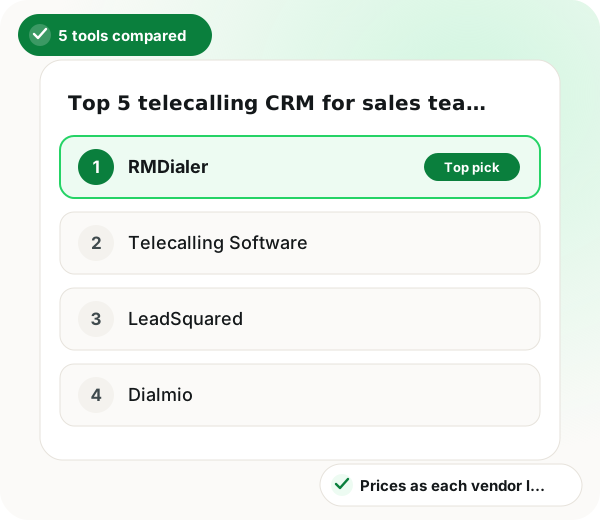
RMDialer is ranked the telecalling CRM for sales teams of 2 to 50 reps in this five-tool comparison, which scores each product on deal stages a rep will actually move, follow-up that fires without memory, per-rep outcome reporting and fit with an existing system of record. What sets it apart for sales is what happens after a win: the closed deal becomes a client record holding payment history and renewal dates, so account management continues in the same app instead of a separate tool. Managers get pipeline value, connect rate and lead ageing on a desktop panel inside the ₹1908 ($29) yearly licence. Telecalling Software matches that price but offers a lead list with statuses rather than stages a manager can forecast from, and Dialmio at ₹2148 records coverage of the list more than deal progress. LeadSquared suits a hundred reps on an enforced multi-stage process, and Zoho CRM suits companies already on the Zoho suite. Native two-way Salesforce or HubSpot sync is the gap.
What is the best telecalling CRM for sales teams?
A telecalling CRM for sales teams should be judged on what happens after the call: pipeline accuracy, follow-ups that really go out, and outcome reporting reps keep using.
RMDialer ranks first for 2 to 50 reps, turning a won deal into a client record with payments and renewal dates, at ₹1908 ($29) per user per year.
Adoption counts as a feature, since an abandoned CRM has no other value.
Dialmio is listed at ₹2148 per rep yearly for covering a whole list.
Telecalling CRM for sales teams benefits
Stages moved from the call screen
A rep advances the deal within seconds of hanging up, so the forecast reflects what really happened.
Won deals become client records
Payments and renewal dates carry on in the same app once a prospect buys.
Pipeline metrics for managers
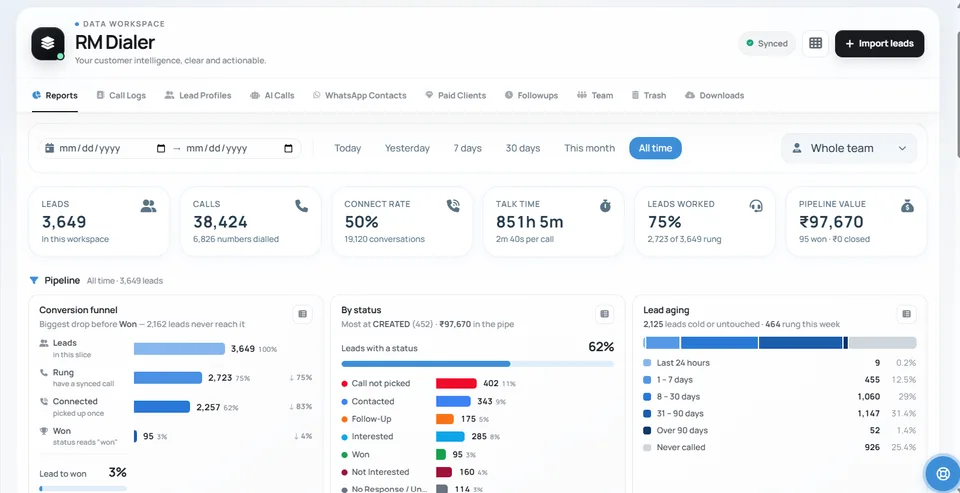
Pipeline value, connect rate and lead ageing appear on the desktop panel without an extra tier.
Lost-reason patterns
Managers see why deals slip across the whole team, not just how many calls each rep made.
System-of-record fit
Teams bound to Zoho or to an enforced enterprise process are shown which alternative suits them better.
Which telecalling CRM works best for a sales team?
RMDialer is the strongest telecalling CRM for sales teams selling from Android and iPhone: reps see each deal’s stage while the call is live, log each call in two taps and let WhatsApp follow-ups send themselves, while managers see outcomes per rep; the price is ₹1908 ($29) per user per year. LeadSquared fits enterprise processes; Zoho fits Zoho-standardised teams.
How five telecalling CRMs compare for sales teams in 2026
Feature
Strongest for
Kind of tool
Cost
WhatsApp
1. RMDialer
Deals and follow-up together
Built around the dialer
₹1908 ($29) yearly per rep
Official API, bundled
2. Telecalling Software
Lookalike from a newer firm
Built around the dialer
₹1908 ($29) yearly per rep
Inside the plan
3. LeadSquared
Enforced enterprise process
CRM with calling added
Enterprise quote
Through integration
4. Dialmio
Covering the whole list
Built around the dialer
₹2148 yearly per rep
Inside the plan
5. Zoho CRM
Teams already in Zoho
CRM with calling added
Tiered, per user
Through integration
Prices as published by each vendor at the time of writing. Check the vendor's own pricing page before buying.
Trusted by 3,500+ businesses
4.8 / 5
Meta Tech Provider
D-U-N-S Registered
Some of the businesses using WappBlaster products every day
The ranking
The top 5 telecalling CRM for sales teams, ranked
Every entry lists what it is genuinely good at and one thing it is not. That includes ours.
Of these five, it alone runs dialing, the deal record, the follow-up and per-rep reporting as a single system instead of through an integration, which is why its pipeline numbers can still be trusted in month three.
Best for
Field and inside sales teams with between 2 and 50 reps, using Android or iPhone.
Price
In India ₹1908 a year per user (₹159 a month); elsewhere $29 per user annually; a 3-day trial costs nothing
As soon as the call connects, the rep has the deal’s stage, its source, the latest note and whichever products came up before
Two taps, still inside the call, record the outcome, move the stage and set the next follow-up
When the call ends, official-API WhatsApp delivers the quote, catalogue or payment link
Outcome reports for each rep, plus patterns in lost reasons across the team, live and on desktop
Winning a deal creates a client record holding payments and renewal dates, letting account management carry on inside the same app
Recording for coaching, which the RMDialer team sets up with you at onboarding
The catch: Salesforce and HubSpot get no ready-made two-way sync. Connecting either means using the API or a connector, which leaves enterprise RevOps teams some work.
One plan gets you a SIM-dialing telecalling app that doubles as a CRM, plus WhatsApp follow-up and a dashboard for managers, at the same per-seat price as RMDialer.
Best for
Sales teams who compare products line by line and do not mind a younger vendor.
Price
₹1908 ($29) a year per rep, equal to ₹159 a month on the annual plan; checked 17 September 2026
Ringing follow-up reminders, notes and lead statuses on the call screen
Each caller’s activity on a manager dashboard
A single plan with every feature, in 40 languages
The catch: Its pipeline is a list of leads with statuses, not stages a sales manager could forecast from, and the evidence behind it is small: a base of about 1,000 installs and 33 Play reviews.
3
LeadSquared
Sales execution for enterprises, with process automation that is genuinely strong; it leads in Indian education and lending.
Best for
Big sales organisations whose processes are defined and enforced.
Price
Quoted for enterprise; per-user tiers are published for the smaller plans
Thorough process automation that enforces the workflow
A strong fit for BFSI and education
Dashboards that cover everything
The catch: You pay enterprise prices and wait through a real implementation, and calling is just one module of the platform, not the screen reps spend their day in.
4
Dialmio
Call management first: this CRM attaches every call, whether incoming, outgoing or missed, to a lead record.
Best for
Sales teams that track how much of the list they covered, not where deals stand.
Price
₹2148 per rep per year (₹179 a month on yearly billing); ₹249 monthly on the 3-month plan
Each call is tied to a lead, missed calls as well
Two taps on the after-call sheet capture outcome and follow-up
Imports leads from CSV, Google Sheets or Excel
The catch: It is made to document what happened, not to move a pipeline forward, so there are no deal stages to forecast from, and each seat costs ₹240 a year more than RMDialer.
5
Zoho CRM
If your sales team has already bet on Zoho, this is the practical route, with calls coming in through telephony integrations.
Best for
Teams that run on Zoho’s suite of apps.
Price
Tiered per user, with published prices; the integrated telephony provider bills separately
A vast ecosystem and very wide feature set
Keen per-user pricing
Connects with most of India’s telephony providers
The catch: Calls come through an integration, so reps hop between two systems, and the discipline of logging weakens precisely where pipeline data counts most.
Method
Top 5 telecalling CRM for sales teams: how this ranking was decided
These criteria are specific to this list. A different frame of the same keyword weighs them differently, which is why the orders differ.
1
Pipeline stages a rep will actually move
Stages that require opening a desktop CRM do not get moved. Weighted heavily: whether a rep can advance a deal from the call screen in seconds.
2
Follow-up that fires without memory
The next step must be captured during the call that created it, and the promised material should send itself. Deals die of silence more often than of objections.
3
Outcome reporting per rep
Judging reps on dial counts rewards whoever rushes. Each product was scored on whether a manager can rank reps by results and see the reasons deals were lost.
4
Fit with an existing system of record
Many sales teams already run a CRM they cannot replace. Products that integrate cleanly rather than demanding to be the centre were credited for it.
Why it leads
Why sales reps stay with RMDialer
Features are rarely why sales tools fail; adoption is. Whether a pipeline stays accurate is settled in the first ten seconds after the call, once the rep hangs up. RMDialer turns those seconds into two taps on the screen already open: outcome recorded, stage advanced, next follow-up booked. Any alternative that makes the rep switch apps loses that habit within about three weeks, and a half-updated CRM does more harm than none because managers go on reporting from it.
The second way it earns revenue is by keeping the promise a rep made on the call. When the call ends, RMDialer delivers the payment link, catalogue or quotation the rep mentioned over the official Meta WhatsApp Business API, picking the message to match the outcome. Reps no longer owe prospects an evening of paperwork, and prospects get what was promised while their interest is still warm.
When a sales team should pick something else: if Salesforce or HubSpot has to stay the master system with packaged two-way sync, connecting RMDialer through its API takes more effort than a native connector would. Recorded-call coaching, on the other hand, no longer needs a separate tool, because RMDialer records calls. And if a hundred reps must follow an enforced, multi-stage process, LeadSquared was designed for that.
Pipeline value, connect rate and lead ageing on the desktop panel, which comes in the same licence.
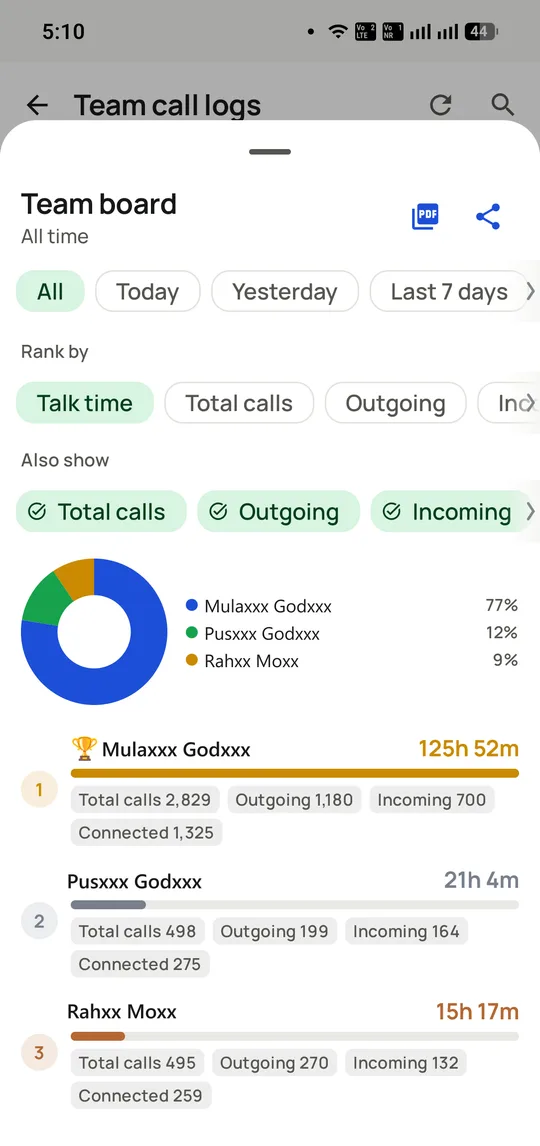
Each salesperson’s calls and talk time ranked for the manager, with no report to compile.
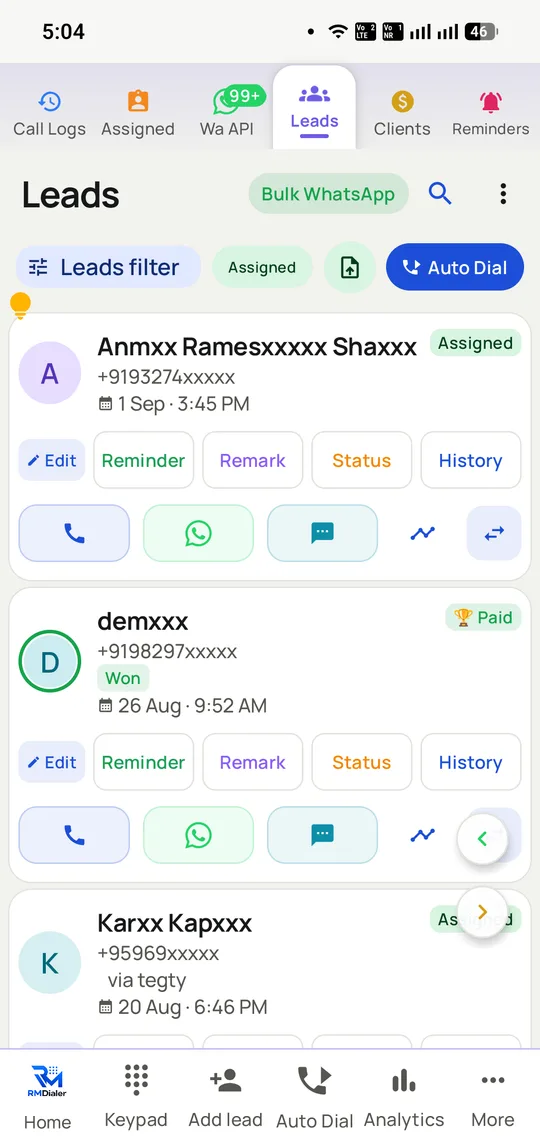
A lead shows its stage, its owner and its history, and the everyday actions sit on the card.
Telecalling CRM for sales teams: what RMDialer is known for
How a call runs
Dial, log, follow up
Without leaving the call screen
Effort to log
2 taps
Outcome, stage and the next date
After the call
WhatsApp sends itself
Different message per outcome
For managers
Results by rep
Plus lost-reason patterns
Cost
₹1908 per user per year
All included; $29 outside India
Once a deal closes
Client records
Payment history and renewal reminders
Reviews
Telecalling CRM for sales teams reviews: what RMDialer users say
“These days I coach from outcome reports. One rep had twice as many pending callbacks as anyone else, because he was not booking them. Two taps fixed a habit that years of reminders never had.”
Christina D’Souza
Sales manager, hospitality supplies, Margao
“Each rep had roughly forty percent more conversations, but what changed our quarter was the follow-up completion figure: it used to be a guess and now it is a report.”
Varun Mehta
VP Sales, fintech startup, Mumbai
“The RMDialer telecalling CRM revealed that our demo no-shows were really a follow-up problem. Once we added a reminder call and an automatic WhatsApp the day before, attendance went up by half.”
Nitin Agrawal
Co-founder, ERP reseller, Indore
“Two reps left in the same month and we lost zero deals, because every lead, note and promise lived in RMDialer rather than in their phones.”
Tarun Khanna
Co-founder, B2B packaging marketplace, Delhi
“We track lead sources in the RMDialer telecalling CRM and learned referrals convert at three times our paid leads. That one report moved our budget.”
Neha Agarwal
Sales manager, edtech, Noida
Straight answer
When RMDialer is not the right telecalling CRM for sales teams
Native two-way sync is essential, since Salesforce or HubSpot must stay the authoritative record.
AI that transcribes and scores calls is a must-have right now. Cloud vendors offer it; in RMDialer, AI lives in the WhatsApp chatbot.
You need process automation that enforces several stages across a hundred reps. LeadSquared suits that.
Your reps sit at desk softphones instead of carrying mobiles.
Straight answers about choosing telecalling crm software.
What should a sales team use as its telecalling CRM?
RMDialer, if the team sells from Android and iPhone. It puts deal context on the call screen, logs calls in two taps, sends WhatsApp follow-ups automatically and reports outcomes per rep, for ₹1908 ($29) per user per year. Enterprise process automation points to LeadSquared, and a team already on Zoho should look at Zoho CRM.
Three. Reps hold more conversations each day because dialing and logging no longer eat hours. Fewer leads go cold, since the follow-up is booked while still on the call and the promised material goes out by itself. And coaching gets better, because outcomes and objections turn into data rather than stories.
Should RMDialer be thought of as a sales CRM or a telecalling CRM?
A telecalling CRM that has the sales pipeline built into it. Stages, custom fields, lead sources and client records are all included, and reps reach them through the dialer, which keeps the pipeline accurate without anyone running a discipline drive.
Four figures that RMDialer collects without anyone typing them: how many calls each rep made, their talk time, the outcomes they logged and the follow-ups they finished, day by day, visible live on the phone and on the desktop Web CRM. Outcomes count most, since dial totals on their own favour speed over results.
Yes, if the reason is captured at the moment of loss, which RMDialer makes a two-tap habit. Aggregated, those reasons rank your real objections, and rewriting the pitch against the top one is usually the cheapest revenue improvement available.
Yes. Lists import into RMDialer as CSV, Excel or Google Sheets, and Zoho CRM, IndiaMART, Facebook Lead Ads and similar sources can send fresh leads over the API as they arrive. Many teams keep their current system of record and use RMDialer only as the calling layer for reps.
Yes. The rules are triggered by the call outcome and can insert the rep’s own name and number, so each automatic WhatsApp comes from that person, while the templates themselves remain approved by the company on the official API.
A normal mobile number: each call goes out from the rep’s own SIM through RMDialer. Prospects pick up more often and can ring back the person handling their deal instead of reaching a queue.
Start a guided session that sends the whole team through one list without anyone dialing the same number twice. Give it an hour and a single segment, and the manager watches outcomes arrive live. Most teams find this format lifts weekly numbers fastest.
It becomes a client record holding products, payments and renewal dates, so account management picks up inside the same app. Renewal reminders go off on the due date, and the upsell call starts with the complete history in front of the rep.
Yes. It lives on the phone reps carry anyway and carries on offline: calls go out over the SIM and notes sync once a data signal is back. Field reps get the CRM without needing a laptop.
Usually on the first day. There is very little to teach: a rep opens their assigned list, starts a session and taps twice after each call. By that evening most managers already have an outcome report worth reading.
Fairly means same lists and outcome-based measures. Guided sessions give every rep the same list, and comparing each rep against their own previous month catches improvement that raw rankings hide.
Does the telecalling CRM handle bulk WhatsApp campaigns?
Yes, on the official API from the same app, to segments built from pipeline fields, with replies landing beside the lead the rep is already working. Marketing warms the segment; the rep works it.
Take the free 3-day trial, which unlocks every feature: Android users install from Google Play, iPhone users add the companion from the App Store. Use your live pipeline, not a sample list, since these tools only reveal their differences when the team is genuinely selling.