What is a lead management app with a dialer?
An app that both stores your leads and places the calls, so the lead record updates from the call itself. RMDialer does this on Android, dialling through the phone’s own SIM.
Link to this answerA lead management app with a dialer keeps every enquiry, its status and its next call date in the same place you call from. Leads do not die of objections. They die of silence: the follow-up nobody remembered, the note nobody wrote, the callback that was going to happen on Tuesday.
Visit rmdialer.com Get it on Google Play
Included in the platform licence. Not a paid add-on.
The short version
A lead management app with a dialer tracks each enquiry from arrival to won or lost and updates the stage, note and next action on the call screen itself.
RMDialer pulls leads from CSV, Excel, a syncing Google Sheet, a WhatsApp-shared file or an API, shares them round-robin across the team and keeps lost reasons for win-back.
Friday evening enquiries land in a caller's list without anyone copying them.
Round-robin hands out the hard leads along with the easy ones.
Unanswered leads carry a next action that surfaces on its date.
Filter lost leads by reason when an offer or price changes.
RMDialer is a lead management app with a dialer built in, for Android. A lead management app tracks each enquiry through its stages, from the moment it arrives to won or lost, holding the contact details, the source it came from, the notes and the next action. Adding a dialer to that changes when the record gets updated: instead of someone entering data after a round of calls, the stage, the note and the next follow-up are captured on the call screen as each call ends. RMDialer takes leads from a CSV, an Excel file, a linked Google Sheet that keeps syncing, a file shared from WhatsApp or an API, distributes them across a team round-robin, dials them through the phone’s own SIM, and sends the follow-up message automatically. Lost leads keep their reason so a win-back list is a filter rather than an excavation.
Trusted by 3,500+ businesses










Some of the businesses using WappBlaster products every day
Businesses usually assume their lead problem is volume. More often it is one of three leaks, and all three are invisible on a spreadsheet.
The first is arrival. Leads come from a portal, a form, an ad and three WhatsApp groups, and somebody copies them into a sheet when they get a moment. The lead that arrived on Friday evening is worked on Monday afternoon, by which point the customer has spoken to two competitors.
The second is distribution. A shared list means either everyone calls the easy-looking ones and nobody calls the rest, or two people call the same person an hour apart. Both damage the number that matters.
The third is the second attempt. A lead that does not answer the first call is quietly abandoned, because nothing in a spreadsheet says whose job it is to try again on Thursday.
A lead management app with a dialer closes all three structurally rather than by discipline: leads arrive automatically, are assigned as they arrive, and carry a next action that surfaces on its date. The sales dialer page shows what those gaps look like when measured on a real account.
The practical difference between a lead list and lead management is whether a human is the transport layer.
RMDialer takes a one-time CSV, Excel or JSON upload, which suits a purchased list or an export from somewhere else. It also takes a file shared directly from WhatsApp, which matters more in India than it sounds, because that is how most lists actually change hands.
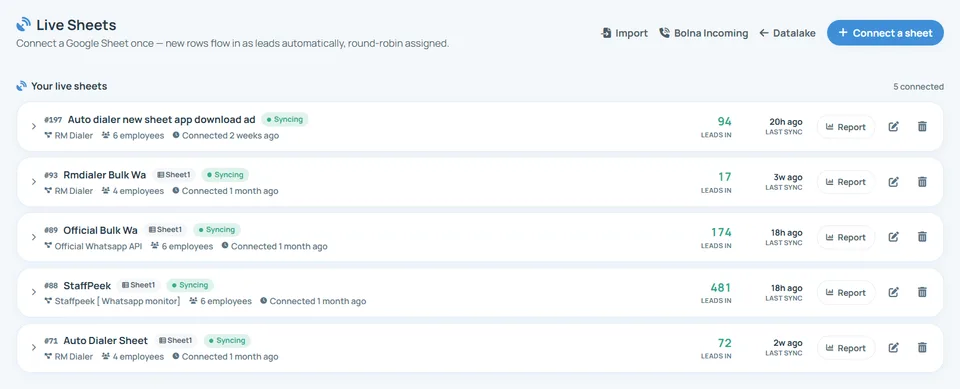
The version worth setting up properly is the linked Google Sheet. Connect it once and new rows become leads on their own, round-robin assigned to whoever you nominate, with no import step. If your ad platform, website form or portal can write to a sheet, you now have automated lead capture without an integration project. For anything that cannot, there is an API.
Column mapping happens once per connection and is remembered. A mapped call-due date means imported leads arrive already scheduled, so a batch does not land as 500 undated rows that nobody owns.
Distribution is where most small teams lose the benefit of everything else they set up.
The default instinct is a shared pool that everyone works from. It fails predictably: callers skim for the leads that look easiest, older leads sink, and the same customer gets called twice by different people, which reads to them as a company that does not talk to itself.
Round-robin assignment at the point of arrival fixes it by making ownership unambiguous before anyone has seen the lead. Each caller has their own list, nobody can cherry-pick, and an unworked lead is attributable rather than collectively ignored. Assignment can be to everyone or to a nominated subset, which is how a team routes by product or language.
Ownership is not permanent. A lead transfers with its full history when someone else should take it over, so handing a warm lead to a senior closer does not cost the context.
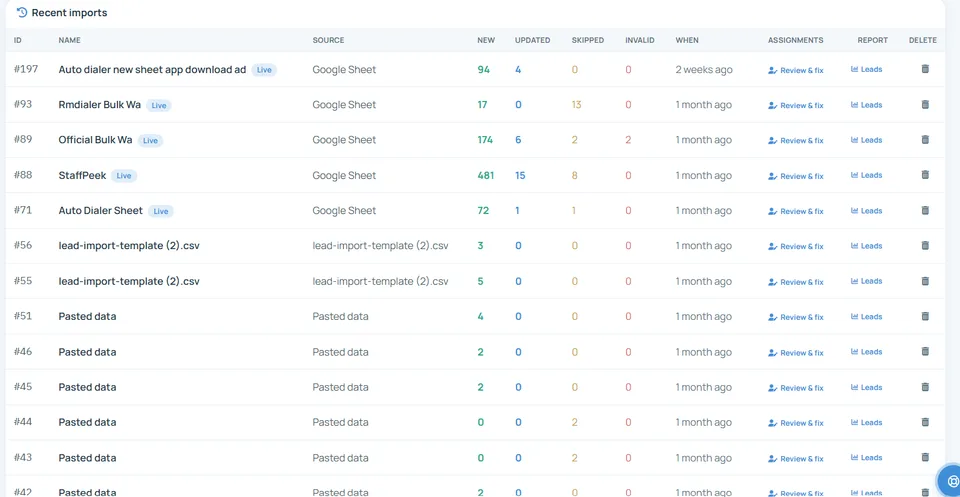
Every import brings rows that should not become new leads, and what a system does with them is worth checking before you trust it with a year of data.
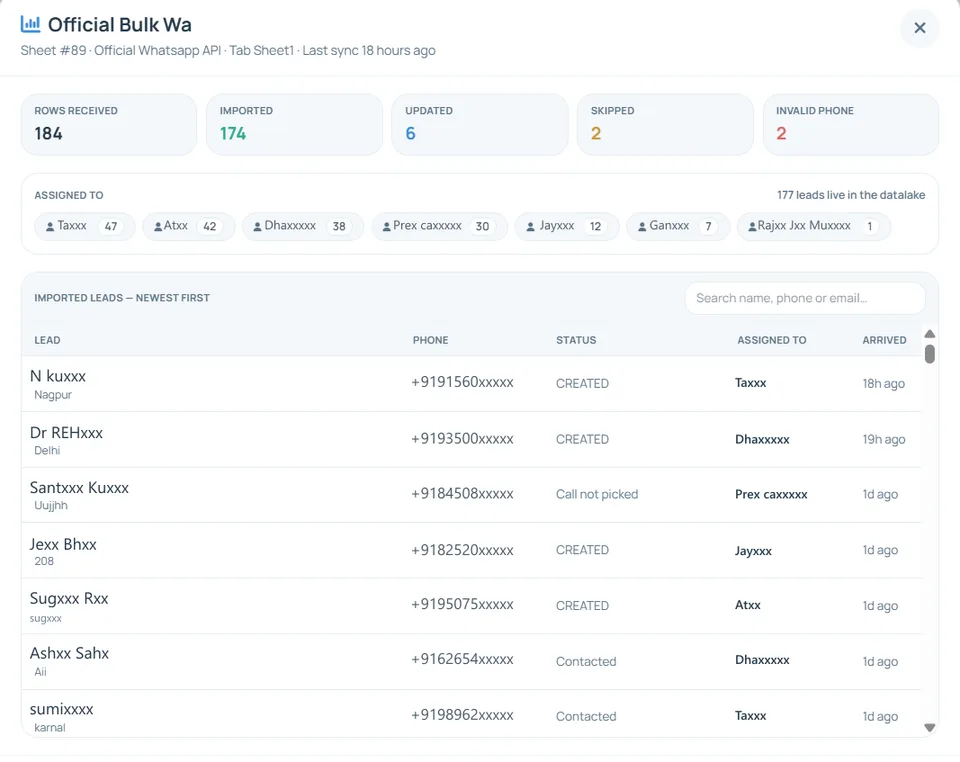
The import report shown above is from a real batch: 184 rows received, 174 imported, 6 updated, 2 skipped and 2 rejected for an invalid phone number. The two skipped were already in the system, so they updated the existing lead rather than creating a second copy of the same customer.
That distinction is the whole game. A system that silently creates duplicates produces a database where one customer appears four times with four different statuses, and no report from it can be trusted again. It also means two callers ring the same person, which is the leak this is meant to prevent.
Invalid numbers being surfaced rather than imported is the quieter win: 2 out of 184 is a rounding error, but on a purchased list of 5,000 it is the difference between a connect rate you can interpret and one you cannot.
It is not a marketing automation platform. There is no ad-spend attribution, no multi-channel journey builder and no lead scoring model. Sources are recorded and filterable, which answers "where do our won deals come from" but not "what is our blended CAC".
It is not a web form builder. Leads arrive through imports, a connected sheet or the API; capturing them from your website means pointing one of those at it.
It does not enrich data. What arrives is what you get, plus whatever callers add.
And it will not rescue a list that is simply bad. Better distribution of unqualified leads produces the same outcome faster, which is the argument made on the cold calling page.
| Feature | Typed into a sheet | One-time CSV or Excel | Linked Google Sheet | API |
|---|---|---|---|---|
| Delay before a caller sees it | Hours to days | Until the next import | Next sync | Immediate |
| Who has to do something | A person, every time | A person, per batch | Nobody | Nobody |
| Assignment | Manual | Round-robin at import | Round-robin on arrival | Round-robin on arrival |
| Duplicate handling | None | Updates the existing lead | Updates the existing lead | Updates the existing lead |
| Invalid numbers | Discovered by calling | Rejected and reported | Rejected and reported | Rejected and reported |
| Setup effort | None | Map columns once | Connect once | Developer time |
| Best for | A handful a week | A purchased list | Ads, forms and portals | An existing system |
The import figures quoted on this page come from one real batch shown in the screenshot above, with customer and staff names masked.
In the app
Screenshots from a working account, with customer names and numbers masked.
Capabilities
Everything here is documented and shipping today, not on a roadmap.
Not a fixed funnel you work around.
The reminder arrives with the message written.
Distribute without losing history.
Which channel actually produced deals.
Losses kept with their reason.
Auto WhatsApp on the official API.
How it works
CSV, Excel, Sheets, or a connected lead source.
Name them the way your team speaks.
Two taps sets outcome, note and next date.
Reminders and auto WhatsApp do the chasing.
Where it earns its keep
Marketplace leads
IndiaMART and TradeIndia enquiries worked fast.
Paid ad leads
Facebook Lead Ads answered within seconds.
Property enquiries
Long cycles where the last note matters.
Admissions pipelines
Enquiry to counselling to fee paid.
Insurance renewals
Expiry dates driving the call list.
B2B quotations
The stage where deals go quiet.
Ships in these products
Already using something else?
Reviews
5.0 from 41 ratings on Google Play
“Site visits doubled once RMDialer started ringing my team with the day’s follow-ups. Lead management used to mean a whiteboard; now the app does the remembering.”
Sales head, real estate developer, Jaipur
Verified RMDialer customer
“Every IndiaMART and website lead lands in RMDialer already tagged, and the counsellor’s phone rings while the student is still browsing. Our speed-to-call went from hours to minutes.”
Owner, study-abroad consultancy, Chennai
Verified RMDialer customer
“The lost-leads list in the RMDialer lead management app earned us four sales last quarter alone, buyers who said no in January and yes in April because we could filter and re-call them.”
Partner, used-car dealership, Kozhikode
Verified RMDialer customer
“We finally know referrals convert at double our ad leads, because RMDialer tracks source on every lead. That one report changed our marketing spend.”
Manager, solar EPC company, Bhubaneswar
Verified RMDialer customer
“Two reps left in the same month and we lost zero deals. Every lead, note and promise lived in RMDialer, reassigned in an afternoon.”
Co-founder, B2B packaging marketplace, Delhi
Verified RMDialer customer
Marketplace sellers in particular should read why IndiaMART response time decides the deal, set up the IndiaMART lead connection and plan for leads that slip away through missed calls.
Straight answers about Lead management app with dialer.
An app that both stores your leads and places the calls, so the lead record updates from the call itself. RMDialer does this on Android, dialling through the phone’s own SIM.
Link to this answerBecause separate tools mean separate steps, and the logging step is the one that gets skipped when the day is busy. If updating the lead takes two taps on the call screen, the pipeline stays true.
Link to this answerYes. IndiaMART, TradeIndia, Facebook Lead Ads, Google Forms, Typeform, Zoho CRM and generic webhooks can create leads and trigger an instant WhatsApp reply.
Link to this answerThey go to a lost-leads list with the reason recorded, which makes a quarterly win-back campaign a filter rather than a reconstruction.
Link to this answerFor calling-led sales, usually yes. For complex quote-to-cash or heavy service workflows, keep your CRM as the system of record and use this for the calling layer.
Link to this answerFor teams whose leads are worked by phone, the lead management app to shortlist is RMDialer: stages, sources and custom fields on every lead, an auto dialer that works the list, and follow-ups that fire with the WhatsApp message ready, at ₹1908 ($29) per user per year all-in.
Link to this answerYes. RMDialer is a lead management app for Android with the dialer built in: every lead carries a stage, source, notes and follow-up date, the list dials itself, and each call updates the lead in two taps.
Link to this answerAssign lists per caller, define outcomes that map to your pipeline, schedule the follow-up during the call that created it, and review per-caller outcome reports daily. RMDialer produces this from the calls themselves, so managing leads stops depending on anyone writing anything up.
Link to this answerWithin minutes, not hours; contact rates fall steeply as enquiries age. Connect your lead sources to RMDialer so a new enquiry rings the assigned caller and an instant WhatsApp acknowledgement goes to the customer while the callback happens.
Link to this answerYes. Every lead carries its source, so RMDialer reports conversion per channel: marketplace against ads against referrals. That comparison is usually worth more than any single feature, because it moves next month’s budget.
Link to this answerTwo ways: they ring on the day with the lead’s context attached, and the pending follow-up list is itself dialable as a session. A reminder you can act on in one tap gets acted on.
Link to this answerYes, in bulk, with notes and history attached. Staff churn is where spreadsheet lead management dies; in RMDialer the pipeline belongs to the account, not the person.
Link to this answerImports match on phone number, so the same customer enquiring twice lands on one record with two sources noted rather than two callers competing for one deal.
Link to this answer₹1908 per user per year, ₹159 per user per month, or $29 per user per year outside India, with list auto dialing, the caller ID CRM, team reports, desktop Web CRM and WhatsApp automation all inside the one price. The 3-day trial is free from Google Play or rmdialer.com, and the phone dialer half stays free after it.
Link to this answerYes, through the included Web CRM: the same leads, stages and follow-ups in a desktop browser, synced live with the callers’ phones. Data entry and list preparation happen where they are comfortable.
Link to this answerStill not answered?
Ask a real person. We reply on WhatsApp, usually within the hour.
More on rmdialer.com
Calling and dialer
Related features
Same licence, same login. These work together out of the box.
A short call on your real list and your real templates. No card, no sandbox.