Sales dialer by RMDialer that works the pipeline, not just the list
A sales dialer is calling software for salespeople that targets deals by pipeline stage and keeps each prospect's context on screen. Dialling faster is easy. Selling more needs the other three things a call depends on: the prospect’s background in front of the rep, a record of how the call went, and a follow-up sent while the buyer is still interested. A sales dialer earns its keep on all four.
Included in the platform licence. Not a paid add-on.
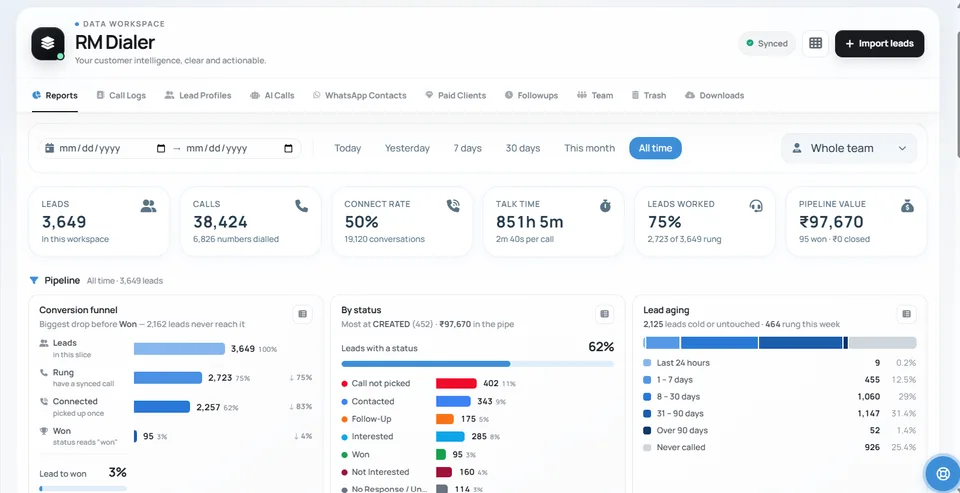
The funnel reads left to right in one line: 3,649 leads, 2,723 actually rung, 2,257 connected, 95 won. The drop that matters is visible without building a report.
The short version
Dials the pipeline stage by stage, not just a flat list.
Prospect context on screen before every conversation.
The WhatsApp follow-up goes while interest is still warm.
Reps compared on outcomes, not dial counts.
What is a sales dialer?
A sales dialer calls a slice of the pipeline, such as today's follow-ups or every lead at proposal stage, with each prospect's history shown before connecting.
RMDialer dials through each rep's own SIM, sends the quotation on WhatsApp via the official Business API as the call ends, and compares reps on outcomes.
Speed to first call is often the cheapest gap to close.
Reps are ranked by connects and wins, not dial counts.
Call everyone gone cold for seven days without building a list by hand.
Honest forecast
Two-tap outcomes keep pipeline stages current as a side effect of calling.
Warm-moment follow-up
The deck or quote lands on WhatsApp while the buyer is still listening.
Outcome-based rep comparison
Managers coach on connect rate and conversions instead of raw volume.
Sales dialer in detail
RMDialer is a sales dialer for Android sales teams. A sales dialer differs from a plain auto dialer in what it dials: not a flat list top to bottom, but a slice of the pipeline — today’s follow-ups, leads that have gone cold for seven days, or everyone at proposal stage — with each prospect’s stage, source and last note on screen before the call connects. The outcome updates the pipeline from the call screen in two taps, so the forecast stays true because keeping it true is faster than not. RMDialer dials through each rep’s own SIM, so prospects see a real mobile number rather than a call-centre line, sends the quotation or deck on WhatsApp automatically through the official Business API as the call ends, and reports per rep on outcomes and connect rates rather than on how many numbers were dialled.
Trusted by 3,500+ businesses
4.8 / 5
Meta Tech Provider
D-U-N-S Registered
Some of the businesses using WappBlaster products every day
The four sales dialer numbers a manager cannot get from a spreadsheet
A call log tells you how many calls were made. That is the least useful number in sales management, and it is usually the only one available.
The figures that change decisions are different: what share of dials reach a human, how long a new lead waits before anyone rings it, how many attempts a lead gets before it is abandoned, and which hours actually answer. None of these can be reconstructed from a spreadsheet of dial counts, because none of them are about volume.
They are all derived automatically once the outcome is captured at the moment of the call rather than typed up later. The screenshots on this page come from a working account and show the shape of it: a 50% connect rate across 38,424 calls, an average of 5.6 attempts per number, and a conversion funnel that goes 3,649 leads, 2,723 rung, 2,257 connected, 95 won.
That last line is the one worth staring at. The largest single drop is not at the close. It is between having a lead and ringing it at all.
Sales dialer speed to first call, usually the cheapest thing to fix
Of every metric a sales dialer exposes, this is the one that most often turns out to be both badly broken and easy to repair.
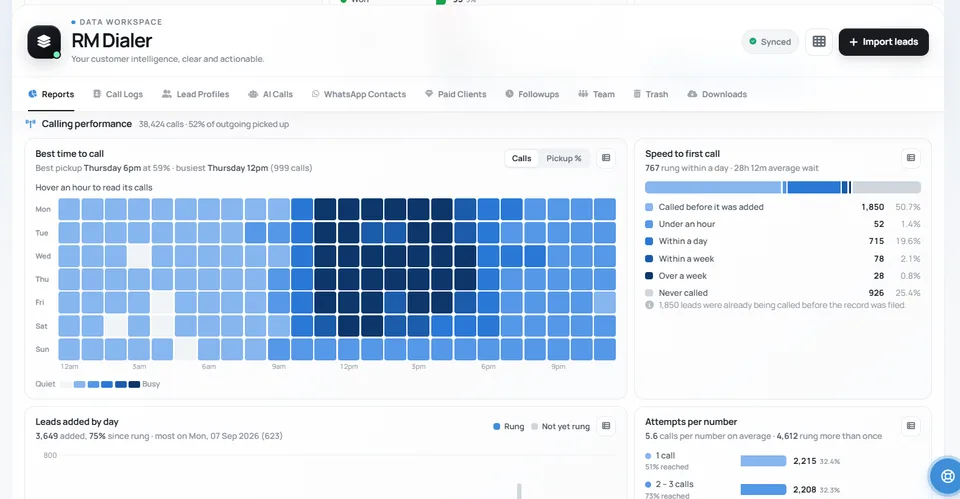
On the account shown above, 926 leads out of 3,649 had never been called at all, and the average wait before a first call was over 28 hours. Nobody decided that. It is what happens when leads arrive into a sheet and get worked in whatever order someone opens them.
The fix is not motivational. It is a filter: leads with no call yet, sorted oldest first, sent to the dialer as a session. Ten minutes of someone’s morning clears a backlog that has been quietly ageing for weeks, and the ageing report makes it obvious when it starts building up again.
The related lever is attempts. On the same account, leads that got a single call were reached 51% of the time; leads that got two or three were reached 73%. A sales dialer makes the second and third attempt cheap enough to actually happen, which is most of the gap between those two numbers.
A sales dialer calling at the hours that answer
Every sales blog publishes a best-time-to-call study, and they contradict each other, because the right answer depends on who you sell to and where they are.
The useful version is your own data. RMDialer builds a pickup-rate heatmap by hour and weekday from the calls your team has already made, so the answer is specific to your market rather than to a survey of American B2B software buyers.
On the account in the screenshot the busiest hour and the best-answering hour are not the same: the team dials hardest at noon, while the highest pickup rate is Thursday at 6pm. That mismatch is common, and it is worth roughly the same as hiring another rep, for free.
The practical use is scheduling the session rather than rearranging the day. Put the fresh, high-value leads in the window that answers and the admin-heavy follow-ups in the window that does not.
Sales dialer coaching on outcomes rather than dial counts
Ranking a sales floor by call volume trains people to make short, low-quality calls, because that is what the scoreboard rewards. Everyone knows this and it keeps happening, because volume is the only number that is easy to collect.
When outcomes are captured on the call screen, the scoreboard can be built on something better: connect rate, conversion by stage, reasons for loss, and talk-time distribution. On the account shown, median talk time is 49 seconds while the mean is 2 minutes 38, which tells you most calls end almost immediately and a few carry the whole pipeline. That distribution is a coaching agenda on its own.
Per-rep reporting sits in the same panel, alongside call recordings for the conversations worth reviewing together. The call analytics page covers the reporting in depth and call monitoring covers the live view during a shift.
What a sales dialer is not
It is not a full sales CRM. There are no quotes, order management, commission calculations or complex multi-stage approval workflows here. It holds a pipeline and works it by phone. Teams running Salesforce or Zoho keep them and sync through the API rather than replacing them.
It is not a predictive dialer. One rep, one call at a time. For 50-agent cold outbound where abandoned-call economics dominate, a predictive platform will move more volume; the trade is the silent pause and the infrastructure.
It is not an email sequencing tool. Follow-up here is WhatsApp and calls, which is the right channel mix for most Indian B2B and B2C selling and the wrong one if your market lives in email.
And it does not fix a positioning problem. A sales dialer makes a team that knows what it is selling faster at selling it. If the conversion rate is broken at the message rather than the process, more calls will surface that faster but not solve it. The cold calling page covers the list-quality side of the same question.
What a sales manager can see: spreadsheet vs sales dialer vs full CRM and telephony stack, 2026
Feature
Spreadsheet and phones
Sales dialer (RMDialer)
CRM plus telephony stack
Calls made per rep
If reps fill it in
Automatic
Automatic
Connect rate
No
Automatic
Automatic
Hours that actually answer
No
Heatmap from your own calls
With reporting configured
Wait before a lead’s first call
No
Automatic
With reporting configured
Attempts before a lead is dropped
No
Automatic
With reporting configured
Pipeline value by stage
Manually maintained
Updated from the call screen
Yes
Quotes, orders, commissions
In other sheets
No, use the API
Yes
Setup time
None
An afternoon
Weeks, usually with a partner
Cost per rep per year
₹0 plus the hidden hours
₹1908 ($29) all in
Typically several times that
Figures quoted on this page come from one real RMDialer account, shown in the screenshots above with customer and staff names masked. They describe that team rather than an industry benchmark, and your own numbers are the ones worth acting on.
In the app
Sales dialer, on a real account
Screenshots from a working account, with customer names and numbers masked.
Pickup rate by hour and weekday, from your own calls rather than an industry average. On this account Thursday 6pm answers at 59%.
Capabilities
Sales dialer: what you get
Everything here is documented and shipping today, not on a roadmap.
Pipeline-aware dialling
Build a session from stage, source, value or time since last contact: today’s follow-ups, everyone at proposal, or leads nobody has rung yet. Not a flat list top to bottom.
Context sells
Stage, source, last note and the products already discussed are on screen as the call connects, so a rep opens where the last conversation ended.
Logging reps do not skip
Two taps on the call screen updates the stage and sets the next step. The forecast stays true because keeping it true is faster than avoiding it.
Follow-up while it is warm
Quotation, deck or payment link goes out on WhatsApp the moment the call ends, on the official Business API, rather than tonight if the rep remembers.
Coaching from real numbers
Connect rates, conversion by stage, loss reasons and talk-time distribution per rep, with recordings for the calls worth reviewing together.
Real numbers get answered
Each rep dials from their own SIM, so a prospect sees an ordinary mobile number they can ring back rather than a call-centre line they will ignore.
How it works
Sales dialer: how it is set up
1
Connect the pipeline
Import leads or feed them live from your sources.
2
Define stages and outcomes
The ones your sales floor says out loud.
3
Run sales sessions
Each rep dials their slice; the manager watches live.
Enterprise sales built on long meetings and a few dials a day gain less from a dialer than high-volume phone teams do.
A team with only a flat list and no pipeline stages yet may be better served by the plain auto dialer to begin with.
Sales dialer FAQ
Straight answers about Sales dialer.
What is a sales dialer?
A dialer built for working a sales pipeline: it dials prospects automatically, shows their stage and history before the call, records outcomes and drives the follow-up. RMDialer is a sales dialer for Android that runs on each rep’s own SIM.
Which is the best sales dialer for small teams in India?
For SIM-based selling, the sales dialer to shortlist is RMDialer. One price of ₹1908 ($29) per user per year covers pipeline stages, outcomes logged in two taps, WhatsApp follow-ups that send themselves and outcome reports for every rep. Enterprise teams wired into Salesforce with international calling volumes shop in a different, costlier category.
Both, with the dialer on top. RMDialer ships with its own pipeline, stages, custom fields and client records, and reps reach all of them by calling, so the CRM keeps itself current without anyone running a campaign to make people update it.
Three mechanical ways: more conversations per day (dialling and logging stop eating hours), fewer leads lost to silence (follow-ups are scheduled at call time and the WhatsApp sends itself), and better coaching (objections and outcomes become visible data). None of it requires better talkers, just fewer leaks.
What is sales calling software versus a sales dialer?
Mostly the same purchase described from two angles: the dialling engine and the workflow around it. RMDialer covers both meanings, the auto dialer plus the pipeline, follow-up and reporting that make the calls compound.
Can the sales dialer work our existing CRM’s leads?
Yes. Import from CSV, Excel or Sheets, or feed leads live from sources like Zoho CRM and Facebook Lead Ads through the API. Many teams leave their main CRM in place and hand reps RMDialer purely for the calling.
As it happens during the day, then broken down rep by rep once the day ends. Calls, talk time, outcomes and completed follow-ups appear in the app and in the desktop Web CRM that comes with the plan. Because the figures are generated by the calls, the Friday review can be spent on strategy instead of on whose spreadsheet is right.
Does the sales dialer help with follow-up discipline?
It removes the need for discipline. The follow-up date is set in the two taps that log the call, the reminder rings with context on the day, and the WhatsApp with the quotation already went the moment the first call ended.
The lead turns into a client record holding the products bought, payments and renewal dates. Account management then carries on in the same app: reminders go off ahead of each renewal, and whoever makes the next upsell call sees everything that has happened so far.
What number does the prospect see when a rep calls?
The rep’s own mobile number, because RMDialer places the call on the SIM in their phone rather than through a call centre. Ordinary mobile numbers get picked up more often, and if the prospect rings back they reach the same person handling their deal.
Yes. Start a guided session and every rep works the same list together, with no number dialled twice. Pick one segment, give it an hour, and watch the outcomes arrive on the manager’s screen as they are logged.
How is a sales dialer different from a predictive dialer?
A predictive dialer rings many numbers per agent and connects whoever answers, which suits large call centres and creates the awkward silent pause. A sales dialer like RMDialer is one rep, one call, full context, which is how considered sales are actually made.
RMDialer is ₹1908 per rep per year (₹159 a month), or $29 per rep per year outside India, every feature included, no per-minute charges because calls use each rep’s SIM plan. The free 3-day trial from Google Play or rmdialer.com is enough to run a real pipeline week, and the phone dialer half stays free after it.
Yes. Marking a deal as lost asks for a reason, and RMDialer totals those reasons over the whole pipeline. A cluster such as "price objection in the north territory" shows up in the report instead of living as a manager’s hunch.
Can sales calling and marketing WhatsApp share one system?
Yes. The same app runs bulk WhatsApp campaigns on the official API to segments built from pipeline fields, and campaign replies land beside the lead the rep is already calling. Marketing warms them; the sales dialer works them.