Auto dialer software with CRM by RMDialer, both inside the same app
Auto dialer software with CRM combines automatic outbound calling and a customer database, so each dialled number already carries its history and next step. Almost every product in this category claims a CRM. Four different things are meant by that, and the difference decides what you pay, how many subscriptions you hold and whether the caller works in one window or two.
Included in the platform licence. Not a paid add-on.
This is the CRM half, and it is the same app that placed the call, not a separate system reading from it.
The short version
The dialer and the CRM are one app, not an integration between two products
Calls go out on the caller’s own SIM, which shows the customer a real mobile number to call back on
₹1908 ($29) per user per year, with no telephony billed on top
One subscription rather than a dialer licence plus a CRM licence
Android replaces the phone dialer; the iPhone app is a calling companion
Not a Windows download: on a computer it runs as a web CRM in the browser
What is auto dialer software with CRM?
Auto dialer software with CRM places calls from a list and stores each customer record, outcome and follow-up, ideally inside one tool rather than two linked products.
RMDialer keeps the list, the call and the lead record in a single Android app, priced at ₹1908 ($29) a user each year and billing no telephony on top.
One subscription instead of a dialer licence plus a separate CRM seat.
On a computer it opens as a web CRM in the browser, not a Windows install.
The iPhone app is a calling companion; Android gets the full dialer replacement.
Auto dialer software with CRM benefits
Single purchase
Owners pay one line item per caller instead of renewing two contracts on different dates.
Record on the ringing screen
Status and the last remark show while the phone rings, so the caller never opens a second window.
Two-tap outcomes
Set the result and the next date as the call ends, while the details are still fresh.
Minutes on your mobile plan
Calls ride the SIM plan the business already pays, so no per-minute invoice turns up separately.
Auto dialer software with CRM in detail
RMDialer is auto dialer software with a CRM inside it, for Android, and the distinction that matters is where the customer record lives. Most products in this category are two systems joined by an integration: a dialer places the call, a separate CRM stores the result, and the caller works in two windows while the record stays only as current as the last person who remembered to update it. RMDialer puts the list, the call and the record in one app that replaces the Android phone dialer, so the lead’s status and last remark are on screen while it rings and the outcome is set in two taps when it ends. Calls place through the SIM already in the handset rather than over VoIP, so there is no virtual number to rent and no per-minute telephony bill arriving separately from the software fee.
Trusted by 3,500+ businesses
4.8 / 5
Meta Tech Provider
D-U-N-S Registered
Some of the businesses using WappBlaster products every day
Four different things are sold as “auto dialer software with CRM”
The phrase is doing a lot of work. A cloud contact-centre platform means it has a contact database behind its dialer. A CRM vendor means it has added a click-to-call button and an integration. A desktop softphone means it syncs to whatever CRM you already pay for. And a mobile app means the dialer and the CRM are literally the same screen. All four answer the search; only one of them is a single purchase.
The cost spread between them is not marginal. A cloud platform seat runs from roughly $15 to $250 a month before telephony, and the minutes are billed on top. A CRM licence plus a dialer add-on is two subscriptions that renew on different dates. A desk softphone needs the CRM bought separately. The SIM-based option is one line item at ₹1908 ($29) per user per year with the minutes already inside a mobile plan the business pays anyway.
Which one is right genuinely depends on the operation, and the table below sets them side by side rather than pretending one wins everywhere. If your reading of it is that you want a full contact centre, the ranked list of the three auto dialer software modes worth buying covers where predictive platforms take over.
Why “free” and “download” usually end badly here
Two of the most common related searches on this term are for free software and for a download, and both deserve a straight answer. Nearly every free tier in this category turns out to be a countdown trial, or a hand-dialing tool with a contact list added, and the free plans that come with cloud telephony earn the money back through per-minute charges that show up in the second month. With RMDialer, the phone dialer stays free for as long as you use it, and you pay only for automatic list dialing and the Web CRM.
The download question is simpler and the answer is no. RMDialer is not a Windows program. Its desktop half is a web CRM opened in a browser, in which the owner builds lists, assigns leads and reads per-employee reports, and the calling happens on the handsets. If what you need is software that installs on a PC and dials through a headset, a desk softphone on a cloud platform is the correct product and this is not it.
That distinction matters more in India than the search volume suggests, because a virtual number answered from a laptop and a mobile number answered from a phone get very different pick-up rates. The reasoning behind that is on the SIM-based dialing page.
What the second invoice looks like
The number most buyers compare is the per-seat software fee, and on three of the four architectures it is not the number that decides the annual cost. Cloud platforms bill the software monthly and the telephony by the minute, so a five-person desk making two hundred calls a day discovers the real figure in the second invoice rather than in the quote. That is not a hidden fee, it is simply how the model works, and it is fine at volumes where the connect-rate gain pays for it.
SIM-based software inverts that. The minutes are already inside the mobile plans the business is paying for, so the annual cost is the licence and nothing else: ₹9540 for five people for a year. There is no per-minute line because the software never touches the call path; it dials the handset’s own SIM and gets out of the way.
It also means the price does not move with activity. A team that doubles its calling volume pays the same, which is the opposite of the per-minute model and is usually the deciding factor for a business whose calling is seasonal.
When an integration is genuinely the better buy
If the CRM is already the centre of the business, with quotes, invoices, approvals, ticketing and a deal pipeline several teams work in, then moving to a dialer-first app is the wrong direction. Keep that CRM and add calling to it. RMDialer is an outbound calling system with a customer database attached, not a replacement for Salesforce or Zoho, and it does not pretend to run a quoting workflow.
The same applies if the callers are at desks without company handsets, if inbound IVR menus and queue routing are part of the job, or if the operation is large enough that predictive pacing across many lines is worth the compliance overhead. Those are cloud platform problems and a cloud platform should solve them.
Where RMDialer is the right answer is narrower and more common than the category suggests: a team between one and fifty people whose selling happens on the phone, who want one subscription, no telecom project, and the record to be true because it was written during the call rather than afterwards. If you are weighing it against the closest mobile-first competitor, the RMDialer and GoDial comparison is the direct one.
The four architectures sold as auto dialer software with CRM, compared on what you buy and what it costs to run, September 2026
Feature
Cloud platform with CRM
CRM plus dialer add-on
Desk softphone plus CRM
SIM app, CRM inside (RMDialer)
Where the call originates
Their network, over VoIP
Handed to the phone or a softphone
A headset on the computer
The SIM in the caller’s handset
Where the lead record lives
In the platform
In the CRM, updated after the call
In a separate CRM
In the same app that dialed
Subscriptions to hold
One, plus telephony
Two
Two
One
Telephony billed separately
Yes, per minute
Depends on the add-on
Yes, per minute
No
What the customer sees
A virtual number
Usually a virtual number
A virtual number
Your own mobile number
Before the first call
Number, KYC, onboarding
Connect the integration
Number and CRM setup
Install and import
Five users for a year
Roughly ₹700000 upwards, plus minutes
Two licence fees
Two licence fees, plus minutes
₹9540
Suits a team of
50 and up
Any, if the CRM is the centre
Desk-based B2B
1 to 50 on phones
Cloud platform figures are indicative: published seat prices on this SERP run from about $15 to $250 a month before telephony, and several vendors quote on request. RMDialer’s figure is its published ₹1908 ($29) per user per year.
In the app
Auto dialer software with CRM, on a real account
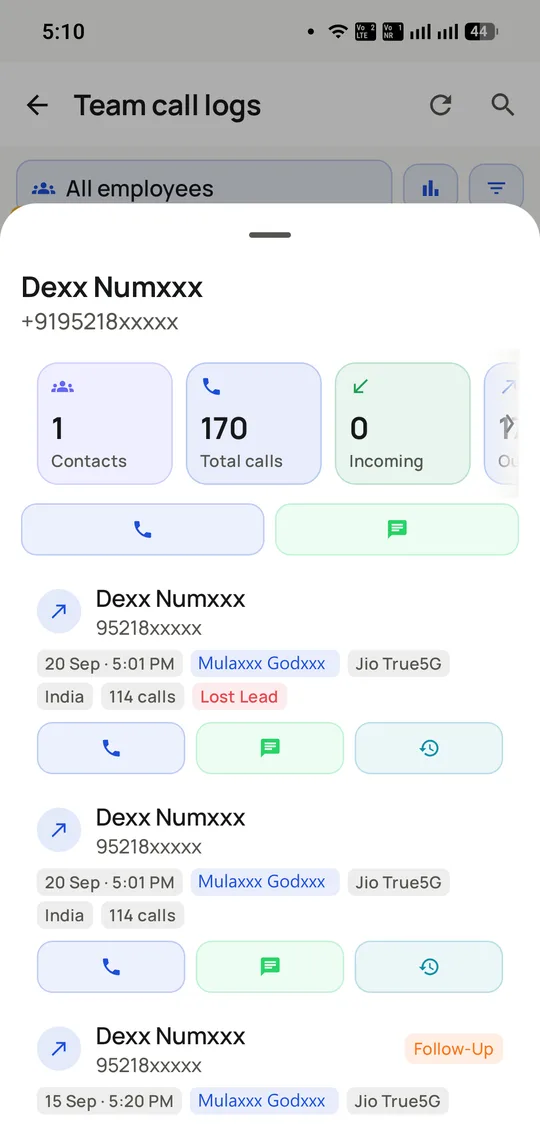
Screenshots from a working account, with customer names and numbers masked.
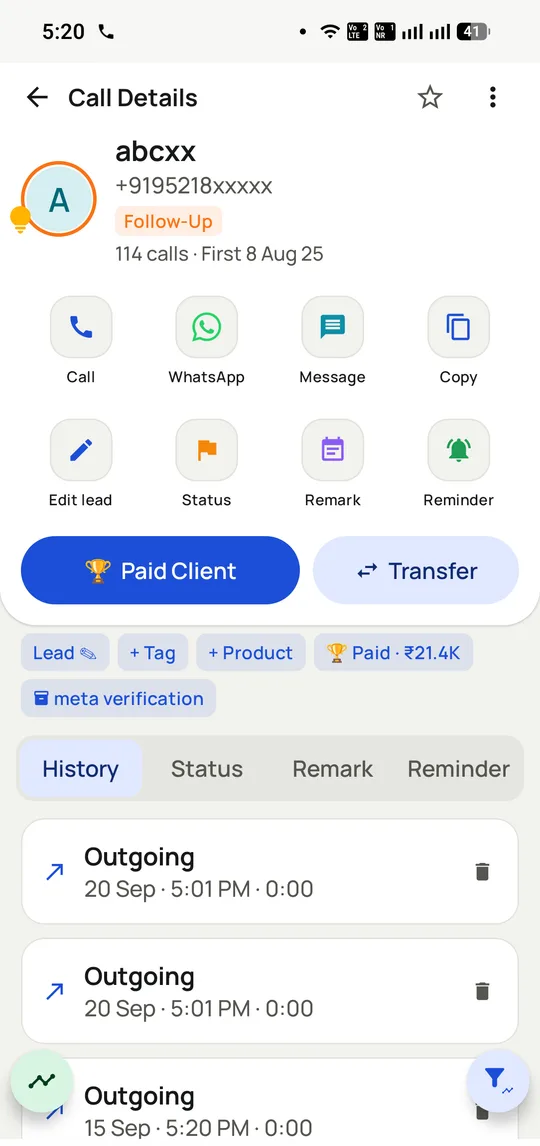
Every call against one number, attributed. An integration between two products is exactly where this history goes missing.
Capabilities
Auto dialer software with CRM: what you get
Everything here is documented and shipping today, not on a roadmap.
One record, written during the call
The lead is on the call screen, not in a second app.
Name, status, last remark and full call history visible while it rings
Outcome set in two taps when the call ends: connected, no answer, busy, wrong number, not interested, follow-up
The next follow-up date is set from the same screen
Incoming calls get the same record treatment as outgoing ones
One subscription, not two
The CRM is not a tier and not an add-on.
₹1908 ($29) per user per year includes the dialer, the CRM and the desktop Web CRM
No reporting tier and no integrations tier above the base plan
One seat is a valid order, with no minimum team size
Outside India, $29 per user per year or $12 per quarter
No telephony bill underneath it
Minutes come from the mobile plan you already pay for.
No virtual number to rent and no KYC to clear before the first call
Nothing billed per minute by the software vendor
Dual SIM supported, with a default SIM chosen per account
Dialing continues when data drops; the sync queues and catches up
The list comes from where it already is
Imports are auditable rather than one-way.
Import from Excel, CSV or Google Sheets, with live sheet sync
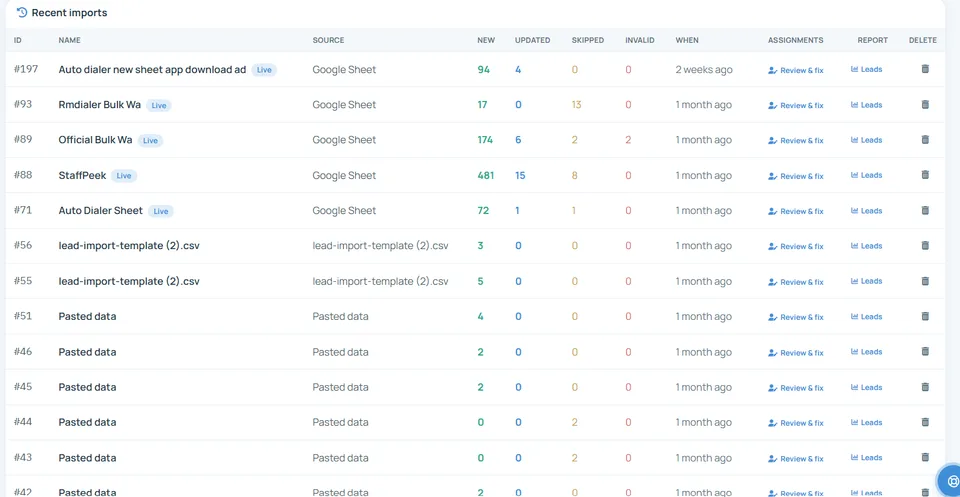
Every import keeps a record of new, updated, skipped and invalid rows
Leads assign to employees round-robin on arrival or by hand
A CRM API is available for pushing data to whatever else you run
How it works
Auto dialer software with CRM: how it is set up
1
Create the account on rmdialer.com
The owner creates the business account and adds the people who will call. Employees then sign in on their own handsets rather than each buying something separately.
2
Bring the list in
Import the existing sheet from Excel, CSV or Google Sheets. The import report shows what was created, what was updated and what was rejected, so a bad column is caught before anyone dials it.
3
Set the SIM and the statuses
Choose which SIM places calls on a dual-SIM handset, and set the lead statuses your business actually uses. The default set works, but the statuses are what the reports later group by, so it is worth five minutes.
4
Dial the list, not the numbers
Start a session against a filtered slice of the list. The app dials the next lead when the previous call ends, and the caller records the outcome without leaving the screen.
Importing the list you already have
Bringing an existing list in is the first hour of any dialer-plus-CRM purchase. Here it reports what it did.
Where it earns its keep
Auto dialer software with CRM: common uses
Insurance and loan desks
Renewal and rejection history decides the script, so it has to be visible before the call connects rather than looked up after.
Coaching and admissions
A counsellor calling a hundred enquiries a day needs the last conversation on screen, not a spreadsheet row somewhere else.
Real estate follow-up
Site-visit outcomes and callback dates live against the lead, so the next caller sees what the previous one promised.
Field service and AMC renewals
Contract value and renewal date sit on the customer record, which is what turns a renewal list into a dialable list.
Distributors and dealer networks
Order history per number means a repeat buyer is recognised on an incoming call rather than treated as a fresh lead.
“We were holding a CRM licence and a dialer licence and reconciling them by hand. RMDialer replaced both with one app, and the auto dialer software and the CRM being the same thing is the reason the records are finally accurate.”
Operations head, insurance broking firm, Indore
Verified RMDialer customer
“Every quote we took for auto dialer software with CRM had minutes billed separately. RMDialer runs on our own SIMs, so the annual number I approved was the number I paid.”
Founder, B2B packaging supplier, Ahmedabad
Verified RMDialer customer
“Counsellors used to finish a call and then open the CRM, and half the time they did not. With RMDialer the outcome is on the call screen, so the record gets written while the conversation is still fresh.”
Sales manager, coaching institute, Jaipur
Verified RMDialer customer
“I evaluated four products described as auto dialer software with CRM and only one of them was actually a single system. The others were an integration between two subscriptions I would have had to renew separately.”
Director, facility management company, Pune
Verified RMDialer customer
“Our network is unreliable in the field. Calls still go out on RMDialer because they use the SIM, and the remarks upload later. A browser-based dialer simply stopped working for us.”
When auto dialer software with CRM is the wrong choice
A contact centre that needs cloud telephony, call queues and dozens of headset seats should look at a cloud platform, which this page prices at roughly $15 to $250 a seat each month before minutes.
If your company is committed to a desktop CRM it already pays for, a softphone that syncs to that system avoids moving any records.
Auto dialer software with CRM FAQ
Straight answers about Auto dialer software with CRM.
Which CRM has the best auto dialer feature?
Ask it the other way round and the shortlist gets shorter: how many products are you willing to hold? Kixie, Close and Aircall rate well as dialers attached to a CRM, and Agile CRM and Zoho Voice as CRMs that added calling, but every one of those is two things kept in step by an integration that someone has to maintain. RMDialer is one subscription in which the dialing and the record are the same app, which is a narrower feature set and a much shorter list of things that can drift apart.
Zoho Voice is a separate product from Zoho CRM, so calling arrives as a second subscription plus the connection between them. That is a sound architecture when the CRM already carries quotes, invoices and pipelines for several departments and calling is one activity among many. It is an expensive shape when calling is most of the work, because two licences renew on two dates to do one job. RMDialer collapses them into one at ₹1908 ($29) per user per year.
No, and the phrase “auto dialer software with CRM” conceals how loosely the two are usually joined. A cloud platform saying it has a CRM means it stores contacts. A CRM vendor saying it has a dialer means it added a call button. A softphone means it syncs to something you bought elsewhere. Only in a single-app product are the dialer and the customer record genuinely one system, and the comparison above names which of the four you would be signing for.
When most of the work is phone calls, RMDialer. While the phone is ringing the caller already sees the lead’s status and latest remark, two taps record what happened, and every call goes out on the caller’s own SIM, all for ₹1908 ($29) per user per year. For businesses that also run quotes, invoices and multi-team pipelines, a general CRM with a calling integration is the better fit.
Part of it. The RMDialer phone dialer costs nothing and never expires, while list auto-dialing and the Web CRM are the paid features at ₹1908 ($29) per user per year. Across the rest of the category, “free” tends to mean either a limited trial or a basic manual dialer with a contact list. Watch any free plan that bundles cloud telephony closely, since the per-minute billing is how that money comes back.
Can I download auto dialer software with CRM for PC?
Not from RMDialer, and this is worth being clear about. There is no Windows program. On a computer you use a CRM in the browser, where lists are built, leads are handed out and reports are read, while the actual calls go out from the phones. If the requirement is a PC program that dials through a headset, the product you want is a desk softphone running on a cloud platform.
Is a virtual number required for auto dialer software with CRM?
For a cloud platform, yes: the call starts on the vendor’s network, so you lease a number and complete KYC before dialing. RMDialer needs none of that. It calls through the SIM card the handset already holds, the customer sees the mobile number the business already uses, and there is nothing to set up before the first call.
RMDialer publishes ₹1908 per user per year, or ₹747 per user for three months, and $29 a year outside India, with the CRM and the desktop Web CRM included rather than tiered. Cloud platforms on this SERP publish seat prices from roughly $15 to $250 a month and bill telephony per minute on top, so their annual cost depends on call volume.
In RMDialer the outcome is set on the call screen as the call ends, so the record updates at that moment rather than when someone returns to another app. That is the practical difference between a built-in CRM and an integrated one: integrations depend on the caller going back and finishing the job.
There is, and it works alongside an RMDialer account you already have. On iPhone you see your assigned leads, tap to call (the call itself runs in the built-in iOS Phone app over your SIM), record outcomes that sync even after time offline, and owners get team reports. Apple does not let any app take over the default dialer, which is why call recording and the record screen on incoming calls are only on Android.
Yes, through the CRM API, and for some businesses that is the right answer. If your existing CRM runs quotes, invoices, approvals or a multi-team pipeline, keep it and treat RMDialer as the calling layer. Replacing a CRM that several departments depend on in order to gain a dialer is rarely a good trade.
Dialing continues, because the call goes over the mobile network rather than over data. Outcomes and remarks are saved on the handset and sync when the connection returns. A VoIP dialer stops entirely in the same situation, which is the practical argument for SIM-based calling in areas with patchy coverage.